数学B 数学的帰納法 問題 28 解説
方針・初手
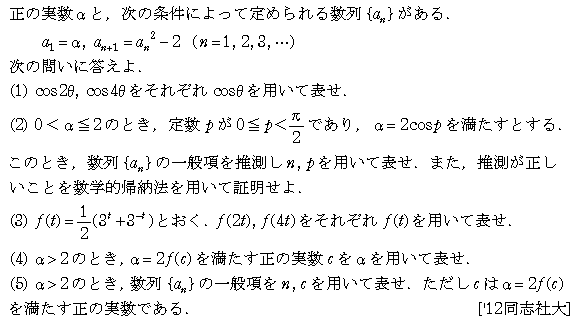
漸化式
$$ a_{n+1}=a_n^2-2 $$
は、$a_n=2\cos x$ とおくと倍角公式により $a_{n+1}=2\cos 2x$ となる。また、$a_n=2f(x)$ とおいても同様に $a_{n+1}=2f(2x)$ となる。
したがって、$0<\alpha\leqq 2$ では三角関数、$\alpha>2$ では $f(t)$ を用いて倍々に角または変数が進む形を考える。
解法1
(1)
倍角公式より、
$$ \cos 2\theta=2\cos^2\theta-1 $$
である。
さらに、
$$ \cos 4\theta=2\cos^2 2\theta-1 $$
であるから、
$$ \begin{aligned} \cos 4\theta &=2(2\cos^2\theta-1)^2-1 \\ &=2(4\cos^4\theta-4\cos^2\theta+1)-1 \\ &=8\cos^4\theta-8\cos^2\theta+1 \end{aligned} $$
となる。
よって、
$$ \cos 2\theta=2\cos^2\theta-1,\qquad \cos 4\theta=8\cos^4\theta-8\cos^2\theta+1 $$
である。
(2)
$0<\alpha\leqq 2$ より、$0\leqq \beta<\dfrac{\pi}{2}$ として
$$ \alpha=2\cos\beta $$
と表せる。
ここで、一般項は
$$ a_n=2\cos(2^{n-1}\beta) $$
と推測できる。
これを数学的帰納法で証明する。
まず $n=1$ のとき、
$$ 2\cos(2^{1-1}\beta)=2\cos\beta=\alpha=a_1 $$
より成り立つ。
次に、ある自然数 $n$ について
$$ a_n=2\cos(2^{n-1}\beta) $$
が成り立つと仮定する。このとき、
$$ \begin{aligned} a_{n+1} &=a_n^2-2 \\ &={2\cos(2^{n-1}\beta)}^2-2 \\ &=4\cos^2(2^{n-1}\beta)-2 \\ &=2{2\cos^2(2^{n-1}\beta)-1} \\ &=2\cos(2^n\beta) \end{aligned} $$
である。
これは $n+1$ の場合の式である。したがって、すべての自然数 $n$ について
$$ a_n=2\cos(2^{n-1}\beta) $$
が成り立つ。
(3)
$$ f(t)=\frac{1}{2}(3^t+3^{-t}) $$
とする。
まず、
$$ \begin{aligned} f(2t) &=\frac{1}{2}(3^{2t}+3^{-2t}) \\ &=\frac{1}{2}{(3^t+3^{-t})^2-2} \\ &=\frac{1}{2}{(2f(t))^2-2} \\ &=2f(t)^2-1 \end{aligned} $$
である。
次に、
$$ f(4t)=2f(2t)^2-1 $$
より、
$$ \begin{aligned} f(4t) &=2(2f(t)^2-1)^2-1 \\ &=2(4f(t)^4-4f(t)^2+1)-1 \\ &=8f(t)^4-8f(t)^2+1 \end{aligned} $$
となる。
したがって、
$$ f(2t)=2f(t)^2-1,\qquad f(4t)=8f(t)^4-8f(t)^2+1 $$
である。
(4)
$\alpha=2f(c)$ より、
$$ \alpha=3^c+3^{-c} $$
である。
ここで、
$$ x=3^c $$
とおく。$c>0$ であるから $x>1$ である。また、
$$ \alpha=x+\frac{1}{x} $$
だから、
$$ x^2-\alpha x+1=0 $$
を得る。
これを解くと、
$$ x=\frac{\alpha\pm\sqrt{\alpha^2-4}}{2} $$
である。
$\alpha>2$ のとき、
$$ \frac{\alpha+\sqrt{\alpha^2-4}}{2}>1,\qquad 0<\frac{\alpha-\sqrt{\alpha^2-4}}{2}<1 $$
である。したがって、$x=3^c>1$ に合うのは
$$ 3^c=\frac{\alpha+\sqrt{\alpha^2-4}}{2} $$
である。
よって、
$$ c=\log_3\frac{\alpha+\sqrt{\alpha^2-4}}{2} $$
である。
(5)
$\alpha=2f(c)$ と表されているとき、一般項は
$$ a_n=2f(2^{n-1}c) $$
と推測できる。
これを数学的帰納法で証明する。
まず $n=1$ のとき、
$$ 2f(2^{1-1}c)=2f(c)=\alpha=a_1 $$
より成り立つ。
次に、ある自然数 $n$ について
$$ a_n=2f(2^{n-1}c) $$
が成り立つと仮定する。このとき、(3) より $f(2t)=2f(t)^2-1$ であるから、
$$ \begin{aligned} a_{n+1} &=a_n^2-2 \\ &={2f(2^{n-1}c)}^2-2 \\ &=4f(2^{n-1}c)^2-2 \\ &=2{2f(2^{n-1}c)^2-1} \\ &=2f(2^n c) \end{aligned} $$
である。
これは $n+1$ の場合の式である。したがって、すべての自然数 $n$ について
$$ a_n=2f(2^{n-1}c) $$
が成り立つ。
また、$f(t)=\dfrac{1}{2}(3^t+3^{-t})$ であるから、
$$ a_n=3^{2^{n-1}c}+3^{-2^{n-1}c} $$
とも書ける。
解説
この漸化式の本質は、$x^2-2$ という形が倍角公式と対応している点にある。
$2\cos x$ に対しては、
$$ (2\cos x)^2-2=2\cos 2x $$
となるため、$0<\alpha\leqq 2$ の範囲では三角関数で表すのが自然である。
一方、$\alpha>2$ では $2\cos x$ の範囲を超えるため、同じ構造を持つ関数
$$ f(t)=\frac{1}{2}(3^t+3^{-t}) $$
を用いる。これは双曲線関数の $\cosh$ 型の関数であり、
$$ (2f(t))^2-2=2f(2t) $$
という同じ形の倍角公式を持つ。
したがって、初期値が $2\cos\beta$ のときは角が $\beta,2\beta,4\beta,\ldots$ と進み、初期値が $2f(c)$ のときは変数が $c,2c,4c,\ldots$ と進む。
答え
(1)
$$ \cos 2\theta=2\cos^2\theta-1 $$
$$ \cos 4\theta=8\cos^4\theta-8\cos^2\theta+1 $$
(2)
$$ a_n=2\cos(2^{n-1}\beta) $$
(3)
$$ f(2t)=2f(t)^2-1 $$
$$ f(4t)=8f(t)^4-8f(t)^2+1 $$
(4)
$$ c=\log_3\frac{\alpha+\sqrt{\alpha^2-4}}{2} $$
(5)
$$ a_n=2f(2^{n-1}c) $$
すなわち、
$$ a_n=3^{2^{n-1}c}+3^{-2^{n-1}c} $$
この基礎から進む入試問題
自分の記録
誤りを報告
問題文の写しミス、解説の誤り、誤字、表示崩れに気づいた場合は送信してください。ログイン不要です。