数学3 その他応用 問題 17 解説
方針・初手
指数関数を含む曲線なので、交点では両辺に $e^x$ を掛けて整理する。
また、曲線
$$ y=\frac{e^x+e^{-x}}{2} $$
は微分すると
$$ y'=\frac{e^x-e^{-x}}{2} $$
であり、弧長では
$$ \sqrt{1+(y')^2} $$
を計算する。この曲線では
$$ \begin{aligned} 1+\left(\frac{e^x-e^{-x}}{2}\right)^2 &= \left(\frac{e^x+e^{-x}}{2}\right)^2 \end{aligned} $$
となることが重要である。
解法1
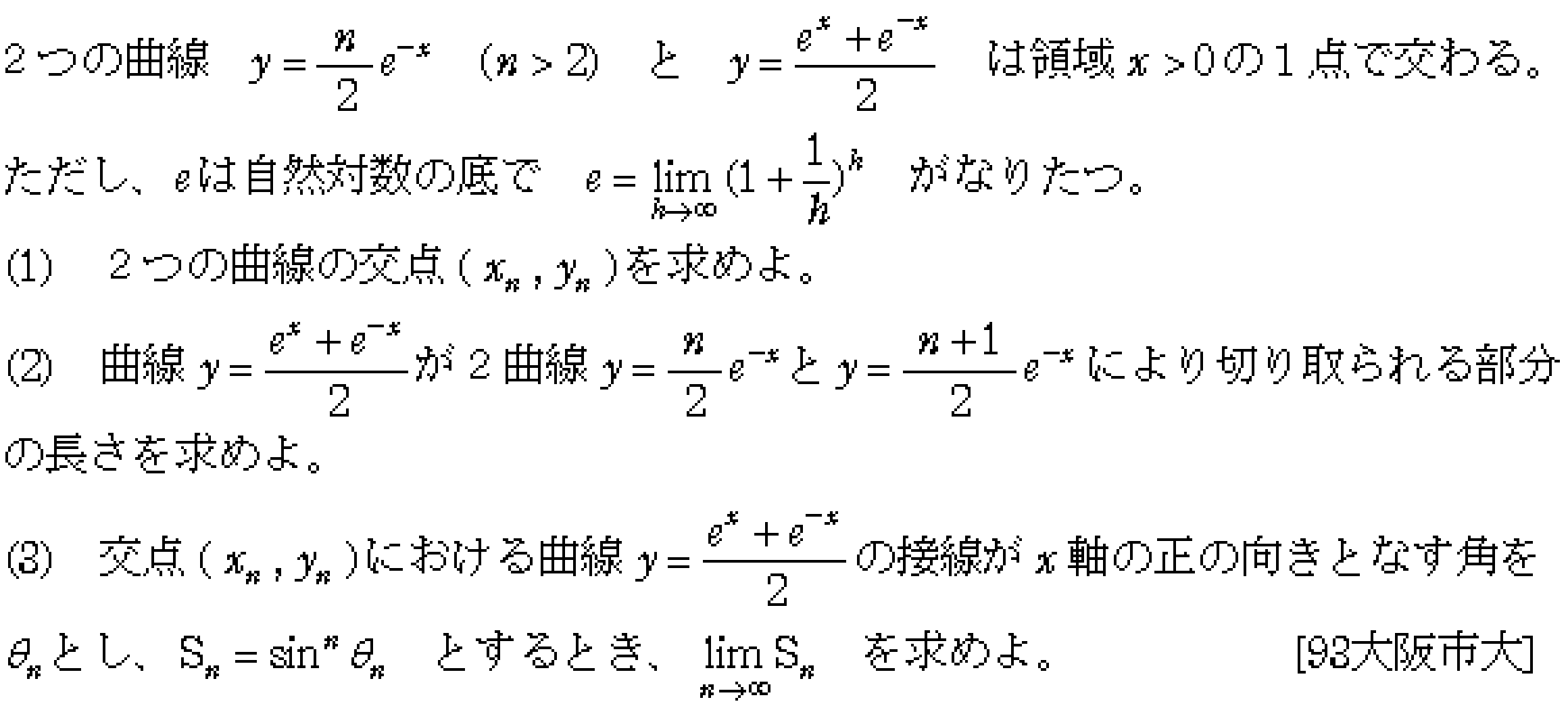
曲線
$$ y=\frac{n}{2}e^{-x} $$
と
$$ y=\frac{e^x+e^{-x}}{2} $$
の交点を求める。
交点では
$$ \frac{n}{2}e^{-x}=\frac{e^x+e^{-x}}{2} $$
である。両辺を $2e^x$ 倍すると、
$$ n=e^{2x}+1 $$
となる。したがって
$$ e^{2x}=n-1 $$
である。$n>2$ より $n-1>1$ だから、交点の $x$ 座標は正であり、
$$ x_n=\frac{1}{2}\log(n-1) $$
である。
このとき
$$ e^{-x_n}=\frac{1}{\sqrt{n-1}} $$
だから、
$$ y_n=\frac{n}{2}e^{-x_n} =\frac{n}{2\sqrt{n-1}} $$
である。
よって
$$ \begin{aligned} (x_n,y_n) &= \left( \frac{1}{2}\log(n-1), \frac{n}{2\sqrt{n-1}} \right) \end{aligned} $$
である。
次に、曲線
$$ y=\frac{e^x+e^{-x}}{2} $$
が、2つの曲線
$$ y=\frac{n}{2}e^{-x},\qquad y=\frac{n+1}{2}e^{-x} $$
により切り取られる部分の長さを求める。
先ほどの結果より、
$$ y=\frac{n}{2}e^{-x} $$
との交点の $x$ 座標は
$$ x_n=\frac{1}{2}\log(n-1) $$
であり、
$$ y=\frac{n+1}{2}e^{-x} $$
との交点の $x$ 座標は
$$ x_{n+1}=\frac{1}{2}\log n $$
である。
曲線
$$ y=\frac{e^x+e^{-x}}{2} $$
について、
$$ y'=\frac{e^x-e^{-x}}{2} $$
であるから、
$$ \begin{aligned} 1+(y')^2 &= 1+\left(\frac{e^x-e^{-x}}{2}\right)^2\\ &= \frac{4+(e^x-e^{-x})^2}{4}\\ &= \frac{e^{2x}+2+e^{-2x}}{4}\\ &= \left(\frac{e^x+e^{-x}}{2}\right)^2. \end{aligned} $$
ここで $x>0$ なので
$$ \frac{e^x+e^{-x}}{2}>0 $$
より、
$$ \begin{aligned} \sqrt{1+(y')^2} &= \frac{e^x+e^{-x}}{2} \end{aligned} $$
である。
したがって、求める長さを $L_n$ とすると、
$$ \begin{aligned} L_n &= \int_{x_n}^{x_{n+1}} \sqrt{1+(y')^2},dx\\ &= \int_{x_n}^{x_{n+1}} \frac{e^x+e^{-x}}{2},dx\\ &= \left[ \frac{e^x-e^{-x}}{2} \right]*{x_n}^{x*{n+1}}. \end{aligned} $$
ここで
$$ e^{x_n}=\sqrt{n-1},\qquad e^{-x_n}=\frac{1}{\sqrt{n-1}} $$
より、
$$ \begin{aligned} \frac{e^{x_n}-e^{-x_n}}{2} &= \frac{\sqrt{n-1}-\frac{1}{\sqrt{n-1}}}{2} \\ \frac{n-2}{2\sqrt{n-1}} \end{aligned} $$
である。
同様に、
$$ e^{x_{n+1}}=\sqrt{n},\qquad e^{-x_{n+1}}=\frac{1}{\sqrt{n}} $$
より、
$$ \begin{aligned} \frac{e^{x_{n+1}}-e^{-x_{n+1}}}{2} &= \frac{\sqrt{n}-\frac{1}{\sqrt{n}}}{2} \\ \frac{n-1}{2\sqrt{n}} \end{aligned} $$
である。
よって、求める長さは
$$ \begin{aligned} L_n &= \frac{n-1}{2\sqrt{n}} \\ \frac{n-2}{2\sqrt{n-1}} \end{aligned} $$
である。
最後に、交点 $(x_n,y_n)$ における曲線
$$ y=\frac{e^x+e^{-x}}{2} $$
の接線が $x$ 軸の正の向きとなす角を $\theta_n$ とする。
接線の傾きは
$$ \begin{aligned} \tan\theta_n=y'(x_n) &= \frac{e^{x_n}-e^{-x_n}}{2} \end{aligned} $$
である。弧長の計算で見たように、
$$ \begin{aligned} \sqrt{1+\tan^2\theta_n} &= \frac{e^{x_n}+e^{-x_n}}{2} \end{aligned} $$
であるから、
$$ \begin{aligned} \sin\theta_n &= \frac{\tan\theta_n}{\sqrt{1+\tan^2\theta_n}} \\ \frac{e^{x_n}-e^{-x_n}}{e^{x_n}+e^{-x_n}} \end{aligned} $$
である。
ここで
$$ e^{2x_n}=n-1 $$
だから、
$$ \begin{aligned} \sin\theta_n &= \frac{e^{2x_n}-1}{e^{2x_n}+1}\\ &= \frac{(n-1)-1}{(n-1)+1}\\ &= \frac{n-2}{n}. \end{aligned} $$
したがって
$$ \begin{aligned} S_n=\sin^n\theta_n &= \left(\frac{n-2}{n}\right)^n \\ \left(1-\frac{2}{n}\right)^n \end{aligned} $$
である。
ここで
$$ \begin{aligned} \left(1-\frac{2}{n}\right)^n &= \left\{\left(1-\frac{2}{n}\right)^{-\frac{n}{2}}\right\}^{-2} \end{aligned} $$
と変形する。
$n\to\infty$ のとき、自然対数の底の定義
$$ e=\lim_{k\to\infty}\left(1+\frac{1}{k}\right)^k $$
から
$$ \begin{aligned} \lim_{n\to\infty} \left(1-\frac{2}{n}\right)^{-\frac{n}{2}} &= e \end{aligned} $$
である。よって
$$ \begin{aligned} \lim_{n\to\infty}S_n &= e^{-2} \end{aligned} $$
である。
解説
この問題の中心は、曲線
$$ y=\frac{e^x+e^{-x}}{2} $$
の扱いである。この曲線は微分すると
$$ y'=\frac{e^x-e^{-x}}{2} $$
となり、
$$ 1+(y')^2=y^2 $$
が成り立つ。そのため、弧長積分が非常に簡単になる。
また、接線の角についても、
$$ \begin{aligned} \sin\theta &= \frac{\tan\theta}{\sqrt{1+\tan^2\theta}} \end{aligned} $$
を使うことで、傾きから直接 $\sin\theta_n$ を求められる。交点条件から $e^{2x_n}=n-1$ が得られるため、最終的に
$$ \sin\theta_n=\frac{n-2}{n} $$
まで簡潔に整理できる。
答え
(1)
$$ \begin{aligned} (x_n,y_n) &= \left( \frac{1}{2}\log(n-1), \frac{n}{2\sqrt{n-1}} \right) \end{aligned} $$
(2)
$$ \begin{aligned} \frac{n-1}{2\sqrt{n}} &= \frac{n-2}{2\sqrt{n-1}} \end{aligned} $$
(3)
$$ \begin{aligned} \lim_{n\to\infty}S_n &= e^{-2} \end{aligned} $$
この基礎から進む入試問題
自分の記録
誤りを報告
問題文の写しミス、解説の誤り、誤字、表示崩れに気づいた場合は送信してください。ログイン不要です。