数学3 その他応用 問題 9 解説
方針・初手
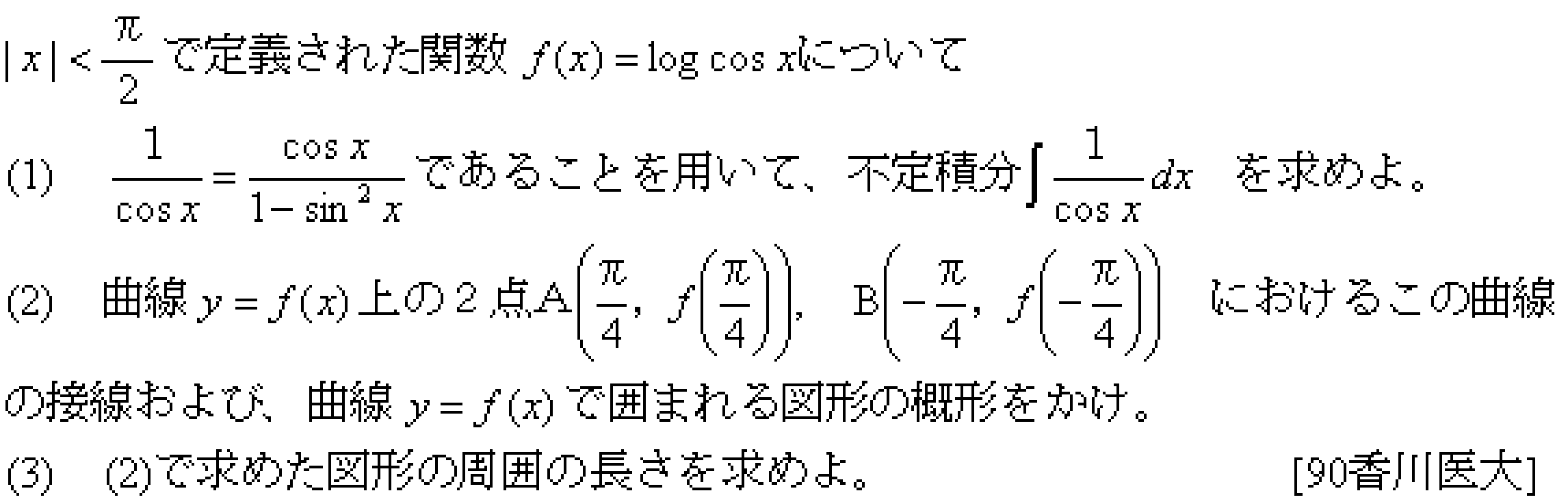
(1) は指示通り $\sin x$ を置換する。
(2) は $f(x)=\log\cos x$ の偶奇性、増減、凹凸を調べ、さらに $x=\pm \dfrac{\pi}{4}$ における接線を求めればよい。
(3) の周の長さは、2本の接線部分の長さと、曲線 $y=f(x)$ の弧長の和である。弧長では
$$ \sqrt{1+{f'(x)}^2} $$
が現れ、(1) の結果を用いる。
解法1
まず
$$ f(x)=\log\cos x $$
であるから、
$$ f'(x)=-\tan x $$
である。
また、$f(x)$ は偶関数であり、
$$ f(-x)=f(x) $$
が成り立つ。
(1)
与えられた変形を用いると、
$$ \begin{aligned} \frac{1}{\cos x} &= \frac{\cos x}{1-\sin^2 x} \end{aligned} $$
である。
ここで
$$ t=\sin x $$
とおくと、
$$ dt=\cos x,dx $$
であるから、
$$ \begin{aligned} \int \frac{1}{\cos x},dx &= \int \frac{\cos x}{1-\sin^2 x},dx \\ \int \frac{1}{1-t^2},dt \end{aligned} $$
となる。
さらに
$$ \begin{aligned} \frac{1}{1-t^2} &= \frac{1}{(1-t)(1+t)} \\ \frac{1}{2}\left(\frac{1}{1+t}+\frac{1}{1-t}\right) \end{aligned} $$
であるから、
$$ \begin{aligned} \int \frac{1}{1-t^2},dt &= \frac{1}{2}\int\left(\frac{1}{1+t}+\frac{1}{1-t}\right),dt \\ &= \frac{1}{2}\log(1+t)-\frac{1}{2}\log(1-t)+C \\ &= \frac{1}{2}\log\frac{1+t}{1-t}+C. \end{aligned} $$
したがって、$t=\sin x$ を戻すと、
$$ \begin{aligned} \int \frac{1}{\cos x},dx &= \frac{1}{2}\log\frac{1+\sin x}{1-\sin x}+C \end{aligned} $$
である。
ここで $|x|<\dfrac{\pi}{2}$ なので $-1<\sin x<1$ であり、対数の中は正である。
(2)
まず点 $A,B$ の座標を求める。
$$ \begin{aligned} f\left(\frac{\pi}{4}\right) &= \log\frac{\sqrt2}{2} \\ -\frac{1}{2}\log2 \end{aligned} $$
であり、$f$ は偶関数なので
$$ \begin{aligned} f\left(-\frac{\pi}{4}\right) &= -\frac{1}{2}\log2 \end{aligned} $$
である。
したがって、
$$ A\left(\frac{\pi}{4},-\frac{1}{2}\log2\right), \qquad B\left(-\frac{\pi}{4},-\frac{1}{2}\log2\right) $$
である。
また、
$$ f'(x)=-\tan x $$
より、
$$ f'\left(\frac{\pi}{4}\right)=-1, \qquad f'\left(-\frac{\pi}{4}\right)=1 $$
である。
よって、点 $A$ における接線は
$$ \begin{aligned} y+\frac{1}{2}\log2 &= -\left(x-\frac{\pi}{4}\right) \end{aligned} $$
すなわち
$$ y=-x+\frac{\pi}{4}-\frac{1}{2}\log2 $$
である。
点 $B$ における接線は
$$ \begin{aligned} y+\frac{1}{2}\log2 &= x+\frac{\pi}{4} \end{aligned} $$
すなわち
$$ y=x+\frac{\pi}{4}-\frac{1}{2}\log2 $$
である。
この2直線の交点を $C$ とすると、対称性から $x=0$ で交わる。よって
$$ C\left(0,\frac{\pi}{4}-\frac{1}{2}\log2\right) $$
である。
次に曲線の概形を確認する。
$$ f'(x)=-\tan x $$
であるから、$x<0$ では $f'(x)>0$、$x>0$ では $f'(x)<0$ である。したがって、$x=0$ で最大値
$$ f(0)=0 $$
をとる。
また、
$$ f''(x)=-\frac{1}{\cos^2 x}<0 $$
であるから、曲線 $y=f(x)$ は上に凸ではなく、全体として上にふくらむ形、すなわち凹である。
したがって、図形の境界は次の3つからなる。
点 $B$ から点 $A$ までの曲線 $y=\log\cos x$ の弧、点 $A$ から点 $C$ までの接線、点 $C$ から点 $B$ までの接線である。
曲線 $y=\log\cos x$ は $x=0$ で最大値 $0$ をとり、点 $A,B$ は同じ高さにある。2本の接線は点 $C$ で交わり、曲線の上側にあるため、囲まれる図形は左右対称の曲線を底辺にもつ図形である。
(3)
周の長さは、
$$ \begin{aligned} \text{周の長さ} &= \text{曲線 }BA\text{ の弧長} + AC+BC \end{aligned} $$
である。
まず、接線部分の長さを求める。
$$ A\left(\frac{\pi}{4},-\frac{1}{2}\log2\right), \qquad C\left(0,\frac{\pi}{4}-\frac{1}{2}\log2\right) $$
であるから、
$$ \begin{aligned} AC &= \sqrt{\left(\frac{\pi}{4}\right)^2+\left(\frac{\pi}{4}\right)^2} \\ \frac{\pi\sqrt2}{4} \end{aligned} $$
である。
対称性より
$$ BC=\frac{\pi\sqrt2}{4} $$
なので、
$$ AC+BC=\frac{\pi\sqrt2}{2} $$
である。
次に、曲線 $y=f(x)$ の $-\dfrac{\pi}{4}\leqq x\leqq \dfrac{\pi}{4}$ における弧長を求める。
弧長は
$$ \int_{-\pi/4}^{\pi/4}\sqrt{1+{f'(x)}^2},dx $$
である。
ここで $f'(x)=-\tan x$ だから、
$$ \begin{aligned} \sqrt{1+{f'(x)}^2} &= \sqrt{1+\tan^2 x} \\ \sqrt{\frac{1}{\cos^2 x}} \end{aligned} $$
である。
区間 $-\dfrac{\pi}{4}\leqq x\leqq \dfrac{\pi}{4}$ では $\cos x>0$ なので、
$$ \begin{aligned} \sqrt{\frac{1}{\cos^2 x}} &= \frac{1}{\cos x} \end{aligned} $$
である。
したがって、曲線部分の弧長は
$$ \int_{-\pi/4}^{\pi/4}\frac{1}{\cos x},dx $$
である。
(1) の結果より、
$$ \begin{aligned} \int \frac{1}{\cos x},dx &= \frac{1}{2}\log\frac{1+\sin x}{1-\sin x}+C \end{aligned} $$
だから、
$$ \begin{aligned} \int_{-\pi/4}^{\pi/4}\frac{1}{\cos x},dx &= \left[ \frac{1}{2}\log\frac{1+\sin x}{1-\sin x} \right]_{-\pi/4}^{\pi/4} \\ &= \frac{1}{2}\log\frac{1+\frac{\sqrt2}{2}}{1-\frac{\sqrt2}{2}} &= \frac{1}{2}\log\frac{1-\frac{\sqrt2}{2}}{1+\frac{\sqrt2}{2}} \\ &= \log\frac{1+\frac{\sqrt2}{2}}{1-\frac{\sqrt2}{2}}. \end{aligned} $$
ここで
$$ \begin{aligned} \frac{1+\frac{\sqrt2}{2}}{1-\frac{\sqrt2}{2}} &= \frac{2+\sqrt2}{2-\sqrt2} \\ 3+2\sqrt2 \end{aligned} $$
であるから、曲線部分の弧長は
$$ \log(3+2\sqrt2) $$
である。
よって、求める周の長さは
$$ \frac{\pi\sqrt2}{2}+\log(3+2\sqrt2) $$
である。
解説
この問題の中心は、$f(x)=\log\cos x$ の導関数が
$$ f'(x)=-\tan x $$
となる点である。
接線の傾きは $x=\pm\dfrac{\pi}{4}$ でそれぞれ $-1,1$ となるため、2本の接線は左右対称に交わる。また、$f''(x)<0$ であるから、曲線は凹であり、接線は曲線の上側に位置する。
(3) では弧長公式を使うと
$$ \sqrt{1+\tan^2 x}=\frac{1}{\cos x} $$
が現れる。これが (1) の不定積分を用いる理由である。
答え
(1)
$$ \begin{aligned} \int \frac{1}{\cos x},dx &= \frac{1}{2}\log\frac{1+\sin x}{1-\sin x}+C \end{aligned} $$
(2)
接線は
$$ y=-x+\frac{\pi}{4}-\frac{1}{2}\log2, \qquad y=x+\frac{\pi}{4}-\frac{1}{2}\log2 $$
であり、交点は
$$ C\left(0,\frac{\pi}{4}-\frac{1}{2}\log2\right) $$
である。
囲まれる図形は、点
$$ A\left(\frac{\pi}{4},-\frac{1}{2}\log2\right), \qquad B\left(-\frac{\pi}{4},-\frac{1}{2}\log2\right) $$
を結ぶ曲線 $y=\log\cos x$ の弧と、2本の接線の線分 $AC,BC$ で囲まれる左右対称の図形である。
(3)
$$ \frac{\pi\sqrt2}{2}+\log(3+2\sqrt2) $$
この基礎から進む入試問題
自分の記録
誤りを報告
解説の誤り、誤字、表示崩れに気づいた場合は送信してください。ログイン不要です。