大阪大学 1998年 文系 第2問 解説
方針・初手
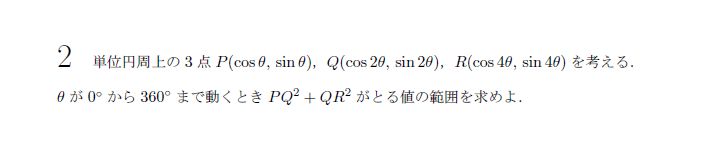
与えられた3点 $P, Q, R$ はいずれも原点中心、半径 $1$ の単位円周上にある。 まずは、2点間の距離の2乗である $PQ^2$ と $QR^2$ を、それぞれ三角関数を用いて表す。 得られた式を角 $\theta$ で統一し、$\cos \theta = t$ とおいて2次関数の値の範囲を求める問題に帰着させる。
解法1
原点を $O$ とすると、点 $P(\cos \theta, \sin \theta)$, $Q(\cos 2\theta, \sin 2\theta)$, $R(\cos 4\theta, \sin 4\theta)$ について、位置ベクトルはそれぞれ以下のようになる。
$$ \overrightarrow{OP} = (\cos \theta, \sin \theta), \quad \overrightarrow{OQ} = (\cos 2\theta, \sin 2\theta), \quad \overrightarrow{OR} = (\cos 4\theta, \sin 4\theta) $$
また、これらは単位円上の点であるから、原点からの距離はすべて $1$ であり、大きさは $|\overrightarrow{OP}| = |\overrightarrow{OQ}| = |\overrightarrow{OR}| = 1$ である。
2点間の距離の2乗 $PQ^2$ をベクトルの内積を用いて計算する。
$$ PQ^2 = |\overrightarrow{OQ} - \overrightarrow{OP}|^2 $$
$$ = |\overrightarrow{OQ}|^2 - 2\overrightarrow{OP} \cdot \overrightarrow{OQ} + |\overrightarrow{OP}|^2 $$
$$ = 1^2 - 2(\cos \theta \cos 2\theta + \sin \theta \sin 2\theta) + 1^2 $$
三角関数の加法定理 $\cos(\alpha - \beta) = \cos \alpha \cos \beta + \sin \alpha \sin \beta$ より、
$$ PQ^2 = 2 - 2\cos(2\theta - \theta) = 2 - 2\cos \theta $$
同様にして、$QR^2$ も計算する。
$$ QR^2 = |\overrightarrow{OR} - \overrightarrow{OQ}|^2 $$
$$ = |\overrightarrow{OR}|^2 - 2\overrightarrow{OQ} \cdot \overrightarrow{OR} + |\overrightarrow{OQ}|^2 $$
$$ = 1^2 - 2(\cos 2\theta \cos 4\theta + \sin 2\theta \sin 4\theta) + 1^2 $$
$$ = 2 - 2\cos(4\theta - 2\theta) = 2 - 2\cos 2\theta $$
これらを足し合わせると、
$$ PQ^2 + QR^2 = (2 - 2\cos \theta) + (2 - 2\cos 2\theta) = 4 - 2\cos \theta - 2\cos 2\theta $$
ここで、2倍角の公式 $\cos 2\theta = 2\cos^2 \theta - 1$ を用いて $\cos \theta$ のみに統一する。
$$ PQ^2 + QR^2 = 4 - 2\cos \theta - 2(2\cos^2 \theta - 1) $$
$$ = -4\cos^2 \theta - 2\cos \theta + 6 $$
次に、$t = \cos \theta$ とおく。 $\theta$ は $0^\circ$ から $360^\circ$ まで動くため、$t$ のとり得る値の範囲は
$$ -1 \leqq t \leqq 1 $$
である。与式を $t$ の関数 $f(t)$ とおき、平方完成する。
$$ f(t) = -4t^2 - 2t + 6 $$
$$ = -4\left(t^2 + \frac{1}{2}t\right) + 6 $$
$$ = -4\left(t + \frac{1}{4}\right)^2 + 4 \cdot \left(\frac{1}{4}\right)^2 + 6 $$
$$ = -4\left(t + \frac{1}{4}\right)^2 + \frac{25}{4} $$
関数 $y = f(t)$ のグラフは、上に凸の放物線であり、軸は直線 $t = -\frac{1}{4}$ である。
定義域 $-1 \leqq t \leqq 1$ における最大値と最小値を調べる。 軸 $t = -\frac{1}{4}$ は定義域に含まれるため、頂点で最大となる。
$$ t = -\frac{1}{4} \text{ のとき、最大値 } \frac{25}{4} $$
最小値は、軸から遠い方の端点である $t = 1$ でとる。
$$ f(1) = -4(1)^2 - 2(1) + 6 = 0 $$
なお、もう一方の端点 $t = -1$ のときは、$f(-1) = -4 + 2 + 6 = 4$ となり最小ではない。
したがって、$f(t)$ のとる値の範囲は
$$ 0 \leqq f(t) \leqq \frac{25}{4} $$
となる。
解説
三角関数の最大・最小問題における典型的な解法プロセスを踏む問題である。 ポイントは以下の3点に集約される。
- 円周上の2点間の距離を三角関数で表現する。成分計算でもよいが、ベクトルの内積や余弦定理を用いると加法定理の形が自然に現れ見通しが良い。
- 角度が $\theta$ と $2\theta$ で混在しているため、倍角の公式を用いて角を $\theta$ に統一する。
- $\cos \theta$ を別の文字に置き換え、定義域に注意しながら2次関数の最大・最小を求める。
置き換えを行った際は、必ず新しい文字の定義域を確認することが重要である。本問では $\theta$ が $0^\circ$ から $360^\circ$ まで動くため $-1 \leqq t \leqq 1$ となるが、この確認を怠ると誤った結論を導く可能性がある。
答え
$$ 0 \leqq PQ^2 + QR^2 \leqq \frac{25}{4} $$
この問題の前に見る基礎問題





類題
自分の記録
誤りを報告
解説の誤り、誤字、表示崩れに気づいた場合は送信してください。ログイン不要です。