数学2 三角関数・最大最小 問題 14 解説

方針・初手
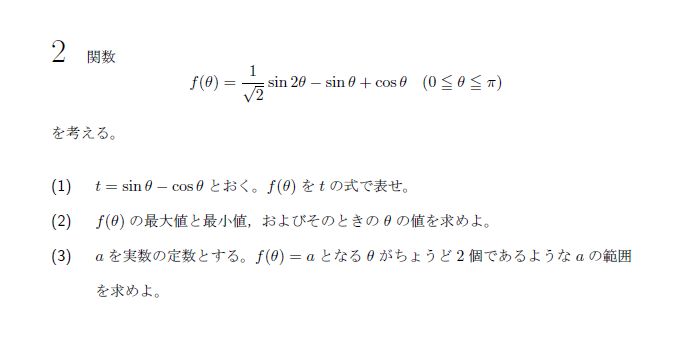
(1)は左辺を展開して、三角関数の相互関係 $\sin^2\theta + \cos^2\theta = 1$ を用いて整理することで右辺を導く。
(2)は(1)の結果を利用する。(1)より、与えられた関数は $\frac{1}{2}(1+\sin\theta+\cos\theta)^2$ と変形できるため、$t = \sin\theta+\cos\theta$ とおき、$t$ の関数として最大値と最小値を求める。三角関数の合成を用いて $t$ の変域を求めることが重要である。
解法1
(1)
与式の左辺を展開する。
$$\begin{aligned} (\text{左辺}) &= 1 + \sin^2\theta + \cos^2\theta + 2\sin\theta + 2\cos\theta + 2\sin\theta\cos\theta \\ &= 1 + (\sin^2\theta + \cos^2\theta) + 2\sin\theta + 2\cos\theta + 2\sin\theta\cos\theta \end{aligned}$$
$\sin^2\theta + \cos^2\theta = 1$ であるから、
$$\begin{aligned} (\text{左辺}) &= 1 + 1 + 2\sin\theta + 2\cos\theta + 2\sin\theta\cos\theta \\ &= 2 + 2\sin\theta + 2\cos\theta + 2\sin\theta\cos\theta \\ &= 2(1 + \sin\theta + \cos\theta + \sin\theta\cos\theta) \end{aligned}$$
さらに因数分解して、
$$\begin{aligned} (\text{左辺}) &= 2\{1(1 + \sin\theta) + \cos\theta(1 + \sin\theta)\} \\ &= 2(1+\sin\theta)(1+\cos\theta) \end{aligned}$$
したがって、等式 $(1+\sin\theta+\cos\theta)^2 = 2(1+\sin\theta)(1+\cos\theta)$ が成り立つ。
(2)
(1)で証明した等式より、求める関数は次のように変形できる。
$$(1+\sin\theta)(1+\cos\theta) = \frac{1}{2}(1+\sin\theta+\cos\theta)^2$$
ここで、$t = \sin\theta+\cos\theta$ とおく。三角関数の合成を用いると、
$$t = \sqrt{2}\sin(\theta+45^\circ)$$
$\theta$ の範囲は $0^\circ \leqq \theta < 360^\circ$ であるから、$\theta+45^\circ$ の範囲は以下のようになる。
$$45^\circ \leqq \theta+45^\circ < 405^\circ$$
この範囲において、正弦関数の値の範囲は $-1 \leqq \sin(\theta+45^\circ) \leqq 1$ であるから、$t$ のとり得る値の範囲は、
$$-\sqrt{2} \leqq t \leqq \sqrt{2}$$
となる。
次に、与えられた関数を $f(t)$ とすると、
$$f(t) = \frac{1}{2}(1+t)^2$$
これは $t$ についての2次関数であり、グラフは頂点が $(-1, 0)$ で下に凸の放物線である。 定義域 $-\sqrt{2} \leqq t \leqq \sqrt{2}$ における $f(t)$ の最大値と最小値を調べる。
最小値は、頂点である $t = -1$ のときにとる。その値は、
$$f(-1) = 0$$
最大値は、軸 $t = -1$ から最も遠い $t = \sqrt{2}$ のときにとる。その値は、
$$f(\sqrt{2}) = \frac{1}{2}(1+\sqrt{2})^2 = \frac{1}{2}(1+2\sqrt{2}+2) = \frac{3+2\sqrt{2}}{2}$$
最大値をとる $\theta$ の値を求める。 $t = \sqrt{2}$ のとき、$\sqrt{2}\sin(\theta+45^\circ) = \sqrt{2}$ より $\sin(\theta+45^\circ) = 1$。 $45^\circ \leqq \theta+45^\circ < 405^\circ$ より、$\theta+45^\circ = 90^\circ$ すなわち $\theta = 45^\circ$。
最小値をとる $\theta$ の値を求める。 $t = -1$ のとき、$\sqrt{2}\sin(\theta+45^\circ) = -1$ より $\sin(\theta+45^\circ) = -\frac{1}{\sqrt{2}}$。 $45^\circ \leqq \theta+45^\circ < 405^\circ$ より、$\theta+45^\circ = 225^\circ, 315^\circ$ すなわち $\theta = 180^\circ, 270^\circ$。
解説
(1)は基本的な式の展開と因数分解の問題であり、ここでつまずくことは少ないだろう。(2)は(1)の誘導に乗る典型的な問題である。$\sin\theta+\cos\theta$ を1つの文字に置き換え、与式をその文字の2次関数に帰着させる手法は頻出である。 このとき、置き換えた文字 $t$ の変域を三角関数の合成を用いて正確に求めることが極めて重要である。変域を求め忘れると、最大値・最小値を誤る原因になる。
答え
(1) 証明は解法に記載の通り。
(2) 最大値 $\frac{3+2\sqrt{2}}{2}$ ($\theta = 45^\circ$ のとき)
(2) 最小値 $0$ ($\theta = 180^\circ, 270^\circ$ のとき)
この基礎から進む入試問題
自分の記録
誤りを報告
問題文の写しミス、解説の誤り、誤字、表示崩れに気づいた場合は送信してください。ログイン不要です。