北海道大学 2020年 文系 第2問 解説
方針・初手
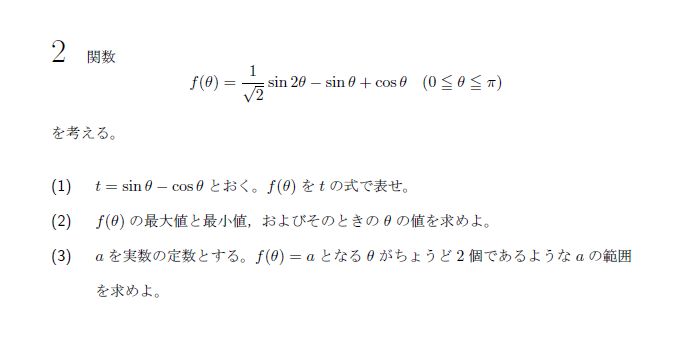
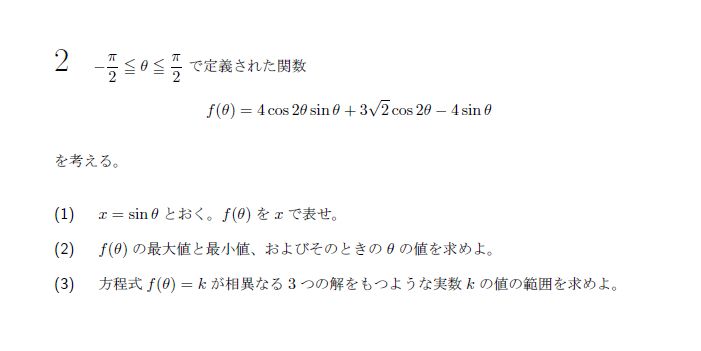
$t = \sin\theta - \cos\theta$ の両辺を2乗して $\sin 2\theta$ を $t$ で表し、$f(\theta)$ を $t$ の2次関数に帰着させる。(2) では三角関数の合成を用いて $t$ のとり得る値の範囲を求めたうえで、2次関数の最大・最小を考える。(3) では、$t$ の値1つに対して $\theta$ の値がいくつ対応するか(対応個数)を調べ、$t$ の2次方程式の解の個数と対応個数を組み合わせて条件を求める。
解法1
(1) $t = \sin\theta - \cos\theta$ の両辺を2乗すると、
$$ t^2 = \sin^2\theta - 2\sin\theta\cos\theta + \cos^2\theta = 1 - \sin 2\theta $$
よって、
$$ \sin 2\theta = 1 - t^2 $$
これを $f(\theta)$ の式に代入すると、
$$ \begin{aligned} f(\theta) &= \frac{1}{\sqrt{2}}(1 - t^2) - (\sin\theta - \cos\theta) \\ &= \frac{1}{\sqrt{2}}(1 - t^2) - t \\ &= -\frac{1}{\sqrt{2}}t^2 - t + \frac{1}{\sqrt{2}} \end{aligned} $$
(2) $t = \sin\theta - \cos\theta$ を三角関数の合成を用いて変形すると、
$$ t = \sqrt{2}\sin\left(\theta - \frac{\pi}{4}\right) $$
$0 \leqq \theta \leqq \pi$ より、$\theta - \frac{\pi}{4}$ のとり得る値の範囲は
$$ -\frac{\pi}{4} \leqq \theta - \frac{\pi}{4} \leqq \frac{3\pi}{4} $$
この範囲において、$\sin\left(\theta - \frac{\pi}{4}\right)$ は $-\frac{1}{\sqrt{2}} \leqq \sin\left(\theta - \frac{\pi}{4}\right) \leqq 1$ を満たすから、$t$ のとり得る値の範囲は
$$ -1 \leqq t \leqq \sqrt{2} $$
(1) の結果を $g(t)$ とおくと、
$$ \begin{aligned} g(t) &= -\frac{1}{\sqrt{2}}t^2 - t + \frac{1}{\sqrt{2}} \\ &= -\frac{1}{\sqrt{2}}\left( t^2 + \sqrt{2}t \right) + \frac{1}{\sqrt{2}} \\ &= -\frac{1}{\sqrt{2}}\left( t + \frac{\sqrt{2}}{2} \right)^2 + \frac{1}{\sqrt{2}} \cdot \frac{1}{2} + \frac{1}{\sqrt{2}} \\ &= -\frac{\sqrt{2}}{2}\left( t + \frac{\sqrt{2}}{2} \right)^2 + \frac{3\sqrt{2}}{4} \end{aligned} $$
$-1 \leqq t \leqq \sqrt{2}$ における $g(t)$ の最大値と最小値を求める。 軸は $t = -\frac{\sqrt{2}}{2}$ であり、これは定義域に含まれる。 最大値は、頂点において
$$ g\left(-\frac{\sqrt{2}}{2}\right) = \frac{3\sqrt{2}}{4} $$
このとき、$t = -\frac{\sqrt{2}}{2}$ より $\sin\left(\theta - \frac{\pi}{4}\right) = -\frac{1}{2}$ である。 $-\frac{\pi}{4} \leqq \theta - \frac{\pi}{4} \leqq \frac{3\pi}{4}$ より $\theta - \frac{\pi}{4} = -\frac{\pi}{6}$ となり、$\theta = \frac{\pi}{12}$。
最小値は、軸から遠い方の端点 $t = \sqrt{2}$ において
$$ g(\sqrt{2}) = -\frac{1}{\sqrt{2}}(\sqrt{2})^2 - \sqrt{2} + \frac{1}{\sqrt{2}} = -\sqrt{2} - \sqrt{2} + \frac{\sqrt{2}}{2} = -\frac{3\sqrt{2}}{2} $$
このとき、$t = \sqrt{2}$ より $\sin\left(\theta - \frac{\pi}{4}\right) = 1$ である。 $-\frac{\pi}{4} \leqq \theta - \frac{\pi}{4} \leqq \frac{3\pi}{4}$ より $\theta - \frac{\pi}{4} = \frac{\pi}{2}$ となり、$\theta = \frac{3\pi}{4}$。
(3) $f(\theta) = a$ を満たす $\theta$ の個数は、$t$ の方程式 $g(t) = a$ の解と、それぞれの解 $t$ に対して定まる $\theta$ の個数の総和に等しい。 $t = \sqrt{2}\sin\left(\theta - \frac{\pi}{4}\right)$ より、$-1 \leqq t \leqq \sqrt{2}$ における $t$ の値1つに対する $\theta$ ($0 \leqq \theta \leqq \pi$)の個数は以下のようになる。
- $-1 \leqq t < 1$ のとき: $\theta$ は $1$ 個
- $1 \leqq t < \sqrt{2}$ のとき: $\theta$ は $2$ 個
- $t = \sqrt{2}$ のとき: $\theta$ は $1$ 個
次に、$y = g(t)$ のグラフと直線 $y = a$ の共有点を考える。 $g(-1) = -\frac{1}{\sqrt{2}} + 1 + \frac{1}{\sqrt{2}} = 1$ $g(1) = -\frac{1}{\sqrt{2}} - 1 + \frac{1}{\sqrt{2}} = -1$ $y = g(t)$ のグラフは、上に凸の放物線であり、以下のようになる。
- $t = -\frac{\sqrt{2}}{2}$ を軸とし、最大値 $\frac{3\sqrt{2}}{4}$
- 両端の点は $(-1, 1)$ と $(\sqrt{2}, -\frac{3\sqrt{2}}{2})$
- 点 $(1, -1)$ を通る
$g(t) = a$ を満たす $t$ の個数と、対応する $\theta$ の個数の総和がちょうど $2$ 個となるのは、以下のいずれかの場合である。
(i) $-1 \leqq t < 1$ の範囲に共有点を $2$ つもつ場合 このとき、それぞれの共有点 $t$ に対して $\theta$ が $1$ 個ずつ定まるため、計 $2$ 個となる。 グラフより、この条件を満たす $a$ の範囲は
$$ 1 \leqq a < \frac{3\sqrt{2}}{4} $$
($a=1$ のとき、共有点の $t$ 座標は $t=-1$ および $t=1-\sqrt{2}$ であり、ともに $-1 \leqq t < 1$ の範囲に含まれるため適する。)
(ii) $1 \leqq t < \sqrt{2}$ の範囲に共有点を $1$ つもち、他の範囲に共有点をもたない場合 このとき、その共有点 $t$ に対して $\theta$ が $2$ 個定まるため、計 $2$ 個となる。 グラフより、この条件を満たす $a$ の範囲は
$$ -\frac{3\sqrt{2}}{2} < a \leqq -1 $$
($a=-1$ のとき、共有点の $t$ 座標は $t=1$ のみであり適する。)
(iii) $-1 \leqq t < 1$ と $t = \sqrt{2}$ の範囲に共有点をそれぞれ $1$ つもつ場合 $t = \sqrt{2}$ のときの値は $g(\sqrt{2}) = -\frac{3\sqrt{2}}{2}$ であるが、このとき直線 $y = a$ は $-1 \leqq t < 1$ の範囲に共有点をもたないため不適である。
以上より、求める $a$ の範囲は
$$ -\frac{3\sqrt{2}}{2} < a \leqq -1 , \quad 1 \leqq a < \frac{3\sqrt{2}}{4} $$
解説
三角関数の最大・最小および方程式の解の個数を求める問題における典型的な解法を用いている。 $\sin\theta$ と $\cos\theta$ の和や差が現れた場合は、$t = \sin\theta \pm \cos\theta$ と置き換えることで、両辺を2乗して得られる $\sin 2\theta$ も $t$ の式で表すことができ、2次関数に帰着できる。 (3) のような解の個数を問う問題では、「置き換えた文字 $t$ と元の変数 $\theta$ の対応関係が1対1ではないこと」に注意を払う必要がある。$t$ の値の範囲に応じて $\theta$ が何個存在するかを単位円やグラフを用いて丁寧に場合分けし、$t$ の方程式の実数解の配置(グラフの共有点)と組み合わせて考えるのが定石である。
答え
(1) $f(\theta) = -\frac{1}{\sqrt{2}}t^2 - t + \frac{1}{\sqrt{2}}$
(2) 最大値 $\frac{3\sqrt{2}}{4}$ ($\theta = \frac{\pi}{12}$ のとき)、最小値 $-\frac{3\sqrt{2}}{2}$ ($\theta = \frac{3\pi}{4}$ のとき)
(3) $-\frac{3\sqrt{2}}{2} < a \leqq -1 , \quad 1 \leqq a < \frac{3\sqrt{2}}{4}$
この問題の前に見る基礎問題






類題
自分の記録
誤りを報告
解説の誤り、誤字、表示崩れに気づいた場合は送信してください。ログイン不要です。