数学2 三角関数・最大最小 問題 19 解説

方針・初手
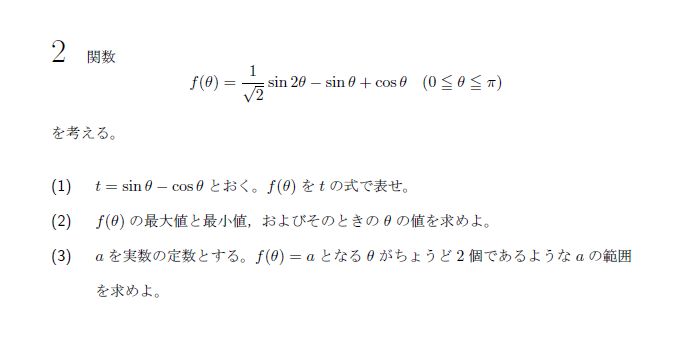
与えられた関数 $f(\theta)$ を $2\theta$ の三角関数を用いて変形し、$t = \sin 2\theta + \cos 2\theta$ の式で表す。(1)では三角関数の合成を用いて $t$ の変域を求め、(2)では $f(\theta)$ を $t$ の2次関数に帰着させる。(3)では、(1)で求めた変域において(2)の2次関数の最大値を求める。
解法1
(1)
与えられた式 $t = \sin 2\theta + \cos 2\theta$ について、三角関数の合成を行う。
$$t = \sqrt{2} \sin\left(2\theta + \frac{\pi}{4}\right)$$
$\theta$ に制限はないため $2\theta + \frac{\pi}{4}$ は実数全体を動く。 したがって、正弦関数の値域より以下の不等式が成り立つ。
$$-1 \leqq \sin\left(2\theta + \frac{\pi}{4}\right) \leqq 1$$
よって、$t$ のとりうる値の範囲は以下となる。
$$-\sqrt{2} \leqq t \leqq \sqrt{2}$$
(2)
$f(\theta)$ を $2\theta$ の関数に書き換える。 2倍角の公式 $\cos 2\theta = 2\cos^2\theta - 1$ と $\sin 2\theta = 2\sin\theta\cos\theta$ 、および半角の公式 $\sin^2\theta = \frac{1 - \cos 2\theta}{2}$ を用いる。
$$\begin{aligned} f(\theta) &= 6\sin\theta\cos\theta - 8\sin^3\theta\cos\theta + 2\cos^2\theta - 1 \\ &= 2\sin\theta\cos\theta(3 - 4\sin^2\theta) + \cos 2\theta \\ &= \sin 2\theta \left\{ 3 - 4 \left( \frac{1 - \cos 2\theta}{2} \right) \right\} + \cos 2\theta \\ &= \sin 2\theta (3 - 2 + 2\cos 2\theta) + \cos 2\theta \\ &= \sin 2\theta (1 + 2\cos 2\theta) + \cos 2\theta \\ &= \sin 2\theta + 2\sin 2\theta\cos 2\theta + \cos 2\theta \end{aligned}$$
項を並べ替えると、以下のようになる。
$$f(\theta) = (\sin 2\theta + \cos 2\theta) + 2\sin 2\theta\cos 2\theta$$
ここで、$t = \sin 2\theta + \cos 2\theta$ の両辺を2乗する。
$$t^2 = \sin^2 2\theta + 2\sin 2\theta\cos 2\theta + \cos^2 2\theta$$
$\sin^2 2\theta + \cos^2 2\theta = 1$ より、以下が成り立つ。
$$t^2 = 1 + 2\sin 2\theta\cos 2\theta$$
したがって、$2\sin 2\theta\cos 2\theta = t^2 - 1$ となるので、これを先ほどの $f(\theta)$ の式に代入する。
$$f(\theta) = t + (t^2 - 1) = t^2 + t - 1$$
(3)
(2)の結果より、$f(\theta)$ は $t$ の2次関数として表されるので、これを $g(t)$ とおく。
$$g(t) = t^2 + t - 1$$
平方完成すると以下のようになる。
$$g(t) = \left(t + \frac{1}{2}\right)^2 - \frac{5}{4}$$
これは下に凸の放物線であり、軸は直線 $t = -\frac{1}{2}$ である。 (1)より $t$ の定義域は $-\sqrt{2} \leqq t \leqq \sqrt{2}$ である。
軸 $t = -\frac{1}{2}$ はこの定義域内にあり、区間の両端との距離を比較すると、$-\frac{1}{2}$ から右端 $\sqrt{2}$ までの距離の方が、左端 $-\sqrt{2}$ までの距離よりも大きい。 したがって、$g(t)$ は軸から遠い方の端点である $t = \sqrt{2}$ のとき最大値をとる。
最大値は以下のように計算できる。
$$g(\sqrt{2}) = (\sqrt{2})^2 + \sqrt{2} - 1 = 2 + \sqrt{2} - 1 = \sqrt{2} + 1$$
よって、$f(\theta)$ の最大値は $\sqrt{2} + 1$ である。
解説
2倍角の公式を用いて式を整理し、$\sin$ と $\cos$ の和を1つの文字 $t$ で置換して2次関数に帰着させる、極めて典型的な問題である。(2)で $f(\theta)$ を $t$ で表す際、$\sin^3\theta\cos\theta$ の項をどう処理するかがポイントとなる。ここではまず $\sin\theta\cos\theta$ でくくり出すことで見通しを良くしたが、すべての項をあらかじめ $\sin 2\theta$ と $\cos 2\theta$ だけで表すことを意識すると迷わずに済む。置換した文字 $t$ には変域の制限がつくことに注意して2次関数の最大・最小を考えるという、入試数学の定石が詰まっている。
答え
(1) $-\sqrt{2} \leqq t \leqq \sqrt{2}$
(2) $f(\theta) = t^2 + t - 1$
(3) $\sqrt{2} + 1$
この基礎から進む入試問題
自分の記録
誤りを報告
問題文の写しミス、解説の誤り、誤字、表示崩れに気づいた場合は送信してください。ログイン不要です。