数学2 三角関数・最大最小 問題 22 解説

方針・初手
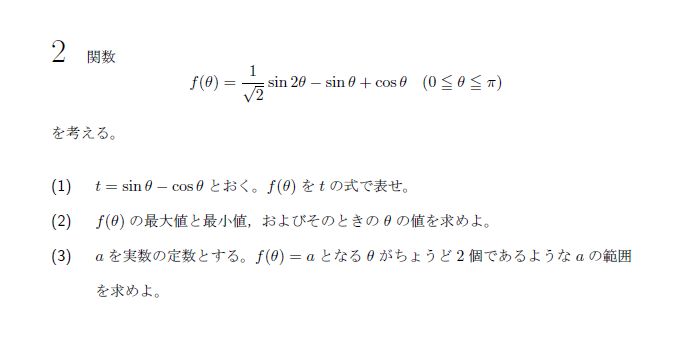
与えられた式を倍角の公式を用いて $2\theta$ の式に統一し、置換積分や2次関数の最大・最小問題に帰着させるのが基本方針である。 (1)は三角関数の合成を用いて $t$ の変域を求める。 (2)は $f(\theta)$ を展開・整理し、和 $\sin 2\theta + \cos 2\theta$ と積 $\sin 2\theta \cos 2\theta$ の形を作り出す。その後、$t = \sin 2\theta + \cos 2\theta$ を2乗することで積の部分を $t$ で表す。 (3)は(1)で求めた定義域において、(2)で得られた $t$ の2次関数の最大値を求める。
解法1
(1)
$t = \sin 2\theta + \cos 2\theta$ を三角関数の合成を用いて変形する。
$$t = \sqrt{2} \sin \left( 2\theta + \frac{\pi}{4} \right)$$
$\theta$ についての範囲指定はないため、$2\theta + \frac{\pi}{4}$ はすべての実数値をとる。 したがって、$-1 \le \sin \left( 2\theta + \frac{\pi}{4} \right) \le 1$ であるから、$t$ のとりうる値の範囲は、
$$-\sqrt{2} \le t \le \sqrt{2}$$
である。
(2)
$f(\theta)$ の式を変形する。
$$\begin{aligned} f(\theta) &= 6 \sin \theta \cos \theta - 8 \sin^3 \theta \cos \theta + 2 \cos^2 \theta - 1 \\ &= 2 \sin \theta \cos \theta (3 - 4 \sin^2 \theta) + (2 \cos^2 \theta - 1) \end{aligned}$$
倍角の公式 $\sin 2\theta = 2 \sin \theta \cos \theta$ と $\cos 2\theta = 2 \cos^2 \theta - 1$ を用いる。 また、半角の公式から $\sin^2 \theta = \frac{1 - \cos 2\theta}{2}$ であるため、これを利用して括弧の中を整理する。
$$\begin{aligned} 3 - 4 \sin^2 \theta &= 3 - 4 \left( \frac{1 - \cos 2\theta}{2} \right) \\ &= 3 - 2(1 - \cos 2\theta) \\ &= 1 + 2 \cos 2\theta \end{aligned}$$
これらを $f(\theta)$ の式に代入すると、
$$\begin{aligned} f(\theta) &= \sin 2\theta (1 + 2 \cos 2\theta) + \cos 2\theta \\ &= \sin 2\theta + 2 \sin 2\theta \cos 2\theta + \cos 2\theta \\ &= (\sin 2\theta + \cos 2\theta) + 2 \sin 2\theta \cos 2\theta \end{aligned}$$
となる。ここで、$t = \sin 2\theta + \cos 2\theta$ の両辺を2乗すると、
$$\begin{aligned} t^2 &= (\sin 2\theta + \cos 2\theta)^2 \\ &= \sin^2 2\theta + 2 \sin 2\theta \cos 2\theta + \cos^2 2\theta \\ &= 1 + 2 \sin 2\theta \cos 2\theta \end{aligned}$$
が得られる。これより $2 \sin 2\theta \cos 2\theta = t^2 - 1$ となるので、これを $f(\theta)$ に代入して、
$$\begin{aligned} f(\theta) &= t + (t^2 - 1) \\ &= t^2 + t - 1 \end{aligned}$$
と表せる。
(3)
(2)より、$f(\theta)$ を $t$ の関数とみて $g(t) = t^2 + t - 1$ とおく。 平方完成すると、
$$g(t) = \left( t + \frac{1}{2} \right)^2 - \frac{5}{4}$$
となる。(1)より $t$ の定義域は $-\sqrt{2} \le t \le \sqrt{2}$ である。 この2次関数のグラフは下に凸であり、軸は直線 $t = -\frac{1}{2}$ である。
定義域の端点と軸との距離を比較すると、 軸 $t = -\frac{1}{2}$ から左端 $t = -\sqrt{2}$ までの距離は $\sqrt{2} - \frac{1}{2}$ 軸 $t = -\frac{1}{2}$ から右端 $t = \sqrt{2}$ までの距離は $\sqrt{2} + \frac{1}{2}$ となり、右端の方が軸から遠い。
したがって、$g(t)$ は $t = \sqrt{2}$ のとき最大値をとる。 その値は、
$$g(\sqrt{2}) = (\sqrt{2})^2 + \sqrt{2} - 1 = 2 + \sqrt{2} - 1 = \sqrt{2} + 1$$
である。
解説
三角関数の次数下げと、和・積の変換を組み合わせた典型的な問題である。 関数の中に $\sin\theta\cos\theta$ や $\sin^2\theta, \cos^2\theta$ の項が含まれている場合、倍角・半角の公式を用いて角度を $2\theta$ に統一するのが定石の変形である。 角度を揃えた後、$\sin 2\theta + \cos 2\theta = t$ とおき、その両辺を2乗することで $\sin 2\theta \cos 2\theta$ を $t$ を用いて表すことができる。これは対称式の基本定理と同様の考え方である。 変数を置き換えた際は、必ず新しい変数の定義域(とりうる値の範囲)を調べることが重要である。(3)の2次関数の最大・最小問題では、この変域内で軸との距離を比較することで正しく最大値を求めることができる。
答え
(1) $-\sqrt{2} \le t \le \sqrt{2}$
(2) $f(\theta) = t^2 + t - 1$
(3) 最大値 $\sqrt{2} + 1$
この基礎から進む入試問題
自分の記録
誤りを報告
問題文の写しミス、解説の誤り、誤字、表示崩れに気づいた場合は送信してください。ログイン不要です。