数学2 三角関数・最大最小 問題 23 解説

方針・初手
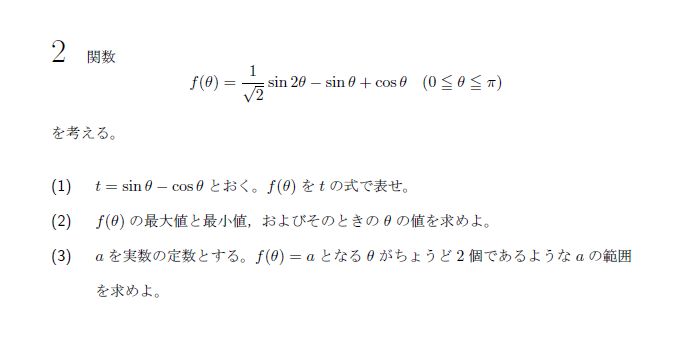
与えられた式に含まれる $\sin x$ と $\cos x$ の対称性(正確には交代式に似た形)に着目する。問題文の誘導に従い $t = \sin x - \cos x$ とおき、$y$ を $t$ の3次関数として表す。その後、三角関数の合成を用いて $t$ の定義域(取り得る値の範囲)を求め、微積分を用いて3次関数の最大値・最小値を求めるのが定石である。
解法1
$t = \sin x - \cos x$ とおく。三角関数の合成を用いると、
$$t = \sqrt{2}\sin\left(x - \frac{\pi}{4}\right)$$
となる。$x$ の範囲は $\frac{\pi}{4} \leqq x \leqq \pi$ であるから、$x - \frac{\pi}{4}$ のとり得る範囲は、
$$0 \leqq x - \frac{\pi}{4} \leqq \frac{3}{4}\pi$$
である。この範囲において、$\sin\left(x - \frac{\pi}{4}\right)$ は $x - \frac{\pi}{4} = 0$ のとき最小値 $0$ をとり、$x - \frac{\pi}{4} = \frac{\pi}{2}$ のとき最大値 $1$ をとる。したがって、
$$0 \leqq \sin\left(x - \frac{\pi}{4}\right) \leqq 1$$
となるため、$t$ の取り得る範囲は、
$$0 \leqq t \leqq \sqrt{2}$$
である。これにより、アは $0$、イは $\sqrt{2}$ と求まる。
次に、$t = \sin x - \cos x$ の両辺を2乗すると、
$$t^2 = \sin^2 x - 2\sin x\cos x + \cos^2 x = 1 - 2\sin x\cos x$$
よって、
$$\sin x\cos x = \frac{1 - t^2}{2}$$
と表せる。与えられた関数 $y$ を変形すると、
$$\begin{aligned} y &= 3\sin^2 x\cos x - 3\sin x\cos^2 x + \sin x - \cos x \\ &= 3\sin x\cos x(\sin x - \cos x) + (\sin x - \cos x) \end{aligned}$$
となる。ここに $t = \sin x - \cos x$ と $\sin x\cos x = \frac{1 - t^2}{2}$ を代入すると、
$$\begin{aligned} y &= 3 \cdot \frac{1 - t^2}{2} \cdot t + t \\ &= \frac{3t - 3t^3}{2} + t \\ &= -\frac{3}{2}t^3 + \frac{5}{2}t \end{aligned}$$
となる。これにより、ウは $-\frac{3}{2}t^3 + \frac{5}{2}t$ と求まる。
最後に、関数 $y = -\frac{3}{2}t^3 + \frac{5}{2}t \quad (0 \leqq t \leqq \sqrt{2})$ の最大値と最小値を求める。$f(t) = -\frac{3}{2}t^3 + \frac{5}{2}t$ とおき、$t$ について微分すると、
$$f'(t) = -\frac{9}{2}t^2 + \frac{5}{2} = -\frac{1}{2}(9t^2 - 5)$$
$f'(t) = 0$ とすると $t^2 = \frac{5}{9}$ であり、$0 \leqq t \leqq \sqrt{2}$ の範囲では $t = \frac{\sqrt{5}}{3}$ である。$0 \leqq t \leqq \sqrt{2}$ における $f(t)$ の増減表は以下のようになる。
| $t$ | $0$ | $\cdots$ | $\frac{\sqrt{5}}{3}$ | $\cdots$ | $\sqrt{2}$ |
|---|---|---|---|---|---|
| $f'(t)$ | $+$ | $0$ | $-$ | ||
| $f(t)$ | $0$ | $\nearrow$ | 極大 | $\searrow$ | $-\frac{\sqrt{2}}{2}$ |
ここで、極大値 $f\left(\frac{\sqrt{5}}{3}\right)$ および区間の端点での値 $f(\sqrt{2})$ を計算する。
$$\begin{aligned} f\left(\frac{\sqrt{5}}{3}\right) &= -\frac{3}{2} \left(\frac{\sqrt{5}}{3}\right)^3 + \frac{5}{2} \left(\frac{\sqrt{5}}{3}\right) \\ &= -\frac{3}{2} \cdot \frac{5\sqrt{5}}{27} + \frac{5\sqrt{5}}{6} \\ &= -\frac{5\sqrt{5}}{18} + \frac{15\sqrt{5}}{18} \\ &= \frac{10\sqrt{5}}{18} \\ &= \frac{5\sqrt{5}}{9} \end{aligned}$$
$$\begin{aligned} f(\sqrt{2}) &= -\frac{3}{2}(\sqrt{2})^3 + \frac{5}{2}(\sqrt{2}) \\ &= -\frac{3}{2} \cdot 2\sqrt{2} + \frac{5\sqrt{2}}{2} \\ &= -3\sqrt{2} + \frac{5\sqrt{2}}{2} \\ &= -\frac{\sqrt{2}}{2} \end{aligned}$$
したがって、最大値は $\frac{5\sqrt{5}}{9}$、最小値は $-\frac{\sqrt{2}}{2}$ となる。
解説
$\sin x \pm \cos x$ を $t$ とおいて式全体を $t$ の関数(主に3次関数)に帰着させる手法は、大学入試における三角関数の最大・最小問題の頻出パターンである。このとき、置き換えた文字 $t$ の定義域を確認することを忘れてはならない。本問では $x$ の範囲が $\frac{\pi}{4} \leqq x \leqq \pi$ に制限されているため、三角関数の合成を用いて慎重に $t$ の範囲を調べる必要がある。
答え
ア: $0$
イ: $\sqrt{2}$
ウ: $-\frac{3}{2}t^3 + \frac{5}{2}t$
エ: $\frac{5\sqrt{5}}{9}$
オ: $-\frac{\sqrt{2}}{2}$
この基礎から進む入試問題
自分の記録
誤りを報告
問題文の写しミス、解説の誤り、誤字、表示崩れに気づいた場合は送信してください。ログイン不要です。