数学2 三角関数・最大最小 問題 34 解説

方針・初手
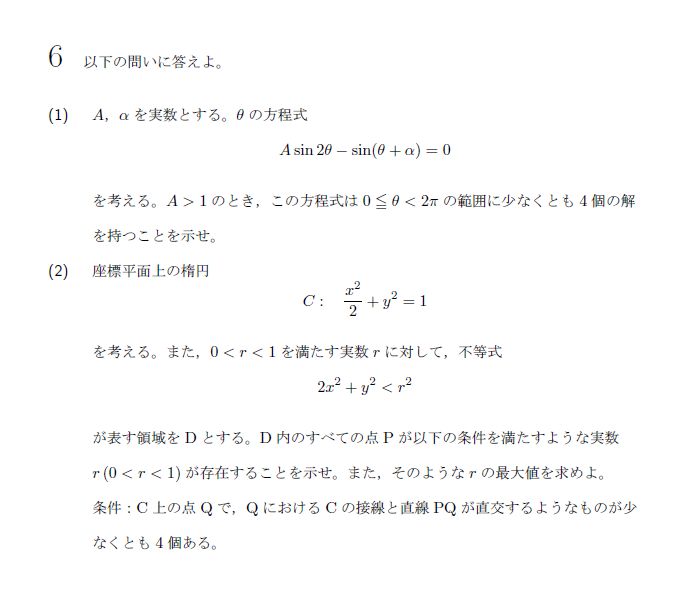
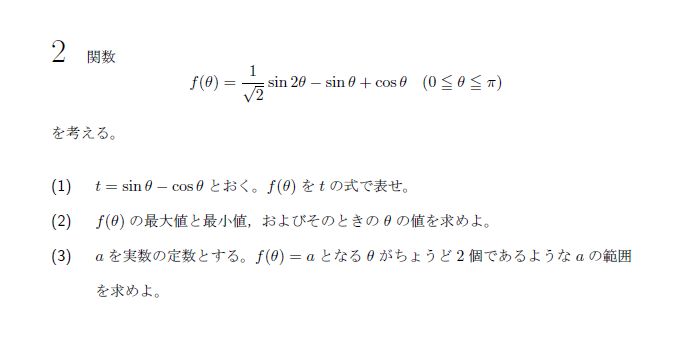
点 $P(x, y)$ が原点中心、半径 $\sqrt{2}$ の円周上にあることから、$x^2 + y^2 = 2$ が成り立つ。 この条件のもとで与式の最大値・最小値を求める。 円の媒介変数表示 $x = \sqrt{2}\cos\theta$、$y = \sqrt{2}\sin\theta$ を用いて三角関数の最大・最小問題に帰着させるのが定石である。
解法1
点 $P(x, y)$ は円 $x^2 + y^2 = 2$ 上の点であるから、$\theta$ を $0 \le \theta < 2\pi$ として、
$$\begin{cases} x = \sqrt{2}\cos\theta \\ y = \sqrt{2}\sin\theta \end{cases}$$
と表すことができる。
[ア]について
求める値を $k_1$ とおくと、
$$\begin{aligned} k_1 &= \sqrt{3}x + y \\ &= \sqrt{3}(\sqrt{2}\cos\theta) + \sqrt{2}\sin\theta \\ &= \sqrt{6}\cos\theta + \sqrt{2}\sin\theta \end{aligned}$$
三角関数の合成を用いると、
$$\begin{aligned} k_1 &= \sqrt{(\sqrt{6})^2 + (\sqrt{2})^2} \sin(\theta + \alpha) \\ &= \sqrt{6 + 2} \sin(\theta + \alpha) \\ &= 2\sqrt{2}\sin(\theta + \alpha) \end{aligned}$$
ただし、$\alpha$ は $\cos\alpha = \frac{\sqrt{6}}{2\sqrt{2}} = \frac{\sqrt{3}}{2}$、$\sin\alpha = \frac{\sqrt{2}}{2\sqrt{2}} = \frac{1}{2}$ を満たす角であり、$\alpha = \frac{\pi}{6}$ である。
$0 \le \theta < 2\pi$ より $\frac{\pi}{6} \le \theta + \frac{\pi}{6} < \frac{13}{6}\pi$ であるから、$-1 \le \sin\left(\theta + \frac{\pi}{6}\right) \le 1$ となる。 したがって、$k_1$ の最小値は $-2\sqrt{2}$ である。
[イ]について
求める値を $k_2$ とおくと、
$$\begin{aligned} k_2 &= x^2 + 2xy + 3y^2 \\ &= (\sqrt{2}\cos\theta)^2 + 2(\sqrt{2}\cos\theta)(\sqrt{2}\sin\theta) + 3(\sqrt{2}\sin\theta)^2 \\ &= 2\cos^2\theta + 4\sin\theta\cos\theta + 6\sin^2\theta \end{aligned}$$
ここで、2倍角の公式と半角の公式 $\sin2\theta = 2\sin\theta\cos\theta$、$\cos^2\theta = \frac{1 + \cos2\theta}{2}$、$\sin^2\theta = \frac{1 - \cos2\theta}{2}$ を用いると、
$$\begin{aligned} k_2 &= 2 \cdot \frac{1 + \cos2\theta}{2} + 2(2\sin\theta\cos\theta) + 6 \cdot \frac{1 - \cos2\theta}{2} \\ &= (1 + \cos2\theta) + 2\sin2\theta + 3(1 - \cos2\theta) \\ &= 2\sin2\theta - 2\cos2\theta + 4 \end{aligned}$$
三角関数の合成を用いると、
$$\begin{aligned} k_2 &= \sqrt{2^2 + (-2)^2} \sin(2\theta - \beta) + 4 \\ &= \sqrt{8} \sin(2\theta - \beta) + 4 \\ &= 2\sqrt{2}\sin(2\theta - \beta) + 4 \end{aligned}$$
ただし、$\beta$ は $\cos\beta = \frac{2}{2\sqrt{2}} = \frac{1}{\sqrt{2}}$、$\sin\beta = \frac{2}{2\sqrt{2}} = \frac{1}{\sqrt{2}}$ を満たす角であり、$\beta = \frac{\pi}{4}$ である。
$0 \le \theta < 2\pi$ において、正弦関数は最大値 $1$ をとる。 したがって、$k_2$ の最大値は $4 + 2\sqrt{2}$ である。
解法2
[ア]についての別解(図形的考察)
$k_1 = \sqrt{3}x + y$ とおくと、$y = -\sqrt{3}x + k_1$ となり、これは傾き $-\sqrt{3}$、 $y$ 切片 $k_1$ の直線を表す。 この直線が円 $x^2 + y^2 = 2$ と共有点をもつような $y$ 切片 $k_1$ の最小値を求めればよい。
直線 $\sqrt{3}x + y - k_1 = 0$ と原点 $(0, 0)$ の距離 $d$ は、点と直線の距離の公式より、
$$d = \frac{|-k_1|}{\sqrt{(\sqrt{3})^2 + 1^2}} = \frac{|k_1|}{2}$$
この距離 $d$ が円の半径 $\sqrt{2}$ 以下であれば、直線と円は共有点をもつ。
$$\frac{|k_1|}{2} \le \sqrt{2}$$
$$|k_1| \le 2\sqrt{2}$$
$$-2\sqrt{2} \le k_1 \le 2\sqrt{2}$$
したがって、$k_1$ の最小値は $-2\sqrt{2}$ である。
解説
円周上の点の座標を変数とする式の最大・最小問題である。 条件式が $x^2 + y^2 = r^2$ の形をしている場合、$x = r\cos\theta$、$y = r\sin\theta$ と媒介変数表示することで、1変数の三角関数の問題に帰着させることができる。
前半の1次式 $\sqrt{3}x + y$ の最大・最小については、解法2のように「円と直線が共有点をもつ条件」として図形的に捉える解法も非常に有効であり、計算量も少なく済む。
後半の2次式 $x^2 + 2xy + 3y^2$ については、媒介変数表示によって $\sin\theta$ と $\cos\theta$ の2次の同次式となる。これらは2倍角の公式と半角の公式を用いて $\sin2\theta$ と $\cos2\theta$ の1次式に次数下げを行い、最後に合成するという流れが定石である。この処理は頻出であるため、確実にマスターしておきたい。
答え
ア:$-2\sqrt{2}$
イ:$4 + 2\sqrt{2}$
この基礎から進む入試問題
自分の記録
誤りを報告
問題文の写しミス、解説の誤り、誤字、表示崩れに気づいた場合は送信してください。ログイン不要です。