数学3 微分の基本 問題 58 解説
方針・初手
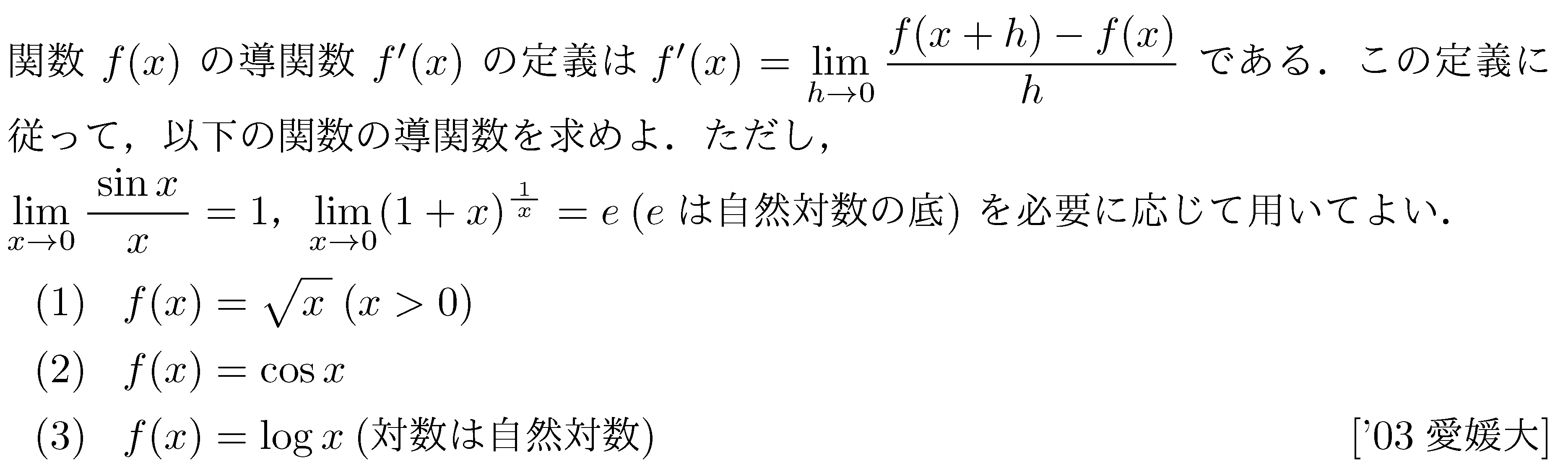
導関数の定義 $f'(x) = \lim_{h \to 0} \frac{f(x+h) - f(x)}{h}$ に従って、それぞれの関数を代入し、極限を計算する。
(1) は分子の有理化を行うことで約分し、極限を求める。 (2) は三角関数の和積の公式(または加法定理)を用いて変形し、与えられた極限 $\lim_{x \to 0} \frac{\sin x}{x} = 1$ を利用する形を作る。 (3) は対数の性質 $\log A - \log B = \log \frac{A}{B}$ と $k \log A = \log A^k$ を用いて変形し、与えられた極限 $\lim_{x \to 0} (1+x)^{\frac{1}{x}} = e$ を利用する形を作る。
解法1
(1)
導関数の定義に従って極限を計算する。分子を有理化するために、分母と分子に $\sqrt{x+h} + \sqrt{x}$ を掛ける。
$$\begin{aligned} f'(x) &= \lim_{h \to 0} \frac{\sqrt{x+h} - \sqrt{x}}{h} \\ &= \lim_{h \to 0} \frac{(\sqrt{x+h} - \sqrt{x})(\sqrt{x+h} + \sqrt{x})}{h(\sqrt{x+h} + \sqrt{x})} \\ &= \lim_{h \to 0} \frac{(x+h) - x}{h(\sqrt{x+h} + \sqrt{x})} \\ &= \lim_{h \to 0} \frac{h}{h(\sqrt{x+h} + \sqrt{x})} \\ &= \lim_{h \to 0} \frac{1}{\sqrt{x+h} + \sqrt{x}} \end{aligned}$$
$h \to 0$ とすると、分母は $\sqrt{x} + \sqrt{x}$ となるので、
$$f'(x) = \frac{1}{2\sqrt{x}}$$
(2)
導関数の定義に従って式を立てる。
$$f'(x) = \lim_{h \to 0} \frac{\cos(x+h) - \cos x}{h}$$
和積の公式 $\cos A - \cos B = -2 \sin \frac{A+B}{2} \sin \frac{A-B}{2}$ を分子に適用する。
$$\begin{aligned} \cos(x+h) - \cos x &= -2 \sin \frac{(x+h)+x}{2} \sin \frac{(x+h)-x}{2} \\ &= -2 \sin \left( x + \frac{h}{2} \right) \sin \frac{h}{2} \end{aligned}$$
これを元の式に代入し、与えられた極限公式が使える形に変形する。
$$\begin{aligned} f'(x) &= \lim_{h \to 0} \frac{-2 \sin \left( x + \frac{h}{2} \right) \sin \frac{h}{2}}{h} \\ &= \lim_{h \to 0} \left\{ -\sin \left( x + \frac{h}{2} \right) \times \frac{\sin \frac{h}{2}}{\frac{h}{2}} \right\} \end{aligned}$$
ここで、$\frac{h}{2} = t$ とおくと、$h \to 0$ のとき $t \to 0$ であり、条件より $\lim_{t \to 0} \frac{\sin t}{t} = 1$ であるから、
$$\begin{aligned} f'(x) &= -\sin x \times 1 \\ &= -\sin x \end{aligned}$$
(3)
導関数の定義に従って式を立て、対数の性質を用いて変形する。
$$\begin{aligned} f'(x) &= \lim_{h \to 0} \frac{\log(x+h) - \log x}{h} \\ &= \lim_{h \to 0} \frac{1}{h} \log \frac{x+h}{x} \\ &= \lim_{h \to 0} \frac{1}{h} \log \left( 1 + \frac{h}{x} \right) \end{aligned}$$
ここで、$\frac{h}{x} = t$ とおくと、$h = xt$ である。$x$ は定数として扱うので、$h \to 0$ のとき $t \to 0$ となる。これを代入し、対数の係数を真数の指数に移動させる。
$$\begin{aligned} f'(x) &= \lim_{t \to 0} \frac{1}{xt} \log(1+t) \\ &= \lim_{t \to 0} \frac{1}{x} \log(1+t)^{\frac{1}{t}} \end{aligned}$$
対数関数は連続であることと、条件の $\lim_{t \to 0} (1+t)^{\frac{1}{t}} = e$ を用いると、
$$\begin{aligned} f'(x) &= \frac{1}{x} \log e \\ &= \frac{1}{x} \times 1 \\ &= \frac{1}{x} \end{aligned}$$
解法2
(2)について
加法定理を用いて分子を展開する方法もある。
$$\begin{aligned} f'(x) &= \lim_{h \to 0} \frac{\cos(x+h) - \cos x}{h} \\ &= \lim_{h \to 0} \frac{(\cos x \cos h - \sin x \sin h) - \cos x}{h} \\ &= \lim_{h \to 0} \frac{\cos x (\cos h - 1) - \sin x \sin h}{h} \\ &= \lim_{h \to 0} \left( \cos x \cdot \frac{\cos h - 1}{h} - \sin x \cdot \frac{\sin h}{h} \right) \end{aligned}$$
ここで、第1項の $\frac{\cos h - 1}{h}$ について、分母分子に $\cos h + 1$ を掛けて変形する。
$$\begin{aligned} \lim_{h \to 0} \frac{\cos h - 1}{h} &= \lim_{h \to 0} \frac{\cos^2 h - 1}{h(\cos h + 1)} \\ &= \lim_{h \to 0} \frac{-\sin^2 h}{h(\cos h + 1)} \\ &= \lim_{h \to 0} \left( -\frac{\sin h}{h} \cdot \frac{\sin h}{\cos h + 1} \right) \\ &= -1 \cdot \frac{0}{1+1} \\ &= 0 \end{aligned}$$
したがって、全体の極限は以下のようになる。
$$\begin{aligned} f'(x) &= \cos x \cdot 0 - \sin x \cdot 1 \\ &= -\sin x \end{aligned}$$
解説
基本的な関数の導関数を、定義に従って自力で導出できるかを問う典型問題である。教科書で公式として暗記するような微分の結果も、一度は定義式から証明しておくことが求められる。
(1) では分子の有理化という基本的な極限計算のテクニックを使う。(2) では三角関数の極限の基本公式 $\lim_{x \to 0} \frac{\sin x}{x} = 1$ に帰着させるための式変形力が問われる。和積の公式を使うと比較的計算が短く済むが、加法定理を用いても導出可能である。(3) では自然対数の底 $e$ の定義式である $\lim_{x \to 0} (1+x)^{\frac{1}{x}} = e$ を利用する形への式変形がポイントとなる。
答え
(1) $f'(x) = \frac{1}{2\sqrt{x}}$
(2) $f'(x) = -\sin x$
(3) $f'(x) = \frac{1}{x}$
この基礎から進む入試問題
自分の記録
誤りを報告
解説の誤り、誤字、表示崩れに気づいた場合は送信してください。ログイン不要です。