北海道大学 1972年 理系 第4問 解説
方針・初手
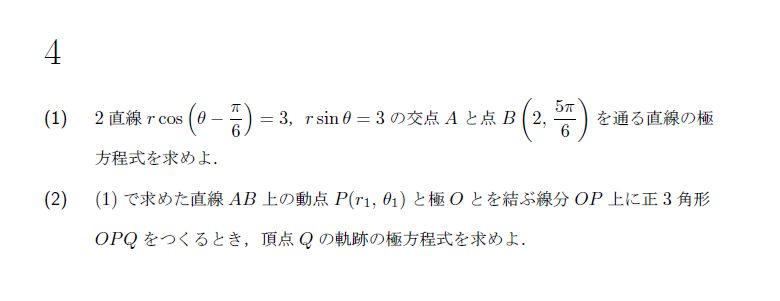
極座標と直交座標の変換を利用するか、極座標のまま図形的に処理するかの2つの方針が考えられる。ここでは、(1)において直交座標を経由して直線の方程式を求め、それを再び極方程式に変換する解法1と、極座標のままで処理する解法2を示す。 (2)では、正三角形の幾何学的な性質(辺の長さが等しいこと、なす角が $\frac{\pi}{3}$ であること)を極座標の動径 $r$ と偏角 $\theta$ の関係式として表現し、(1)で求めた直線の方程式に代入して軌跡を求める。正三角形の作図方向により頂点 Q の位置が2通り存在することに注意する。
解法1
(1)
極座標 $(r, \theta)$ と直交座標 $(x, y)$ の関係は $x = r \cos \theta$, $y = r \sin \theta$ である。
与えられた2直線を直交座標で表す。 $r \sin \theta = 3$ より、$y = 3$ である。
$r \cos \left(\theta - \frac{\pi}{6}\right) = 3$ に加法定理を用いると、
$$ \begin{aligned} r \left( \cos \theta \cos \frac{\pi}{6} + \sin \theta \sin \frac{\pi}{6} \right) &= 3 \\ r \left( \frac{\sqrt{3}}{2} \cos \theta + \frac{1}{2} \sin \theta \right) &= 3 \\ \frac{\sqrt{3}}{2} x + \frac{1}{2} y &= 3 \\ \sqrt{3} x + y &= 6 \end{aligned} $$
点 A はこの2直線の交点なので、$y=3$ を代入して、
$$ \begin{aligned} \sqrt{3} x + 3 &= 6 \\ x &= \sqrt{3} \end{aligned} $$
よって、A の直交座標は $(\sqrt{3}, 3)$ である。
点 B は極座標で $\left(2, \frac{5\pi}{6}\right)$ であるから、直交座標では
$$ \begin{aligned} x &= 2 \cos \frac{5\pi}{6} = 2 \left( -\frac{\sqrt{3}}{2} \right) = -\sqrt{3} \\ y &= 2 \sin \frac{5\pi}{6} = 2 \left( \frac{1}{2} \right) = 1 \end{aligned} $$
よって、B の直交座標は $(-\sqrt{3}, 1)$ である。
2点 A$(\sqrt{3}, 3)$, B$(-\sqrt{3}, 1)$ を通る直線の方程式は、
$$ \begin{aligned} y - 1 &= \frac{3 - 1}{\sqrt{3} - (-\sqrt{3})} (x - (-\sqrt{3})) \\ y - 1 &= \frac{1}{\sqrt{3}} (x + \sqrt{3}) \\ x - \sqrt{3} y + 2\sqrt{3} &= 0 \end{aligned} $$
これを極方程式に変換する。$x = r \cos \theta$, $y = r \sin \theta$ を代入して、
$$ \begin{aligned} r \cos \theta - \sqrt{3} r \sin \theta + 2\sqrt{3} &= 0 \\ r ( \cos \theta - \sqrt{3} \sin \theta ) &= -2\sqrt{3} \\ 2r \left( \frac{1}{2} \cos \theta - \frac{\sqrt{3}}{2} \sin \theta \right) &= -2\sqrt{3} \\ r \left( \cos \theta \cos \frac{\pi}{3} - \sin \theta \sin \frac{\pi}{3} \right) &= -\sqrt{3} \\ r \cos \left( \theta + \frac{\pi}{3} \right) &= -\sqrt{3} \end{aligned} $$
$r>0$ となる形に変形するため、両辺に $-1$ を掛け、$-\cos \alpha = \cos(\alpha - \pi)$ を用いると、
$$ \begin{aligned} -r \cos \left( \theta + \frac{\pi}{3} \right) &= \sqrt{3} \\ r \cos \left( \theta + \frac{\pi}{3} - \pi \right) &= \sqrt{3} \\ r \cos \left( \theta - \frac{2\pi}{3} \right) &= \sqrt{3} \end{aligned} $$
これが求める直線 AB の極方程式である。
(2)
点 P$(r_1, \theta_1)$ は (1) で求めた直線上にあるので、
$$ r_1 \cos \left( \theta_1 - \frac{2\pi}{3} \right) = \sqrt{3} $$
を満たす。
正3角形 OPQ について、頂点 Q の極座標を $(r, \theta)$ とおく。 線分 OP を1辺とする正三角形であるから、$OQ = OP$ より、
$$ r = r_1 $$
である。
また、線分 OQ は線分 OP を極 O を中心に $\frac{\pi}{3}$ または $-\frac{\pi}{3}$ だけ回転させたものであるから、偏角について、
$$ \theta = \theta_1 \pm \frac{\pi}{3} $$
が成り立つ。これを $\theta_1$ について解くと、
$$ \theta_1 = \theta \mp \frac{\pi}{3} $$
となる。これらを点 P の満たす極方程式に代入して場合分けを行う。
(i) $\theta_1 = \theta - \frac{\pi}{3}$ のとき
$$ \begin{aligned} r \cos \left( \left( \theta - \frac{\pi}{3} \right) - \frac{2\pi}{3} \right) &= \sqrt{3} \\ r \cos (\theta - \pi) &= \sqrt{3} \\ -r \cos \theta &= \sqrt{3} \\ r \cos \theta &= -\sqrt{3} \end{aligned} $$
(ii) $\theta_1 = \theta + \frac{\pi}{3}$ のとき
$$ \begin{aligned} r \cos \left( \left( \theta + \frac{\pi}{3} \right) - \frac{2\pi}{3} \right) &= \sqrt{3} \\ r \cos \left( \theta - \frac{\pi}{3} \right) &= \sqrt{3} \end{aligned} $$
以上より、頂点 Q の軌跡の極方程式は
$$ r \cos \theta = -\sqrt{3} \quad \text{または} \quad r \cos \left( \theta - \frac{\pi}{3} \right) = \sqrt{3} $$
である。
解法2
(1) を極座標のままで解く方法
$r \sin \theta = 3$ と $r \cos \left(\theta - \frac{\pi}{6}\right) = 3$ の交点 A の極座標 $(r_A, \theta_A)$ を求める。 $r_A = \frac{3}{\sin \theta_A}$ をもう一方の式に代入し、
$$ \begin{aligned} \frac{3}{\sin \theta_A} \cos \left( \theta_A - \frac{\pi}{6} \right) &= 3 \\ \cos \theta_A \cos \frac{\pi}{6} + \sin \theta_A \sin \frac{\pi}{6} &= \sin \theta_A \\ \frac{\sqrt{3}}{2} \cos \theta_A + \frac{1}{2} \sin \theta_A &= \sin \theta_A \\ \frac{\sqrt{3}}{2} \cos \theta_A &= \frac{1}{2} \sin \theta_A \\ \tan \theta_A &= \sqrt{3} \end{aligned} $$
$r>0$ となる偏角として $\theta_A = \frac{\pi}{3}$ をとる。このとき $r_A = \frac{3}{\sin \frac{\pi}{3}} = 2\sqrt{3}$。 よって、A の極座標は $\left(2\sqrt{3}, \frac{\pi}{3}\right)$ である。
求める直線の極方程式を、原点からの距離が $d \ (d > 0)$、法線の偏角が $\alpha$ であるとして $r \cos (\theta - \alpha) = d$ とおく。
点 A を通ることから、
$$ 2\sqrt{3} \cos \left( \frac{\pi}{3} - \alpha \right) = d $$
点 B$\left(2, \frac{5\pi}{6}\right)$ を通ることから、
$$ 2 \cos \left( \frac{5\pi}{6} - \alpha \right) = d $$
これら2つの式から $d$ を消去して、
$$ \begin{aligned} \sqrt{3} \cos \left( \frac{\pi}{3} - \alpha \right) &= \cos \left( \frac{5\pi}{6} - \alpha \right) \\ \sqrt{3} \left( \frac{1}{2} \cos \alpha + \frac{\sqrt{3}}{2} \sin \alpha \right) &= -\frac{\sqrt{3}}{2} \cos \alpha + \frac{1}{2} \sin \alpha \\ \frac{\sqrt{3}}{2} \cos \alpha + \frac{3}{2} \sin \alpha &= -\frac{\sqrt{3}}{2} \cos \alpha + \frac{1}{2} \sin \alpha \\ \sqrt{3} \cos \alpha + \sin \alpha &= 0 \\ \sin \alpha &= -\sqrt{3} \cos \alpha \\ \tan \alpha &= -\sqrt{3} \end{aligned} $$
これより $\alpha = \frac{2\pi}{3}, \frac{5\pi}{3}$ などが考えられる。
$\alpha = \frac{2\pi}{3}$ のとき、$d = 2 \cos \left( \frac{5\pi}{6} - \frac{2\pi}{3} \right) = 2 \cos \frac{\pi}{6} = \sqrt{3} > 0$ となり適する。 $\alpha = \frac{5\pi}{3}$ のときは $d < 0$ となり、基本形である $d>0$ の条件を満たさない(変形すれば同じ直線を指す)。
よって、求める直線の極方程式は
$$ r \cos \left( \theta - \frac{2\pi}{3} \right) = \sqrt{3} $$
である。 (2)の解法は解法1と同様であるため省略する。
解説
極方程式の問題では、解法1のように一度直交座標に変換して慣れ親しんだ直線や円の方程式で処理をしてから極方程式に戻す方法と、解法2のように極方程式の一般形 $r \cos(\theta - \alpha) = d$ を利用して極座標のまま処理する方法がある。(1)の条件式は直交座標に直すと極めて平易な形になるため、解法1の方が計算の見通しが立ちやすい。
(2)の図形の軌跡については、問題文にある「正3角形OPQ」がどちらの向きに作図されるかが指定されていないため、両方の可能性を考慮して場合分けを行う必要がある。極座標における図形の回転は、偏角の加減算として極めてシンプルに表現できることを確認しておきたい。
答え
(1) $$ r \cos \left( \theta - \frac{2\pi}{3} \right) = \sqrt{3} $$
(2) $$ r \cos \theta = -\sqrt{3} \quad \text{または} \quad r \cos \left( \theta - \frac{\pi}{3} \right) = \sqrt{3} $$
この問題の前に見る基礎問題


類題
自分の記録
誤りを報告
解説の誤り、誤字、表示崩れに気づいた場合は送信してください。ログイン不要です。