京都大学 1994年 理系 第6問 解説
方針・初手
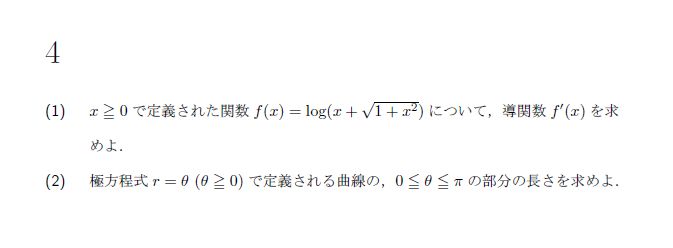
媒介変数表示された曲線の長さを求める公式 $\int \sqrt{\left(\frac{dx}{d\theta}\right)^2 + \left(\frac{dy}{d\theta}\right)^2} d\theta$ を用いる。根号の中身は、三角関数の加法定理や半角の公式を用いて平方式に変形できるのが定石である。 (2) では (1) で求めた積分を実行した結果から、$\theta_n$ と $n$ の関係式を導く。その後、$\lim_{x \to 0} \frac{\sin x}{x} = 1$ の形を作り出すために式を変形し、極限を計算する。
解法1
(1)
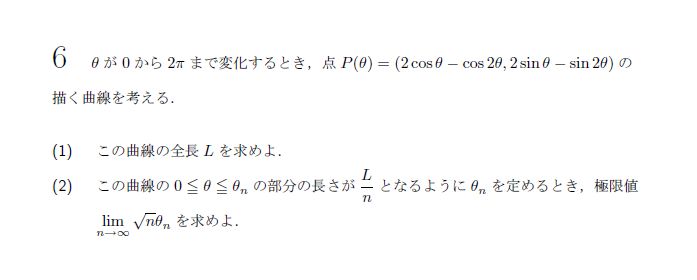
点 $P(\theta)$ の座標を $(x, y)$ とおくと、
$$ \begin{cases} x = 2\cos\theta - \cos 2\theta \\ y = 2\sin\theta - \sin 2\theta \end{cases} $$
である。両辺を $\theta$ で微分すると、
$$ \frac{dx}{d\theta} = -2\sin\theta + 2\sin 2\theta $$
$$ \frac{dy}{d\theta} = 2\cos\theta - 2\cos 2\theta $$
となる。これらより、曲線の微小長さの2乗は次のように計算できる。
$$ \begin{aligned} \left(\frac{dx}{d\theta}\right)^2 + \left(\frac{dy}{d\theta}\right)^2 &= (-2\sin\theta + 2\sin 2\theta)^2 + (2\cos\theta - 2\cos 2\theta)^2 \\ &= (4\sin^2\theta - 8\sin\theta\sin 2\theta + 4\sin^2 2\theta) + (4\cos^2\theta - 8\cos\theta\cos 2\theta + 4\cos^2 2\theta) \\ &= 4(\sin^2\theta + \cos^2\theta) + 4(\sin^2 2\theta + \cos^2 2\theta) - 8(\cos 2\theta\cos\theta + \sin 2\theta\sin\theta) \\ &= 4 \cdot 1 + 4 \cdot 1 - 8\cos(2\theta - \theta) \\ &= 8 - 8\cos\theta \\ &= 8(1 - \cos\theta) \end{aligned} $$
ここで、半角の公式 $\sin^2\frac{\theta}{2} = \frac{1 - \cos\theta}{2}$ を用いると、
$$ \left(\frac{dx}{d\theta}\right)^2 + \left(\frac{dy}{d\theta}\right)^2 = 16\sin^2\frac{\theta}{2} $$
となる。$\theta$ が $0$ から $2\pi$ まで変化するとき、曲線の全長 $L$ は次のように求められる。
$$ \begin{aligned} L &= \int_0^{2\pi} \sqrt{\left(\frac{dx}{d\theta}\right)^2 + \left(\frac{dy}{d\theta}\right)^2} d\theta \\ &= \int_0^{2\pi} \sqrt{16\sin^2\frac{\theta}{2}} d\theta \\ &= \int_0^{2\pi} 4\left| \sin\frac{\theta}{2} \right| d\theta \end{aligned} $$
積分区間 $0 \leqq \theta \leqq 2\pi$ において $0 \leqq \frac{\theta}{2} \leqq \pi$ であり、$\sin\frac{\theta}{2} \geqq 0$ であるから、絶対値記号はそのまま外すことができる。
$$ \begin{aligned} L &= \int_0^{2\pi} 4\sin\frac{\theta}{2} d\theta \\ &= \left[ -8\cos\frac{\theta}{2} \right]_0^{2\pi} \\ &= -8(\cos\pi - \cos 0) \\ &= -8(-1 - 1) \\ &= 16 \end{aligned} $$
したがって、曲線の全長は $L = 16$ である。
(2)
曲線の $0 \leqq \theta \leqq \theta_n$ の部分の長さを考え、これを $L(\theta_n)$ とすると、(1) と同様の計算から以下のようになる。
$$ \begin{aligned} L(\theta_n) &= \int_0^{\theta_n} 4\sin\frac{\theta}{2} d\theta \\ &= \left[ -8\cos\frac{\theta}{2} \right]_0^{\theta_n} \\ &= -8\cos\frac{\theta_n}{2} - (-8\cos 0) \\ &= 8 - 8\cos\frac{\theta_n}{2} \\ &= 8\left(1 - \cos\frac{\theta_n}{2}\right) \end{aligned} $$
題意より、この長さが $\frac{L}{n}$ となるように $\theta_n$ を定める。$L = 16$ であるから、
$$ 8\left(1 - \cos\frac{\theta_n}{2}\right) = \frac{16}{n} $$
$$ 1 - \cos\frac{\theta_n}{2} = \frac{2}{n} $$
ここでも再び半角の公式 $1 - \cos\frac{\theta_n}{2} = 2\sin^2\frac{\theta_n}{4}$ を用いて変形する。
$$ 2\sin^2\frac{\theta_n}{4} = \frac{2}{n} $$
$$ \sin^2\frac{\theta_n}{4} = \frac{1}{n} $$
$\theta_n$ は曲線の弧の長さに対応するパラメータであり、$n \to \infty$ のとき弧の長さ $\frac{16}{n} \to 0$ となることから、$\theta_n \to +0$ である。このとき、十分大きな $n$ に対して $\sin\frac{\theta_n}{4} > 0$ となるため、
$$ \sin\frac{\theta_n}{4} = \frac{1}{\sqrt{n}} $$
となる。これを $\sqrt{n}$ について解くと、
$$ \sqrt{n} = \frac{1}{\sin\frac{\theta_n}{4}} $$
である。求める極限は、これを用いて次のように計算できる。
$$ \begin{aligned} \lim_{n \to \infty} \sqrt{n}\theta_n &= \lim_{n \to \infty} \frac{\theta_n}{\sin\frac{\theta_n}{4}} \\ &= \lim_{n \to \infty} 4 \cdot \frac{\frac{\theta_n}{4}}{\sin\frac{\theta_n}{4}} \end{aligned} $$
$n \to \infty$ のとき $\theta_n \to 0$ より $\frac{\theta_n}{4} \to 0$ であるから、$\lim_{x \to 0} \frac{x}{\sin x} = 1$ の公式を適用できる。
$$ \lim_{n \to \infty} 4 \cdot \frac{\frac{\theta_n}{4}}{\sin\frac{\theta_n}{4}} = 4 \cdot 1 = 4 $$
したがって、求める極限値は $4$ である。
解説
媒介変数表示された曲線の長さを求める典型的な微積分・極限の問題である。 積分計算における $1 - \cos\theta = 2\sin^2\frac{\theta}{2}$ という変形は、根号を外すための方策として非常によく現れるので確実に押さえておきたい。また、根号を外す際に絶対値がつくこと、積分区間において中身が正であることの確認を怠らないようにする。 (2) の極限では、関係式から $n \to \infty$ のとき $\theta_n \to 0$ になることに着目し、三角関数の極限の基本公式 $\lim_{x \to 0} \frac{\sin x}{x} = 1$ の形に無理やり帰着させる式変形を行うのがポイントである。
答え
(1)
$16$
(2)
$4$
この問題の前に見る基礎問題

類題
自分の記録
誤りを報告
解説の誤り、誤字、表示崩れに気づいた場合は送信してください。ログイン不要です。