東北大学 2012年 理系 第5問 解説
方針・初手
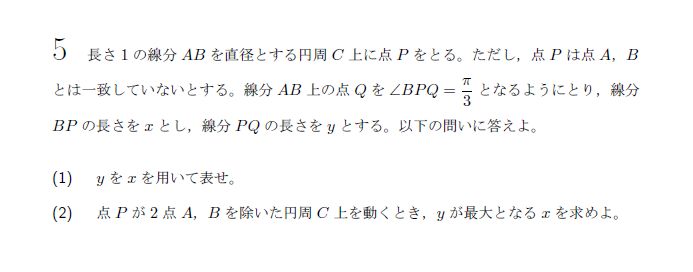
円周 $C$ は $AB$ を直径とするので,まず円周角の定理から $\angle APB=\pi/2$ を用いる。すると,直角三角形 $ABP$ で $x=BP$ と他の辺・角の関係が出る。
さらに,$Q$ は $AB$ 上にあるから,三角形 $BPQ$ に正弦定理を適用すると $y$ を $x$ で表せる。最大値は,$\angle ABP$ を媒介変数にして整理すると計算しやすい。
解法1
(1)
円周 $C$ は $AB$ を直径とするから,円周角の定理より
$$ \angle APB=\frac{\pi}{2} $$
である。
したがって,直角三角形 $ABP$ において $AB=1,\ BP=x$ なので,
$$ AP=\sqrt{1-x^2} $$
となる。
ここで
$$ \theta=\angle ABP $$
とおくと,
$$ \cos\theta=\frac{BP}{AB}=x,\qquad \sin\theta=\frac{AP}{AB}=\sqrt{1-x^2} $$
である。
また,$Q$ は線分 $AB$ 上にあるから,
$$ \angle PBQ=\angle PBA=\theta $$
である。三角形 $BPQ$ で $\angle BPQ=\pi/3$ だから,正弦定理より
$$ \frac{y}{\sin\theta} ==================== \frac{x}{\sin\left(\theta+\frac{\pi}{3}\right)} $$
となる。よって
$$ y = \frac{x\sin\theta}{\sin\left(\theta+\frac{\pi}{3}\right)} $$
であり,$\sin\theta=\sqrt{1-x^2},\ \cos\theta=x$ を代入すると,
$$ \begin{aligned} y &= \frac{x\sqrt{1-x^2}} {\frac12\sqrt{1-x^2}+\frac{\sqrt3}{2}x} \\ &= \frac{2x\sqrt{1-x^2}} {\sqrt{1-x^2}+\sqrt3,x}. \end{aligned} $$
したがって,
$$ y=\frac{2x\sqrt{1-x^2}}{\sqrt{1-x^2}+\sqrt3,x} $$
である。
(2)
(1) で用いた $\theta=\angle ABP$ をそのまま用いる。$0<\theta<\pi/2$ であり,
$$ x=\cos\theta $$
である。
さらに
$$ t=\tan\theta \qquad (t>0) $$
とおくと,
$$ x=\cos\theta=\frac{1}{\sqrt{1+t^2}} $$
である。また (1) の式を $\theta$ で書き直すと
$$ y = \frac{\cos\theta\sin\theta}{\sin\left(\theta+\frac{\pi}{3}\right)} $$
であるから,
$$ \sin\left(\theta+\frac{\pi}{3}\right) ===================================== \frac{t+\sqrt3}{2\sqrt{1+t^2}} $$
を用いて
$$ y= \frac{2t}{(t+\sqrt3)\sqrt{1+t^2}} $$
となる。ここで
$$ Y(t)=\frac{2t}{(t+\sqrt3)\sqrt{1+t^2}} $$
とおけば,
$$ Y'(t)= \frac{2(\sqrt3-t^3)} {(t+\sqrt3)^2(1+t^2)^{3/2}} $$
である。
分母は常に正であるから,
$$ Y'(t) \begin{cases} > 0 & (0<t<\sqrt[6]{3}) \\ > =0 & (t=\sqrt[6]{3}) \\ > <0 & (t>\sqrt[6]{3}) > \end{cases} > $$
となる。したがって,$y$ は
$$ t=\sqrt[6]{3} $$
のとき最大である。
このとき
$$ x=\frac{1}{\sqrt{1+t^2}} ======================== \frac{1}{\sqrt{1+\sqrt[3]{3}}} $$
となる。
よって,$y$ が最大となるのは
$$ x=\frac{1}{\sqrt{1+\sqrt[3]{3}}} $$
のときである。
解説
この問題の本質は,直径に対する円周角から $\angle APB=\pi/2$ を見抜くことである。これにより,$x=BP$ から $AP=\sqrt{1-x^2}$ が直ちに出る。
そのうえで,$Q$ が $AB$ 上にあることから $\angle PBQ=\angle PBA$ と分かるので,三角形 $BPQ$ に正弦定理を使えば $y$ を自然に表せる。最大値の処理は,$x$ のまま微分するよりも,$\theta=\angle ABP$,さらに $t=\tan\theta$ と置いて整理したほうが計算が素直である。
答え
$$ y=\frac{2x\sqrt{1-x^2}}{\sqrt{1-x^2}+\sqrt3,x} $$
また,$y$ が最大となるのは
$$ x=\frac{1}{\sqrt{1+\sqrt[3]{3}}} $$
のときである。
この問題の前に見る基礎問題



類題
自分の記録
誤りを報告
解説の誤り、誤字、表示崩れに気づいた場合は送信してください。ログイン不要です。