九州大学 1992年 文系 第3問 解説
方針・初手
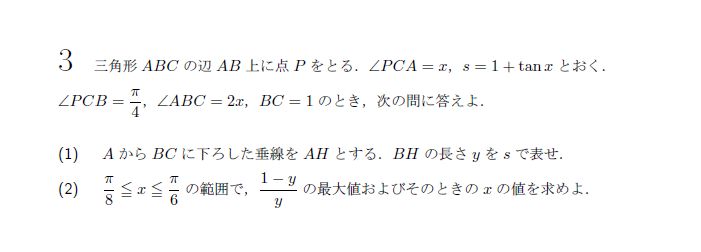
図形的な条件を角と辺の長さに翻訳し、直角三角形を用いて立式します。 点 $A$ から辺 $BC$ に下ろした垂線の足を $H$ としたとき、$x$ の変域から $\angle B$ および $\angle C$ が鋭角となることを確認し、$H$ が線分 $BC$ 上にあることを押さえるのが初手です。 直角三角形 $ABH$ と $ACH$ に着目し、高さ $AH$ を2通りに表すことで $y$ を導出します。
解法1
(1)
$\triangle ABC$ において、$\angle B = 2x$ であり、また
$$\angle C = \angle PCA + \angle PCB = x + \frac{\pi}{4}$$
である。
ここで、与えられた $x$ の範囲は $\frac{\pi}{8} \le x \le \frac{\pi}{6}$ であるから、
$$\frac{\pi}{4} \le \angle B \le \frac{\pi}{3}$$
$$\frac{3\pi}{8} \le \angle C \le \frac{5\pi}{12}$$
となる。したがって、$\angle B$ および $\angle C$ はいずれも鋭角であるため、点 $A$ から辺 $BC$ に下ろした垂線の足 $H$ は、線分 $BC$ 上(両端を除く)にある。
直角三角形 $ABH$ において、
$$AH = BH \tan B = y \tan 2x$$
が成り立つ。また、直角三角形 $ACH$ において、点 $H$ が線分 $BC$ 上にあることから $CH = BC - BH = 1 - y$ であり、
$$AH = CH \tan C = (1 - y) \tan\left(x + \frac{\pi}{4}\right)$$
が成り立つ。
これらより、次の等式を得る。
$$y \tan 2x = (1 - y) \tan\left(x + \frac{\pi}{4}\right)$$
ここで、$s = 1 + \tan x$ より $\tan x = s - 1$ であるから、$\tan 2x$ と $\tan\left(x + \frac{\pi}{4}\right)$ をそれぞれ $s$ を用いて表す。 加法定理より、
$$\begin{aligned} \tan 2x &= \frac{2\tan x}{1 - \tan^2 x} \\ &= \frac{2(s - 1)}{1 - (s - 1)^2} \\ &= \frac{2(s - 1)}{2s - s^2} \\ &= \frac{2(s - 1)}{s(2 - s)} \end{aligned}$$
$$\begin{aligned} \tan\left(x + \frac{\pi}{4}\right) &= \frac{\tan x + 1}{1 - \tan x} \\ &= \frac{(s - 1) + 1}{1 - (s - 1)} \\ &= \frac{s}{2 - s} \end{aligned}$$
となる。
なお、$x \in \left[\frac{\pi}{8}, \frac{\pi}{6}\right]$ において $\tan x > 0$ であり、$s = 1 + \tan x > 1$ である。 また、$\tan\frac{\pi}{6} = \frac{1}{\sqrt{3}}$ より $s \le 1 + \frac{1}{\sqrt{3}} < 2$ となるため、$s(2 - s) \neq 0$ である。
これらを先の等式に代入すると、
$$y \cdot \frac{2(s - 1)}{s(2 - s)} = (1 - y) \cdot \frac{s}{2 - s}$$
となる。両辺に $\frac{s(2 - s)}{s}$ を掛けて整理すると、
$$y \cdot \frac{2(s - 1)}{s^2} = 1 - y$$
$$y \left( \frac{2s - 2}{s^2} + 1 \right) = 1$$
$$y \left( \frac{s^2 + 2s - 2}{s^2} \right) = 1$$
となる。
ここで $s > 1$ より $s^2 + 2s - 2 > 1 + 2 - 2 > 0$ であるから、$y$ について解くことができ、
$$y = \frac{s^2}{s^2 + 2s - 2}$$
を得る。
(2)
(1) の結果より、
$$\frac{1 - y}{y} = \frac{1}{y} - 1 = \frac{s^2 + 2s - 2}{s^2} - 1 = \frac{2s - 2}{s^2}$$
となる。これを $f(s)$ とおく。
$f(s)$ を $s$ で微分すると、
$$\begin{aligned} f'(s) &= \frac{2 \cdot s^2 - (2s - 2) \cdot 2s}{s^4} \\ &= \frac{2s - 2(2s - 2)}{s^3} \\ &= \frac{4 - 2s}{s^3} \\ &= \frac{2(2 - s)}{s^3} \end{aligned}$$
となる。
ここで、$s$ のとりうる値の範囲を考える。 $x$ は $\frac{\pi}{8} \le x \le \frac{\pi}{6}$ の範囲を動き、この区間で $\tan x$ は単調に増加する。 $\tan\frac{\pi}{4} = \frac{2\tan\frac{\pi}{8}}{1 - \tan^2\frac{\pi}{8}} = 1$ より、$\tan^2\frac{\pi}{8} + 2\tan\frac{\pi}{8} - 1 = 0$ となり、$\tan\frac{\pi}{8} > 0$ であることから $\tan\frac{\pi}{8} = \sqrt{2} - 1$ である。 したがって、$s = 1 + \tan x$ のとりうる範囲は
$$1 + (\sqrt{2} - 1) \le s \le 1 + \frac{1}{\sqrt{3}}$$
すなわち
$$\sqrt{2} \le s \le 1 + \frac{\sqrt{3}}{3}$$
となる。
この範囲において、つねに $s < 2$ であるから、$f'(s) > 0$ となる。 よって、$f(s)$ は区間 $\sqrt{2} \le s \le 1 + \frac{\sqrt{3}}{3}$ において単調に増加する。
最大値をとるのは $s$ が最大となるとき、すなわち $x = \frac{\pi}{6}$ のときであり、その値は
$$\begin{aligned} f\left(1 + \frac{1}{\sqrt{3}}\right) &= \frac{2\left(1 + \frac{1}{\sqrt{3}} - 1\right)}{\left(1 + \frac{1}{\sqrt{3}}\right)^2} \\ &= \frac{\frac{2}{\sqrt{3}}}{\frac{3 + 2\sqrt{3} + 1}{3}} \\ &= \frac{2\sqrt{3}}{4 + 2\sqrt{3}} \\ &= \frac{\sqrt{3}}{2 + \sqrt{3}} \\ &= \sqrt{3}(2 - \sqrt{3}) \\ &= 2\sqrt{3} - 3 \end{aligned}$$
となる。
解法2
(2) の別解:相加・相乗平均の関係を利用
(1) より、
$$\frac{1 - y}{y} = \frac{2s - 2}{s^2}$$
となる。$s = 1 + \tan x$ であるから $\tan x = s - 1$ とおくと、
$$\frac{1 - y}{y} = \frac{2\tan x}{(1 + \tan x)^2} = \frac{2\tan x}{1 + 2\tan x + \tan^2 x}$$
となる。分母分子を $\tan x$($\neq 0$)で割ると、
$$\frac{1 - y}{y} = \frac{2}{\frac{1}{\tan x} + \tan x + 2}$$
となる。
ここで、$g(x) = \frac{1}{\tan x} + \tan x$ とおき、$\frac{\pi}{8} \le x \le \frac{\pi}{6}$ の範囲で考える。 $t = \tan x$ とすると、$t$ の範囲は $\sqrt{2} - 1 \le t \le \frac{1}{\sqrt{3}}$ である。 $h(t) = t + \frac{1}{t}$ は、$0 < t < 1$ の範囲において
$$h'(t) = 1 - \frac{1}{t^2} = \frac{t^2 - 1}{t^2} < 0$$
となるため、単調に減少する。
したがって、$\frac{1 - y}{y}$ の値が最大となるのは、分母の $g(x)$ が最小となるとき、すなわち $t = \tan x$ が最大となるときである。 これは $x = \frac{\pi}{6}$ のときであり、このとき $t = \frac{1}{\sqrt{3}}$ となる。
最大値は、
$$\begin{aligned} \frac{2}{\sqrt{3} + \frac{1}{\sqrt{3}} + 2} &= \frac{2}{\frac{4}{\sqrt{3}} + 2} \\ &= \frac{\sqrt{3}}{2 + \sqrt{3}} \\ &= \sqrt{3}(2 - \sqrt{3}) \\ &= 2\sqrt{3} - 3 \end{aligned}$$
となる。
解説
図形的な制約を三角比の方程式に帰着させる標準的な問題です。 垂線の足 $H$ の位置関係($H$ が線分 $BC$ 上にあるか否か)によって $CH$ の表し方が $1 - y$ または $y - 1$ に変わるため、図形的に考える際は $\angle B, \angle C$ の大きさが鋭角であることを答案内で言及しておくと論理的な欠陥がなくなります。 (2) の最大値問題は、導関数を用いて調べる(解法1)のが正攻法ですが、式変形から逆数の和をくくり出し、関数 $t + \frac{1}{t}$ の単調性を利用する(解法2)と、より手短に結論を得ることができます。
答え
(1)
$$y = \frac{s^2}{s^2 + 2s - 2}$$
(2) 最大値 $2\sqrt{3} - 3$ ($x = \frac{\pi}{6}$ のとき)
この問題の前に見る基礎問題



類題
自分の記録
誤りを報告
解説の誤り、誤字、表示崩れに気づいた場合は送信してください。ログイン不要です。