数学3 最大最小・解の個数 問題 6 解説
方針・初手
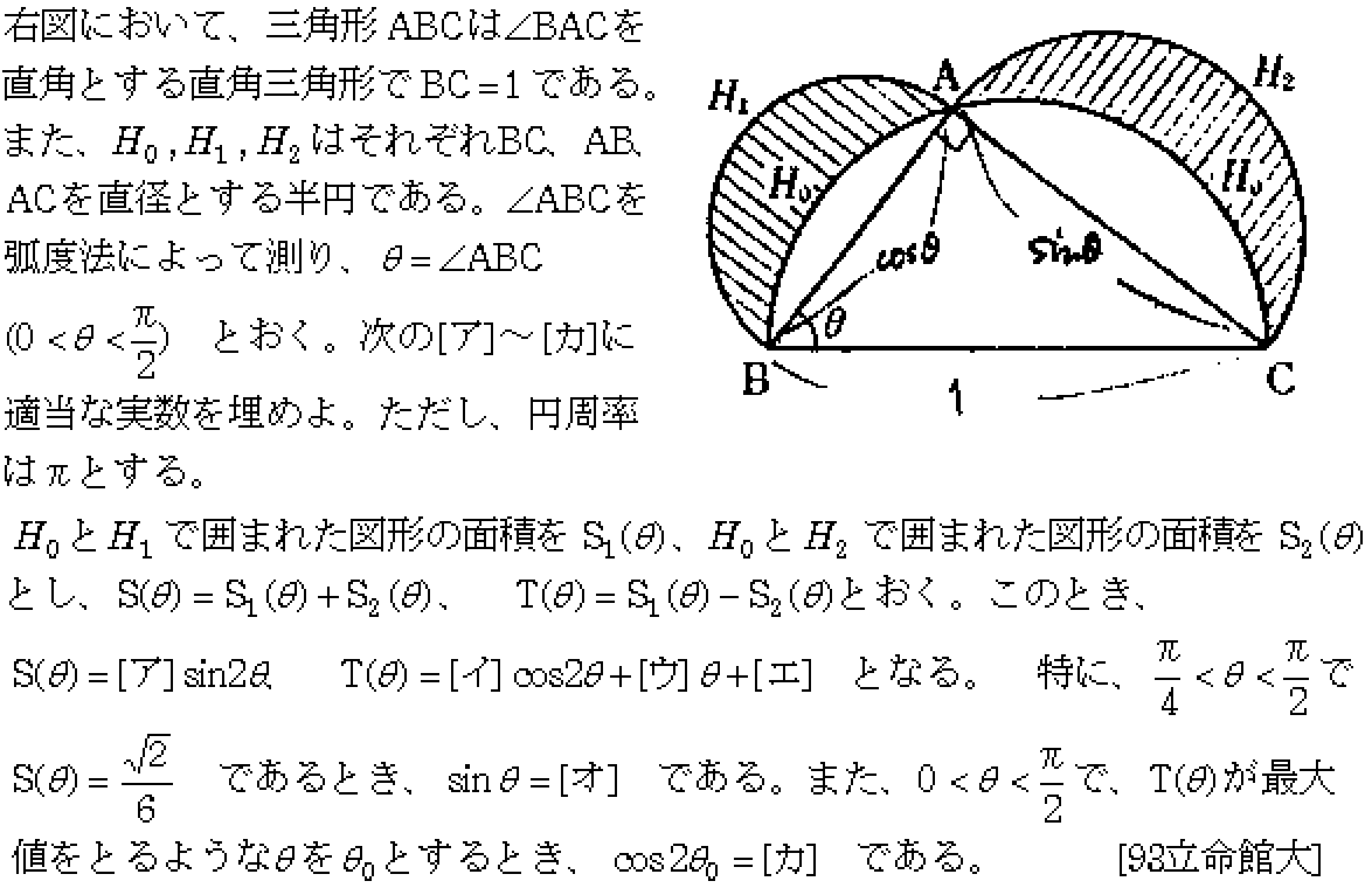
直角三角形の辺の長さを $\theta$ を用いて表し、各半円の面積を計算する。 $S_1(\theta)$ と $S_2(\theta)$ は、斜辺を直径とする半円 $H_0$ と直角三角形の各辺が作る弓形の面積をそれぞれ計算して、半円 $H_1, H_2$ の面積から引くことで求められる。 後半は、三角関数の倍角・半角の公式を用いた計算と、導関数を活用した最大値の考察を行う。
解法1
まず、直角三角形 $\text{ABC}$ について、$\text{BC}=1$、$\angle \text{A} = \frac{\pi}{2}$、$\angle \text{B} = \theta$ であるから、
$$\text{AB} = \cos \theta, \quad \text{AC} = \sin \theta$$
である。 $\triangle \text{ABC}$ の面積は以下のように表せる。
$$\frac{1}{2} \cos \theta \sin \theta = \frac{1}{4} \sin 2\theta$$
各半円の面積は、半径がそれぞれ $\frac{1}{2}, \frac{1}{2}\cos\theta, \frac{1}{2}\sin\theta$ であることから以下のようになる。 半円 $H_0$ の面積:$\frac{\pi}{8}$ 半円 $H_1$ の面積:$\frac{\pi}{8} \cos^2 \theta$ 半円 $H_2$ の面積:$\frac{\pi}{8} \sin^2 \theta$
半円 $H_0$ は $\text{BC}$ を直径とするため、円周角の定理より点 $\text{A}$ は半円 $H_0$ の弧上にある。 弦 $\text{AB}$ と半円 $H_0$ の弧で囲まれる弓形の面積を $U_1$、弦 $\text{AC}$ と半円 $H_0$ の弧で囲まれる弓形の面積を $U_2$ とする。 半円 $H_0$ の中心を $\text{M}$ とすると、$\text{M}$ は $\text{BC}$ の中点である。 $\triangle \text{MAB}$ は $\text{MA}=\text{MB}$ の二等辺三角形であり、$\angle \text{ABM} = \theta$ より $\angle \text{AMB} = \pi - 2\theta$ である。 扇形 $\text{MAB}$ の面積から $\triangle \text{MAB}$ の面積を引くことで $U_1$ が求まる。
$$U_1 = \frac{1}{2} \left(\frac{1}{2}\right)^2 (\pi - 2\theta) - \frac{1}{2} \left(\frac{1}{2}\right)^2 \sin(\pi - 2\theta) = \frac{\pi - 2\theta}{8} - \frac{1}{8} \sin 2\theta$$
同様に、$\triangle \text{MAC}$ は $\text{MA}=\text{MC}$ の二等辺三角形であり、$\angle \text{ACM} = \frac{\pi}{2} - \theta$ より $\angle \text{AMC} = 2\theta$ である。 扇形 $\text{MAC}$ の面積から $\triangle \text{MAC}$ の面積を引くことで $U_2$ が求まる。
$$U_2 = \frac{1}{2} \left(\frac{1}{2}\right)^2 (2\theta) - \frac{1}{2} \left(\frac{1}{2}\right)^2 \sin 2\theta = \frac{\theta}{4} - \frac{1}{8} \sin 2\theta$$
ここで、$S_1(\theta)$ は半円 $H_1$ の面積から $U_1$ を引いたものであり、$S_2(\theta)$ は半円 $H_2$ の面積から $U_2$ を引いたものである。
$$\begin{aligned} S_1(\theta) &= \frac{\pi}{8} \cos^2 \theta - U_1 \\ &= \frac{\pi}{8} \cos^2 \theta - \frac{\pi - 2\theta}{8} + \frac{1}{8} \sin 2\theta \end{aligned}$$
$$\begin{aligned} S_2(\theta) &= \frac{\pi}{8} \sin^2 \theta - U_2 \\ &= \frac{\pi}{8} \sin^2 \theta - \frac{\theta}{4} + \frac{1}{8} \sin 2\theta \end{aligned}$$
これらを足し合わせると、$S(\theta)$ が求まる。
$$\begin{aligned} S(\theta) &= S_1(\theta) + S_2(\theta) \\ &= \frac{\pi}{8} (\cos^2 \theta + \sin^2 \theta) - \frac{\pi - 2\theta}{8} - \frac{\theta}{4} + \frac{1}{4} \sin 2\theta \\ &= \frac{\pi}{8} - \frac{\pi}{8} + \frac{\theta}{4} - \frac{\theta}{4} + \frac{1}{4} \sin 2\theta \\ &= \frac{1}{4} \sin 2\theta \end{aligned}$$
よって、[ア] に入る値は $\frac{1}{4}$ である。
次に、これらを引き算すると $T(\theta)$ が求まる。
$$\begin{aligned} T(\theta) &= S_1(\theta) - S_2(\theta) \\ &= \frac{\pi}{8} (\cos^2 \theta - \sin^2 \theta) - \frac{\pi - 2\theta}{8} + \frac{\theta}{4} \\ &= \frac{\pi}{8} \cos 2\theta + \frac{\theta}{2} - \frac{\pi}{8} \end{aligned}$$
よって、[イ]、[ウ]、[エ] に入る値は順に $\frac{\pi}{8}, \frac{1}{2}, -\frac{\pi}{8}$ である。
続いて、$\frac{\pi}{4} < \theta < \frac{\pi}{2}$ で $S(\theta) = \frac{\sqrt{2}}{6}$ のときを考える。
$$\frac{1}{4} \sin 2\theta = \frac{\sqrt{2}}{6} \implies \sin 2\theta = \frac{2\sqrt{2}}{3}$$
$\frac{\pi}{4} < \theta < \frac{\pi}{2}$ より $\frac{\pi}{2} < 2\theta < \pi$ であるため、$\cos 2\theta < 0$ となる。
$$\cos 2\theta = -\sqrt{1 - \sin^2 2\theta} = -\sqrt{1 - \frac{8}{9}} = -\frac{1}{3}$$
半角の公式を用いて $\sin \theta$ を求める。$\theta$ の範囲より $\sin \theta > 0$ である。
$$\sin^2 \theta = \frac{1 - \cos 2\theta}{2} = \frac{1 - \left(-\frac{1}{3}\right)}{2} = \frac{2}{3}$$
$$\sin \theta = \sqrt{\frac{2}{3}} = \frac{\sqrt{6}}{3}$$
よって、[オ] に入る値は $\frac{\sqrt{6}}{3}$ である。
最後に、$T(\theta)$ の $0 < \theta < \frac{\pi}{2}$ における最大値を考える。
$$T'(\theta) = \frac{\pi}{8} (-2 \sin 2\theta) + \frac{1}{2} = -\frac{\pi}{4} \sin 2\theta + \frac{1}{2}$$
$T'(\theta) = 0$ とすると、$\sin 2\theta = \frac{2}{\pi}$ である。 $0 < \theta < \frac{\pi}{2}$ より $0 < 2\theta < \pi$ であり、$0 < \frac{2}{\pi} < 1$ であるため、この方程式は2つの解をもつ。 それらを $\alpha, \beta$ $\left(0 < \alpha < \frac{\pi}{2} < \beta < \pi\right)$ とおくと、$T(\theta)$ の増減は以下のようになる。
(i) $0 < 2\theta < \alpha$ のとき、$\sin 2\theta < \frac{2}{\pi}$ より $T'(\theta) > 0$ (ii) $\alpha < 2\theta < \beta$ のとき、$\sin 2\theta > \frac{2}{\pi}$ より $T'(\theta) < 0$ (iii) $\beta < 2\theta < \pi$ のとき、$\sin 2\theta < \frac{2}{\pi}$ より $T'(\theta) > 0$
したがって、$T(\theta)$ は $2\theta = \alpha$ で極大、 $2\theta = \beta$ で極小となる。 区間の両端における値は $T(0) = 0$、$T\left(\frac{\pi}{2}\right) = 0$ であり、極大値は正であるため、$T(\theta)$ が最大となるのは $2\theta = \alpha$ のときである。 よって、$2\theta_0 = \alpha$ となる。 このとき、$\sin 2\theta_0 = \frac{2}{\pi}$ であり、$0 < 2\theta_0 < \frac{\pi}{2}$ であるため $\cos 2\theta_0 > 0$ となる。
$$\cos 2\theta_0 = \sqrt{1 - \sin^2 2\theta_0} = \sqrt{1 - \frac{4}{\pi^2}} = \frac{\sqrt{\pi^2 - 4}}{\pi}$$
よって、[カ] に入る値は $\frac{\sqrt{\pi^2 - 4}}{\pi}$ である。
解説
本問の前半部分は「ヒポクラテスの三日月」として知られる有名な図形の面積に関する問題である。 誘導に従って各面積を計算していくのが本筋であるが、$S(\theta)$ が $\triangle \text{ABC}$ の面積と等しくなるという性質を知っていれば、計算結果の強力な検算となる。 後半は、三角関数の倍角・半角の公式の運用と、微分の標準的な最大値問題である。 $\sin 2\theta = \frac{2}{\pi}$ という具体的な角の大きさが求まらない方程式に直面するが、解の存在範囲と増減の符号変化を落ち着いて調べることで、最大値を与える条件を特定できる。
答え
[ア] $\frac{1}{4}$
[イ] $\frac{\pi}{8}$
[ウ] $\frac{1}{2}$
[エ] $-\frac{\pi}{8}$
[オ] $\frac{\sqrt{6}}{3}$
[カ] $\frac{\sqrt{\pi^2 - 4}}{\pi}$
この基礎から進む入試問題
自分の記録
誤りを報告
解説の誤り、誤字、表示崩れに気づいた場合は送信してください。ログイン不要です。