数学3 最大最小・解の個数 問題 53 解説
方針・初手
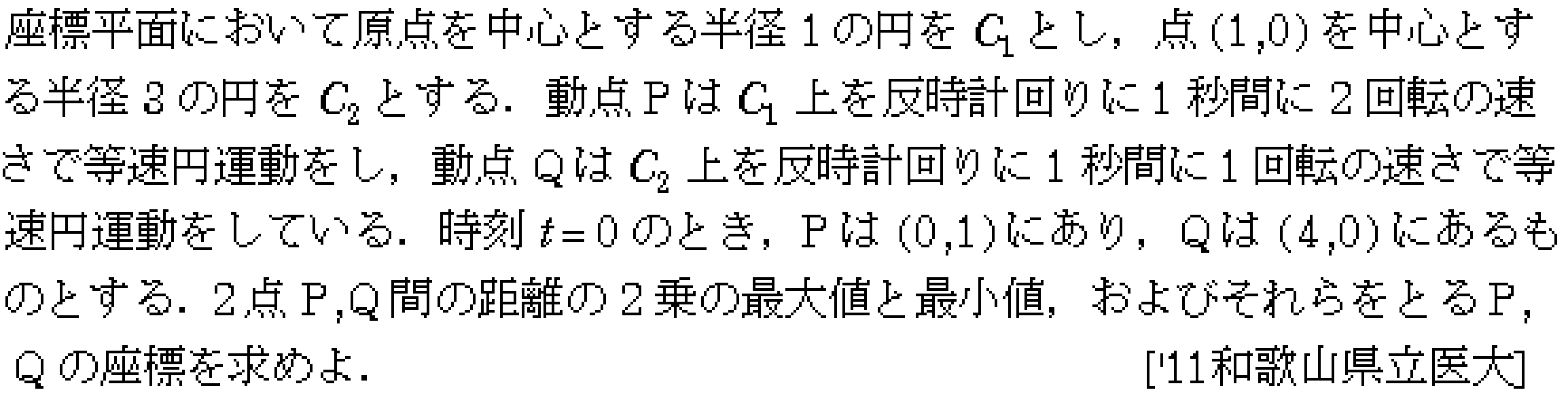
時刻 $t$ における2点 $\text{P}, \text{Q}$ の座標をそれぞれ立式し、2点間の距離の2乗を $t$ の関数として表す。三角関数の加法定理や2倍角の公式を用いて式を整理し、和と積の形である $\sin\theta + \cos\theta$ と $\sin\theta\cos\theta$ を作り出すことで、1変数の2次関数に帰着させる。
解法1
円 $C_1$ は原点を中心とする半径 $1$ の円であり、動点 $\text{P}$ は反時計回りに1秒間に2回転するから、その角速度は $4\pi \text{ rad/s}$ である。時刻 $t=0$ において $\text{P}$ は $(0, 1)$ にあるため、時刻 $t$ における動径の偏角は $4\pi t + \frac{\pi}{2}$ と表せる。よって、点 $\text{P}$ の座標は以下のようになる。
$$\text{P}\left(\cos\left(4\pi t + \frac{\pi}{2}\right), \sin\left(4\pi t + \frac{\pi}{2}\right)\right) = (-\sin(4\pi t), \cos(4\pi t))$$
円 $C_2$ は点 $(1, 0)$ を中心とする半径 $3$ の円であり、動点 $\text{Q}$ は反時計回りに1秒間に1回転するから、その角速度は $2\pi \text{ rad/s}$ である。時刻 $t=0$ において $\text{Q}$ は $(4, 0)$ にあり、これは円の中心から見て偏角 $0$ の位置に該当する。よって、点 $\text{Q}$ の座標は以下のようになる。
$$\text{Q}(1 + 3\cos(2\pi t), 3\sin(2\pi t))$$
ここで、$\theta = 2\pi t$ とおくと、$\text{P}(-\sin 2\theta, \cos 2\theta)$、$\text{Q}(1 + 3\cos\theta, 3\sin\theta)$ となる。$t \geqq 0$ より $\theta \geqq 0$ であるが、以降の関数は周期 $2\pi$ であり、任意の実数 $\theta$ に対して最大値・最小値を考えれば十分である。
2点 $\text{P, Q}$ 間の距離の2乗を $f(\theta)$ とおき、計算する。
$$\begin{aligned} f(\theta) &= (1 + 3\cos\theta + \sin 2\theta)^2 + (3\sin\theta - \cos 2\theta)^2 \\ &= (1 + 3\cos\theta)^2 + 2(1 + 3\cos\theta)\sin 2\theta + \sin^2 2\theta + 9\sin^2\theta - 6\sin\theta\cos 2\theta + \cos^2 2\theta \\ &= 1 + 6\cos\theta + 9\cos^2\theta + 2\sin 2\theta + 6\cos\theta\sin 2\theta + \sin^2 2\theta + 9\sin^2\theta - 6\sin\theta\cos 2\theta + \cos^2 2\theta \\ &= (1 + \sin^2 2\theta + \cos^2 2\theta) + 9(\cos^2\theta + \sin^2\theta) + 6\cos\theta + 2\sin 2\theta + 6(\sin 2\theta\cos\theta - \cos 2\theta\sin\theta) \\ &= 2 + 9 + 6\cos\theta + 2\sin 2\theta + 6\sin(2\theta - \theta) \\ &= 11 + 6\cos\theta + 2\sin 2\theta + 6\sin\theta \\ &= 11 + 6(\sin\theta + \cos\theta) + 4\sin\theta\cos\theta \end{aligned}$$
ここで、$x = \sin\theta + \cos\theta$ とおく。三角関数の合成により $x = \sqrt{2}\sin\left(\theta + \frac{\pi}{4}\right)$ となるため、$x$ のとりうる値の範囲は以下のようになる。
$$-\sqrt{2} \leqq x \leqq \sqrt{2}$$
また、$x^2 = (\sin\theta + \cos\theta)^2 = 1 + 2\sin\theta\cos\theta$ より、$\sin\theta\cos\theta = \frac{x^2 - 1}{2}$ である。これを $f(\theta)$ の式に代入し、$x$ の関数 $g(x)$ として表す。
$$\begin{aligned} g(x) &= 11 + 6x + 4 \cdot \frac{x^2 - 1}{2} \\ &= 2x^2 + 6x + 9 \\ &= 2\left(x + \frac{3}{2}\right)^2 + \frac{9}{2} \end{aligned}$$
放物線 $y = g(x)$ の軸は直線 $x = -\frac{3}{2}$ である。$\sqrt{2} \approx 1.414$ であることから、$-\frac{3}{2} < -\sqrt{2}$ が成り立つ。すなわち、定義域 $-\sqrt{2} \leqq x \leqq \sqrt{2}$ において関数 $g(x)$ は単調増加である。
したがって、$g(x)$ は $x = \sqrt{2}$ で最大値、 $x = -\sqrt{2}$ で最小値をとる。
(i) 最大値について $x = \sqrt{2}$ のとき、最大値は以下の通りである。
$$g(\sqrt{2}) = 2(\sqrt{2})^2 + 6\sqrt{2} + 9 = 13 + 6\sqrt{2}$$
このとき、$\sqrt{2}\sin\left(\theta + \frac{\pi}{4}\right) = \sqrt{2}$ より $\sin\left(\theta + \frac{\pi}{4}\right) = 1$ であるから、$\theta + \frac{\pi}{4} = \frac{\pi}{2} + 2n\pi$ ($n$ は整数) となる。代表して $\theta = \frac{\pi}{4}$ とすると、2点 $\text{P, Q}$ の座標は以下のように求まる。
$$\text{P}\left(-\sin\frac{\pi}{2}, \cos\frac{\pi}{2}\right) = (-1, 0)$$
$$\text{Q}\left(1 + 3\cos\frac{\pi}{4}, 3\sin\frac{\pi}{4}\right) = \left(1 + \frac{3\sqrt{2}}{2}, \frac{3\sqrt{2}}{2}\right)$$
(ii) 最小値について $x = -\sqrt{2}$ のとき、最小値は以下の通りである。
$$g(-\sqrt{2}) = 2(-\sqrt{2})^2 + 6(-\sqrt{2}) + 9 = 13 - 6\sqrt{2}$$
このとき、$\sqrt{2}\sin\left(\theta + \frac{\pi}{4}\right) = -\sqrt{2}$ より $\sin\left(\theta + \frac{\pi}{4}\right) = -1$ であるから、$\theta + \frac{\pi}{4} = \frac{3\pi}{2} + 2n\pi$ ($n$ は整数) となる。代表して $\theta = \frac{5\pi}{4}$ とすると、2点 $\text{P, Q}$ の座標は以下のように求まる。
$$\text{P}\left(-\sin\frac{5\pi}{2}, \cos\frac{5\pi}{2}\right) = \text{P}\left(-\sin\frac{\pi}{2}, \cos\frac{\pi}{2}\right) = (-1, 0)$$
$$\text{Q}\left(1 + 3\cos\frac{5\pi}{4}, 3\sin\frac{5\pi}{4}\right) = \left(1 - \frac{3\sqrt{2}}{2}, -\frac{3\sqrt{2}}{2}\right)$$
解説
円運動する2点間の距離の最大・最小を求める典型的な問題である。時刻 $t$ を用いて座標を立式した後は、加法定理などを駆使して式を整理する計算力が求められる。展開の過程で現れる $\sin(2\theta)\cos\theta - \cos(2\theta)\sin\theta$ を $\sin(2\theta - \theta)$ とまとめる工夫に気づけると計算量を減らすことができる。また、最終的に現れる2次関数の軸 $x = -1.5$ と、定義域の左端 $x = -\sqrt{2} \approx -1.414$ の大小関係の判定は重要であり、安易に頂点で最小値をとると誤認しないように注意したい。
答え
最大値: $13 + 6\sqrt{2}$
(このとき $\text{P}(-1, 0), \text{Q}\left(1 + \frac{3\sqrt{2}}{2}, \frac{3\sqrt{2}}{2}\right)$)
最小値: $13 - 6\sqrt{2}$
(このとき $\text{P}(-1, 0), \text{Q}\left(1 - \frac{3\sqrt{2}}{2}, -\frac{3\sqrt{2}}{2}\right)$)
この基礎から進む入試問題
自分の記録
誤りを報告
問題文の写しミス、解説の誤り、誤字、表示崩れに気づいた場合は送信してください。ログイン不要です。