数学C 空間ベクトル 問題 139 解説
方針・初手
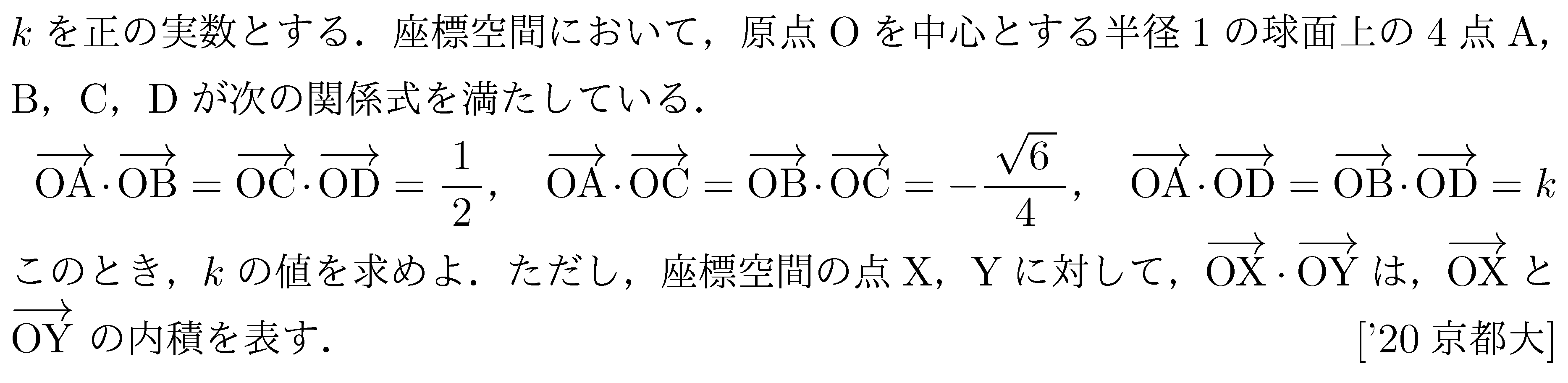
$\overrightarrow{OA},\overrightarrow{OB},\overrightarrow{OC},\overrightarrow{OD}$ をそれぞれ単位ベクトル $\mathbf a,\mathbf b,\mathbf c,\mathbf d$ とおく。
条件に対称性があり、特に $\mathbf a-\mathbf b$ が $\mathbf c,\mathbf d$ と直交することに注目する。これにより、$\mathbf a+\mathbf b,\mathbf c,\mathbf d$ が同一平面上にあることを用いて、$k$ を決定する。
解法1
$$ \mathbf a=\overrightarrow{OA},\quad \mathbf b=\overrightarrow{OB},\quad \mathbf c=\overrightarrow{OC},\quad \mathbf d=\overrightarrow{OD} $$
とおく。4点は半径 $1$ の球面上にあるので、
$$ |\mathbf a|=|\mathbf b|=|\mathbf c|=|\mathbf d|=1 $$
である。
与えられた条件は
$$ \mathbf a\cdot \mathbf b=\frac12,\quad \mathbf c\cdot \mathbf d=\frac12, $$
$$ \mathbf a\cdot \mathbf c=\mathbf b\cdot \mathbf c=-\frac{\sqrt6}{4}, \quad \mathbf a\cdot \mathbf d=\mathbf b\cdot \mathbf d=k $$
である。
まず、
$$ (\mathbf a-\mathbf b)\cdot \mathbf c = \mathbf a\cdot \mathbf c-\mathbf b\cdot \mathbf c -\frac{\sqrt6}{4}-\left(-\frac{\sqrt6}{4}\right) =0 $$
であり、同様に
$$ \begin{aligned} (\mathbf a-\mathbf b)\cdot \mathbf d &= \mathbf a\cdot \mathbf d-\mathbf b\cdot \mathbf d\\ &= k-k \end{aligned} =0 $$
である。また、
$$ \begin{aligned} (\mathbf a-\mathbf b)\cdot(\mathbf a+\mathbf b) &= |\mathbf a|^2-|\mathbf b|^2\\ &= 1-1 \end{aligned} =0 $$
である。
さらに
$$ \begin{aligned} |\mathbf a-\mathbf b|^2 &= |\mathbf a|^2+|\mathbf b|^2-2\mathbf a\cdot\mathbf b\\ &= 1+1-2\cdot\frac12 \end{aligned} =1 $$
より、$\mathbf a-\mathbf b$ は零ベクトルではない。
したがって、空間内で $\mathbf a+\mathbf b,\mathbf c,\mathbf d$ は、零でないベクトル $\mathbf a-\mathbf b$ にすべて直交する。よって、これら3つのベクトルは同一平面上にある。
そのため、$\mathbf a+\mathbf b,\mathbf c,\mathbf d$ のグラム行列の行列式は $0$ である。
各内積を求める。
$$ \begin{aligned} |\mathbf a+\mathbf b|^2 &= |\mathbf a|^2+|\mathbf b|^2+2\mathbf a\cdot\mathbf b\\ &= 1+1+2\cdot\frac12 \end{aligned} =3 $$
また、
$$ (\mathbf a+\mathbf b)\cdot \mathbf c = \mathbf a\cdot\mathbf c+\mathbf b\cdot\mathbf c -\frac{\sqrt6}{4}-\frac{\sqrt6}{4} -\frac{\sqrt6}{2} $$
であり、
$$ \begin{aligned} (\mathbf a+\mathbf b)\cdot \mathbf d &= \mathbf a\cdot\mathbf d+\mathbf b\cdot\mathbf d\\ &= k+k\\ &= 2k \end{aligned} $$
である。
したがって、グラム行列は
$$ \begin{pmatrix} 3 & -\frac{\sqrt6}{2} & 2k \\ -\frac{\sqrt6}{2} & 1 & \frac12 \\ 2k & \frac12 & 1 \end{pmatrix} $$
であり、その行列式が $0$ となる。
よって
$$ \begin{vmatrix} 3 & -\frac{\sqrt6}{2} & 2k \\ -\frac{\sqrt6}{2} & 1 & \frac12 \\ 2k & \frac12 & 1 \end{vmatrix} =0 $$
である。これを計算すると、
$$ 3\left(1-\frac14\right) +\frac{\sqrt6}{2}\left(-\frac{\sqrt6}{2}-k\right) +2k\left(-\frac{\sqrt6}{4}-2k\right) =0 $$
となる。
整理して
$$ \frac94-\frac32-\frac{\sqrt6}{2}k-\frac{\sqrt6}{2}k-4k^2=0 $$
すなわち
$$ \frac34-\sqrt6 k-4k^2=0 $$
である。
したがって
$$ 4k^2+\sqrt6 k-\frac34=0 $$
となる。解の公式より、
$$ k= \frac{-\sqrt6\pm\sqrt{6+12}}{8} = \frac{-\sqrt6\pm3\sqrt2}{8} $$
である。
$k$ は正の実数であるから、
$$ k=\frac{3\sqrt2-\sqrt6}{8} $$
である。
解説
この問題では、4点の位置を直接座標で置くよりも、内積条件の対称性を使うのが自然である。
特に
$$ \mathbf a\cdot\mathbf c=\mathbf b\cdot\mathbf c,\quad \mathbf a\cdot\mathbf d=\mathbf b\cdot\mathbf d $$
から、$\mathbf a-\mathbf b$ が $\mathbf c,\mathbf d$ と直交する。また、$\mathbf a-\mathbf b$ は $\mathbf a+\mathbf b$ とも直交する。したがって、$\mathbf a+\mathbf b,\mathbf c,\mathbf d$ が同じ2次元平面内にあることが分かる。
この「同一平面上にある3ベクトルのグラム行列式は $0$」という処理が本問の中心である。空間ベクトルの問題では、直接座標化する前に、内積条件から直交関係や一次従属関係を探すと計算が大きく短くなる。
答え
$$ \boxed{\frac{3\sqrt2-\sqrt6}{8}} $$
この基礎から進む入試問題
自分の記録
誤りを報告
問題文の写しミス、解説の誤り、誤字、表示崩れに気づいた場合は送信してください。ログイン不要です。