京都大学 2018年 文系 第2問 解説
方針・初手
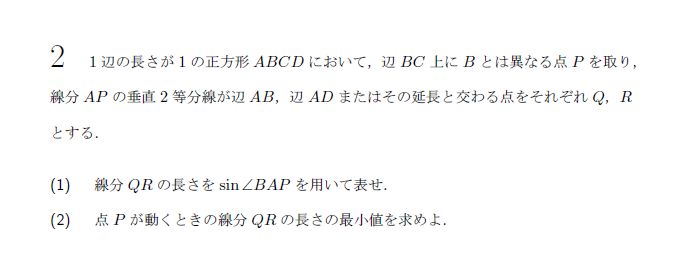
$\angle BAP = \theta$ とおき、(1) は図形の性質または座標平面を設定して線分 $QR$ の長さを $\sin\theta$ の式で表します。(2) は (1) で求めた式を $\sin\theta = t$ と置き換え、点 $P$ の動く範囲から $t$ の変域を求めた上で、微分法を用いて関数の増減を調べ、最小値を判断します。
解法1
(1)
$\angle BAP = \theta$ とおく。点 $P$ は辺 $BC$ 上にあり点 $B$ とは異なるため、$0 < \theta \leqq \dfrac{\pi}{4}$ である。
直角三角形 $\triangle ABP$ において、$\angle ABP = \dfrac{\pi}{2}$, $AB = 1$ より、
$$ AP = \frac{1}{\cos\theta} $$
線分 $AP$ の中点を $M$ とすると、
$$ AM = \frac{AP}{2} = \frac{1}{2\cos\theta} $$
線分 $AP$ の垂直二等分線と直線 $AB$, $AD$ の交点がそれぞれ $Q$, $R$ である。
直角三角形 $\triangle AMQ$ において、$\angle MAQ = \theta$ であるから、
$$ AQ = \frac{AM}{\cos\theta} = \frac{1}{2\cos^2\theta} $$
また、$\angle DAB = \dfrac{\pi}{2}$ より $\angle MAR = \dfrac{\pi}{2} - \theta$ であるから、直角三角形 $\triangle AMR$ において、
$$ AR = \frac{AM}{\cos\!\left(\dfrac{\pi}{2} - \theta\right)} = \frac{AM}{\sin\theta} = \frac{1}{2\sin\theta\cos\theta} $$
$\triangle AQR$ は $\angle QAR = \dfrac{\pi}{2}$ の直角三角形であるから、三平方の定理より
$$ QR^2 = AQ^2 + AR^2 = \frac{1}{4\cos^4\theta} + \frac{1}{4\sin^2\theta\cos^2\theta} = \frac{1}{4\cos^2\theta}\left(\frac{1}{\cos^2\theta} + \frac{1}{\sin^2\theta}\right) = \frac{1}{4\sin^2\theta\cos^4\theta} $$
$\sin\theta > 0$, $\cos\theta > 0$ より、
$$ QR = \frac{1}{2\sin\theta\cos^2\theta} $$
$\cos^2\theta = 1 - \sin^2\theta$ であり、$\sin\angle BAP = \sin\theta$ であるから、
$$ QR = \frac{1}{2\sin\angle BAP\,(1 - \sin^2\angle BAP)} $$
(2)
$\sin\angle BAP = t$ とおく。$0 < \angle BAP \leqq \dfrac{\pi}{4}$ より、$0 < t \leqq \dfrac{1}{\sqrt{2}}$ である。
(1) の結果より $QR = \dfrac{1}{2t(1-t^2)}$ である。分母を $f(t) = 2t(1-t^2) = 2t - 2t^3$ とおくと、
$$ f'(t) = 2 - 6t^2 = 2(1 - 3t^2) $$
$f'(t) = 0$ となる正の $t$ は $t = \dfrac{1}{\sqrt{3}}$ であり、$\dfrac{1}{\sqrt{3}} < \dfrac{1}{\sqrt{2}}$ であるから、これは $0 < t \leqq \dfrac{1}{\sqrt{2}}$ の範囲に含まれる。
$t$ の変域における $f(t)$ の増減表は以下のようになる。
| $t$ | $(0)$ | $\cdots$ | $\dfrac{1}{\sqrt{3}}$ | $\cdots$ | $\dfrac{1}{\sqrt{2}}$ |
|---|---|---|---|---|---|
| $f'(t)$ | $+$ | $0$ | $-$ | ||
| $f(t)$ | $\nearrow$ | 極大 | $\searrow$ |
よって $f(t)$ は $t = \dfrac{1}{\sqrt{3}}$ のとき最大値をとり、
$$ f\!\left(\frac{1}{\sqrt{3}}\right) = \frac{2}{\sqrt{3}}\left(1 - \frac{1}{3}\right) = \frac{2}{\sqrt{3}} \cdot \frac{2}{3} = \frac{4}{3\sqrt{3}} = \frac{4\sqrt{3}}{9} $$
分母 $f(t)$ が最大となるとき $QR$ は最小となる。したがって、求める線分 $QR$ の最小値は
$$ QR_{\min} = \frac{1}{f\!\left(\dfrac{1}{\sqrt{3}}\right)} = \frac{9}{4\sqrt{3}} = \frac{3\sqrt{3}}{4} $$
解法2
(1)
点 $A$ を原点 $(0,0)$ とし、辺 $AB$ が $x$ 軸の正の向き、辺 $AD$ が $y$ 軸の正の向きと重なるように座標平面を設定する。各頂点の座標は $A(0,0)$, $B(1,0)$, $C(1,1)$, $D(0,1)$ となる。
$\angle BAP = \theta$ とおくと $0 < \theta \leqq \dfrac{\pi}{4}$ であり、直線 $AP$ の傾きは $\tan\theta$ であるから $P(1,\ \tan\theta)$ と表せる。
線分 $AP$ の中点 $M$ の座標は $\left(\dfrac{1}{2},\ \dfrac{\tan\theta}{2}\right)$ である。線分 $AP$ の垂直二等分線 $\ell$ は傾き $-\dfrac{\cos\theta}{\sin\theta}$ で点 $M$ を通るから、その方程式は
$$ y - \frac{\tan\theta}{2} = -\frac{\cos\theta}{\sin\theta}\left(x - \frac{1}{2}\right) $$
点 $Q$ は $\ell$ と $x$ 軸 $(y=0)$ との交点であるから、
$$ -\frac{\tan\theta}{2} = -\frac{\cos\theta}{\sin\theta}\left(x_Q - \frac{1}{2}\right) \implies x_Q = \frac{1}{2} + \frac{\sin^2\theta}{2\cos^2\theta} = \frac{1}{2\cos^2\theta} $$
よって $AQ = \dfrac{1}{2\cos^2\theta}$ である。
点 $R$ は $\ell$ と $y$ 軸 $(x=0)$ との交点であるから、
$$ y_R = \frac{\tan\theta}{2} + \frac{\cos\theta}{2\sin\theta} = \frac{\sin\theta}{2\cos\theta} + \frac{\cos\theta}{2\sin\theta} = \frac{\sin^2\theta + \cos^2\theta}{2\sin\theta\cos\theta} = \frac{1}{2\sin\theta\cos\theta} $$
よって $AR = \dfrac{1}{2\sin\theta\cos\theta}$ である。
線分 $QR$ の長さは $\angle QAR = \dfrac{\pi}{2}$ を利用した三平方の定理より
$$ QR = \sqrt{AQ^2 + AR^2} = \sqrt{\frac{1}{4\cos^4\theta} + \frac{1}{4\sin^2\theta\cos^2\theta}} = \frac{1}{2\sin\theta\cos^2\theta} $$
よって $\sin\angle BAP = \sin\theta$ を用いて、
$$ QR = \frac{1}{2\sin\angle BAP\,(1 - \sin^2\angle BAP)} $$
(2)
解法1の (2) と同様の議論により、$\dfrac{3\sqrt{3}}{4}$ となる。
解説
図形量を変数 $\theta$ を用いて定式化し、関数の最小値問題に帰着させる典型的な問題です。
(1) では、垂直二等分線上の点からの等距離性に着目して直角三角形の辺の比を追う解法1と、座標を設定して直線の方程式から交点を求める解法2のどちらでも整理できます。いずれの方法でも $AQ = \dfrac{1}{2\cos^2\theta}$、$AR = \dfrac{1}{2\sin\theta\cos\theta}$ が得られる点は共通です。
(2) では、$P$ が辺 $BC$ 上にあるという条件から $\theta$ の変域が $0 < \theta \leqq \dfrac{\pi}{4}$ となり、$t = \sin\theta$ の変域が $0 < t \leqq \dfrac{1}{\sqrt{2}}$ となることを正確に把握することが大切です。分母 $f(t) = 2t(1-t^2)$ を最大化する問題に帰着させ、$f'(t) = 0$ の解 $t = \dfrac{1}{\sqrt{3}}$ が変域内に入ることを確認してから結論を導きます。
答え
(1)
$$ QR = \frac{1}{2\sin\angle BAP\,(1 - \sin^2\angle BAP)} $$
(2)
$$ \frac{3\sqrt{3}}{4} $$
この問題の前に見る基礎問題






類題
自分の記録
誤りを報告
解説の誤り、誤字、表示崩れに気づいた場合は送信してください。ログイン不要です。