京都大学 2014年 理系 第3問 解説
方針・初手
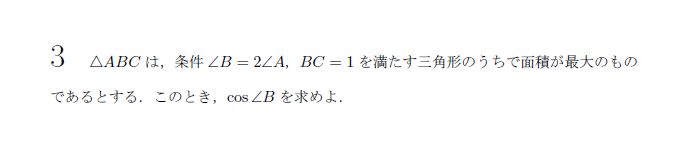
- $\angle A = \theta$ とおき、正弦定理を用いて三角形の辺の長さを $\theta$ で表すことで、面積 $S$ を $\theta$ の関数として立式する。
- その後、微分を用いて最大値を求めるか、$\cos\angle B = \cos2\theta = x$ と置換して代数関数の最大値問題に帰着させる。
- 三角形の内角の和が $\pi$ であることや各内角が正であることから、$\theta$ の定義域を忘れずに確認する。
解法1(三角関数のまま微分)
$\angle A = \theta$ とおく。$\angle B = 2\theta$、$\angle C = \pi - 3\theta$ であり、すべての内角が正であることから、
$$ 0 < \theta < \frac{\pi}{3} \quad \cdots \textcircled{1} $$
正弦定理より $\dfrac{BC}{\sin A} = \dfrac{AC}{\sin B}$、$BC = 1$ を代入して
$$ AC = \frac{\sin 2\theta}{\sin\theta} = 2\cos\theta $$
三角形の面積は
$$ S = \frac{1}{2} \cdot BC \cdot AC \cdot \sin C = \frac{1}{2} \cdot 1 \cdot 2\cos\theta \cdot \sin(\pi - 3\theta) = \cos\theta\sin3\theta $$
積和の公式より
$$ S = \frac{1}{2}(\sin 4\theta + \sin 2\theta) $$
微分すると、
$$ \frac{dS}{d\theta} = \frac{1}{2}(4\cos4\theta + 2\cos2\theta) = 2\cos4\theta + \cos2\theta $$
$\cos4\theta = 2\cos^2 2\theta - 1$ を代入して、
$$ \frac{dS}{d\theta} = 4\cos^2 2\theta + \cos 2\theta - 2 $$
$\dfrac{dS}{d\theta} = 0$ となる $\cos2\theta$ の値を $x = \cos2\theta$ として求めると、
$$ 4x^2 + x - 2 = 0 \implies x = \frac{-1 \pm \sqrt{33}}{8} $$
$\textcircled{1}$ より $0 < 2\theta < \dfrac{2\pi}{3}$ であるから $-\dfrac{1}{2} < \cos2\theta < 1$。
$5 < \sqrt{33} < 6$ より $\dfrac{-1-\sqrt{33}}{8} < -\dfrac{3}{4} < -\dfrac{1}{2}$ となり範囲外。一方 $\dfrac{-1+\sqrt{33}}{8} \in \left(\dfrac{1}{2}, \dfrac{5}{8}\right)$ は範囲内。
$\cos2\theta = \dfrac{\sqrt{33}-1}{8}$ の前後で $\dfrac{dS}{d\theta}$ の符号は正から負へ変化するため、ここで $S$ は最大となる。
$$ \cos\angle B = \frac{\sqrt{33}-1}{8} $$
解法2($x = \cos\angle B$ への置換)
正弦定理より $AB = \dfrac{\sin 3\theta}{\sin\theta} = 3 - 4\sin^2\theta$。
面積は
$$ S = \frac{1}{2} \cdot BC \cdot AB \cdot \sin B = \frac{1}{2}(3 - 4\sin^2\theta)\sin2\theta $$
$x = \cos2\theta$ とおくと、$\sin^2\theta = \dfrac{1-x}{2}$、$\sin2\theta = \sqrt{1-x^2} > 0$ であるから、
$$ S = \frac{1}{2}(1 + 2x)\sqrt{1-x^2} $$
$S > 0$ のもとで $S^2 = f(x)$ の最大値を考える。
$$ f(x) = \frac{1}{4}(1+2x)^2(1-x^2) $$
$$ f'(x) = \frac{1}{2}(1+2x)(-4x^2 - x + 2) $$
$-\dfrac{1}{2} < x < 1$ において $1+2x > 0$ であるから、$f'(x) = 0$ は
$$ 4x^2 + x - 2 = 0 \implies x = \frac{-1 \pm \sqrt{33}}{8} $$
範囲内にあるのは $x = \dfrac{\sqrt{33}-1}{8}$ のみであり、この前後で $f'(x)$ の符号は正から負へ変化するため $S$ は最大となる。
$$ \cos\angle B = \frac{\sqrt{33}-1}{8} $$
解説
三角形の内角や辺の条件から面積の最大値を求める問題である。内角を 1 つの変数で表し正弦定理を用いるのが自然なアプローチとなる。
解法2のように $\cos\angle B = x$ と置換して代数関数に帰着させると、「$S > 0$ のもとで $S^2$ の最大を考える」という工夫で根号の微分を避けられ、計算ミスを減らすことができる。
いずれの解法においても、三角形が成立する条件から角度の定義域を確認することが重要である。
答え
$$ \cos\angle B = \frac{\sqrt{33}-1}{8} $$
この問題の前に見る基礎問題






類題
自分の記録
誤りを報告
解説の誤り、誤字、表示崩れに気づいた場合は送信してください。ログイン不要です。