京都大学 2023年 理系 第6問 解説
方針・初手
- (1) 2倍角の公式と加法定理(または3倍角の公式)を用いて展開し、$\sin$ を消去して $\cos$ のみの式にする。
- (2) (1)の結果から、$\cos n\theta$ は $\cos\theta$ の $n$ 次多項式になることが推測できる。$\theta = \frac{m}{n}\pi$ と仮定して背理法を用いる。「$\cos n\theta$ の最高次の項の係数」に着目し、素数 $p$ の倍数に関する矛盾を導く。
解法1
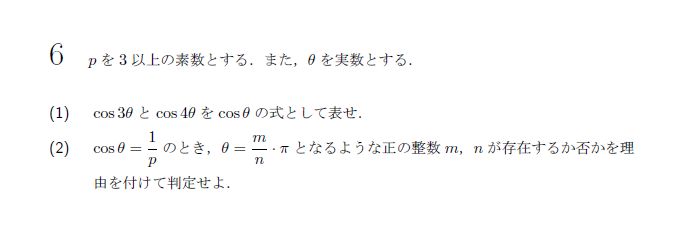
(1)
加法定理と2倍角の公式を用いる。
$$ \cos 3\theta = \cos(2\theta + \theta) = \cos 2\theta \cos \theta - \sin 2\theta \sin \theta $$
ここで、$\cos 2\theta = 2\cos^2 \theta - 1$、$\sin 2\theta = 2\sin \theta \cos \theta$ であるから、
$$ \cos 3\theta = (2\cos^2 \theta - 1)\cos \theta - (2\sin \theta \cos \theta)\sin \theta $$
$$ = 2\cos^3 \theta - \cos \theta - 2\sin^2 \theta \cos \theta $$
$\sin^2 \theta = 1 - \cos^2 \theta$ を代入して、
$$ \cos 3\theta = 2\cos^3 \theta - \cos \theta - 2(1 - \cos^2 \theta)\cos \theta $$
$$ = 2\cos^3 \theta - \cos \theta - 2\cos \theta + 2\cos^3 \theta $$
$$ = 4\cos^3 \theta - 3\cos \theta $$
次に、$\cos 4\theta$ を求める。$\cos 4\theta = \cos 2(2\theta)$ とみて2倍角の公式を用いる。
$$ \cos 4\theta = 2\cos^2 2\theta - 1 $$
$$ = 2(2\cos^2 \theta - 1)^2 - 1 $$
$$ = 2(4\cos^4 \theta - 4\cos^2 \theta + 1) - 1 $$
$$ = 8\cos^4 \theta - 8\cos^2 \theta + 1 $$
(2)
「任意の自然数 $k$ に対して、$\cos k\theta$ は $\cos\theta$ の $k$ 次の整数係数多項式で表され、その最高次の項の係数は $2^{k-1}$ である」という性質が成り立つことを、数学的帰納法で示す。
[I] $k=1, 2$ のとき
$\cos \theta = 1 \cdot \cos\theta$ より、1次式で最高次係数は $2^0 = 1$。 $\cos 2\theta = 2\cos^2 \theta - 1$ より、2次式で最高次係数は $2^1 = 2$。 よって $k=1, 2$ のときは成り立つ。
[II] $k=i, i+1$ ($i \geqq 1$) のとき成り立つと仮定する。
すなわち、$\cos i\theta$ は最高次係数 $2^{i-1}$ の $i$ 次多項式、$\cos(i+1)\theta$ は最高次係数 $2^i$ の $(i+1)$ 次多項式で、ともに整数係数であるとする。 加法定理より、
$$ \cos(i+2)\theta = \cos((i+1)\theta + \theta) = \cos(i+1)\theta \cos\theta - \sin(i+1)\theta \sin\theta $$
$$ \cos i\theta = \cos((i+1)\theta - \theta) = \cos(i+1)\theta \cos\theta + \sin(i+1)\theta \sin\theta $$
この2式を辺々加えると、
$$ \cos(i+2)\theta + \cos i\theta = 2\cos(i+1)\theta \cos\theta $$
$$ \cos(i+2)\theta = 2\cos\theta \cos(i+1)\theta - \cos i\theta $$
仮定より、$\cos(i+1)\theta$ は最高次係数 $2^i$ の $(i+1)$ 次多項式であるから、$2\cos\theta \cos(i+1)\theta$ は最高次係数 $2 \cdot 2^i = 2^{i+1}$ の $(i+2)$ 次多項式となる。また $\cos i\theta$ は $i$ 次多項式である。 よって、これらの差である $\cos(i+2)\theta$ は最高次係数 $2^{i+1}$ の $(i+2)$ 次多項式となり、係数はすべて整数となる。ゆえに $k=i+2$ のときも成り立つ。
[I], [II] より、すべての自然数 $n$ について上記の性質が示された。
さて、$\cos\theta = \frac{1}{p}$ のとき、$\theta = \frac{m}{n}\pi$ となる正の整数 $m, n$ が存在すると仮定する。 $n\theta = m\pi$ より、$\cos(n\theta) = \cos(m\pi) = (-1)^m$ であるから、$\cos(n\theta)$ は $1$ または $-1$ となる。 一方、上で示した性質より、$\cos n\theta = f_n(\cos\theta)$ となる整数係数多項式 $f_n(x)$ を
$$ f_n(x) = 2^{n-1}x^n + c_{n-1}x^{n-1} + \dots + c_1x + c_0 \quad (c_i \text{ は整数}) $$
とおくことができる。これに $x = \cos\theta = \frac{1}{p}$ を代入すると、
$$ f_n\left(\frac{1}{p}\right) = \frac{2^{n-1}}{p^n} + \frac{c_{n-1}}{p^{n-1}} + \dots + \frac{c_1}{p} + c_0 $$
$$ = \frac{2^{n-1} + c_{n-1}p + \dots + c_1p^{n-1} + c_0p^n}{p^n} $$
これが $\cos(n\theta) = (-1)^m$ と等しいので、
$$ \frac{2^{n-1} + c_{n-1}p + \dots + c_0p^n}{p^n} = (-1)^m $$
分母を払い、移項して整理すると、
$$ 2^{n-1} = (-1)^m p^n - (c_{n-1}p + \dots + c_0p^n) $$
$$ 2^{n-1} = p \{ (-1)^m p^{n-1} - (c_{n-1} + \dots + c_0p^{n-1}) \} $$
括弧の中は整数であるから、右辺は $p$ の倍数である。 したがって、左辺の $2^{n-1}$ も $p$ の倍数でなければならない。 しかし、$p$ は3以上の素数であるため、2とは互いに素であり、$2^{n-1}$ が $p$ の倍数になることはない。これは矛盾である。 よって、仮定は誤りであり、条件を満たす正の整数 $m, n$ は存在しない。
解説
- (1) は(2)への誘導になっています。計算結果から「$\cos n\theta$ は $\cos\theta$ の $n$ 次式で表せる」「その最高次の係数は $2^{n-1}$ になる」という法則性を読み取ることが最大の鍵です。
- このように $\cos n\theta$ を $\cos\theta$ の多項式で表したものをチェビシェフ多項式と呼びます。(2)では、有理数が三角関数の値になる条件を問う難関大の頻出テーマであり、「漸化式 $\cos(k+2)\theta = 2\cos\theta \cos(k+1)\theta - \cos k\theta$ を用いた数学的帰納法で多項式の性質を証明し、背理法で素数の倍数に関する矛盾を突く」という一連の鮮やかな論証構造が求められます。
答え
(1)
$\cos 3\theta = 4\cos^3 \theta - 3\cos \theta$
$\cos 4\theta = 8\cos^4 \theta - 8\cos^2 \theta + 1$
(2)
存在しない
この問題の前に見る基礎問題






類題
自分の記録
誤りを報告
解説の誤り、誤字、表示崩れに気づいた場合は送信してください。ログイン不要です。