九州大学 1996年 理系 第1問 解説
方針・初手
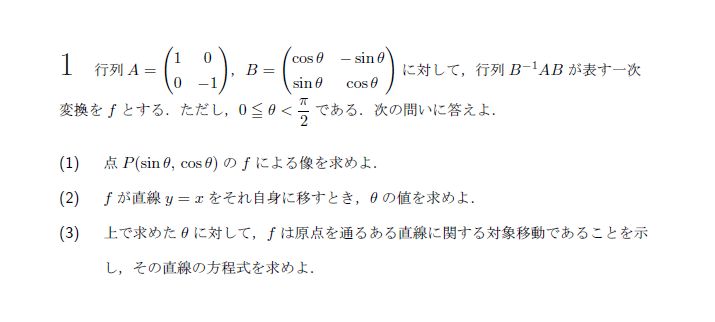
一次変換 $f$ の表現行列を $C$ とおく。$C = B^{-1}AB$ であるから、直接行列の積を計算して成分を求め、代数的に処理する方針が基本となる。
また、$B$ が原点周りの回転移動、$A$ が $x$ 軸に関する対称移動を表すことに着目し、変換の合成として幾何学的な意味を捉えることも有効である。ここでは、行列の成分計算による解法(解法1)と、図形的性質を利用した解法(解法2)を示す。
解法1
$f$ の表現行列を $C$ とする。
$$A = \begin{pmatrix} 1 & 0 \\ 0 & -1 \end{pmatrix}, \quad B = \begin{pmatrix} \cos\theta & -\sin\theta \\ \sin\theta & \cos\theta \end{pmatrix}$$
行列 $B$ の逆行列は
$$B^{-1} = \begin{pmatrix} \cos\theta & \sin\theta \\ -\sin\theta & \cos\theta \end{pmatrix}$$
これより、$C = B^{-1}AB$ を計算する。
$$AB = \begin{pmatrix} 1 & 0 \\ 0 & -1 \end{pmatrix} \begin{pmatrix} \cos\theta & -\sin\theta \\ \sin\theta & \cos\theta \end{pmatrix} = \begin{pmatrix} \cos\theta & -\sin\theta \\ -\sin\theta & -\cos\theta \end{pmatrix}$$
よって
$$C = \begin{pmatrix} \cos\theta & \sin\theta \\ -\sin\theta & \cos\theta \end{pmatrix} \begin{pmatrix} \cos\theta & -\sin\theta \\ -\sin\theta & -\cos\theta \end{pmatrix}$$
$$= \begin{pmatrix} \cos^2\theta - \sin^2\theta & -\sin\theta\cos\theta - \sin\theta\cos\theta \\ -\sin\theta\cos\theta - \sin\theta\cos\theta & \sin^2\theta - \cos^2\theta \end{pmatrix}$$
$$= \begin{pmatrix} \cos 2\theta & -\sin 2\theta \\ -\sin 2\theta & -\cos 2\theta \end{pmatrix}$$
(1)
点 $P(\sin\theta, \cos\theta)$ の位置ベクトルを $\vec{p}$ とすると、その像 $f(P)$ の位置ベクトルは
$$C \vec{p} = \begin{pmatrix} \cos 2\theta & -\sin 2\theta \\ -\sin 2\theta & -\cos 2\theta \end{pmatrix} \begin{pmatrix} \sin\theta \\ \cos\theta \end{pmatrix}$$
$$= \begin{pmatrix} \sin\theta\cos 2\theta - \cos\theta\sin 2\theta \\ -\sin\theta\sin 2\theta - \cos\theta\cos 2\theta \end{pmatrix}$$
加法定理を用いて整理すると
$$\sin\theta\cos 2\theta - \cos\theta\sin 2\theta = \sin(\theta - 2\theta) = \sin(-\theta) = -\sin\theta$$
$$-\sin\theta\sin 2\theta - \cos\theta\cos 2\theta = -(\cos 2\theta\cos\theta + \sin 2\theta\sin\theta) = -\cos(2\theta - \theta) = -\cos\theta$$
よって、像の座標は $(-\sin\theta, -\cos\theta)$ である。
(2)
直線 $y = x$ 上の任意の点を $(t, t)$ ($t$ は実数) とおく。この点の $f$ による像 $(X, Y)$ は
$$\begin{pmatrix} X \\ Y \end{pmatrix} = \begin{pmatrix} \cos 2\theta & -\sin 2\theta \\ -\sin 2\theta & -\cos 2\theta \end{pmatrix} \begin{pmatrix} t \\ t \end{pmatrix} = \begin{pmatrix} t(\cos 2\theta - \sin 2\theta) \\ t(-\sin 2\theta - \cos 2\theta) \end{pmatrix}$$
$f$ が直線 $y = x$ をそれ自身に移す条件は、任意の $t$ に対して、像 $(X, Y)$ も直線 $y = x$ 上にあること、すなわち $X = Y$ が常に成り立つことである。
$$t(\cos 2\theta - \sin 2\theta) = t(-\sin 2\theta - \cos 2\theta)$$
これがすべての $t$ について成り立つための条件は
$$\cos 2\theta - \sin 2\theta = -\sin 2\theta - \cos 2\theta$$
$$2\cos 2\theta = 0$$
$$\cos 2\theta = 0$$
$0 \leqq \theta < \frac{\pi}{2}$ より $0 \leqq 2\theta < \pi$ であるから
$$2\theta = \frac{\pi}{2}$$
ゆえに
$$\theta = \frac{\pi}{4}$$
(3)
(2) より $\theta = \frac{\pi}{4}$ のとき、$2\theta = \frac{\pi}{2}$ であるから、$f$ の表現行列 $C$ は
$$C = \begin{pmatrix} \cos\frac{\pi}{2} & -\sin\frac{\pi}{2} \\ -\sin\frac{\pi}{2} & -\cos\frac{\pi}{2} \end{pmatrix} = \begin{pmatrix} 0 & -1 \\ -1 & 0 \end{pmatrix}$$
点 $Q(x, y)$ が $f$ によって点 $Q'(X, Y)$ に移るとすると
$$\begin{pmatrix} X \\ Y \end{pmatrix} = \begin{pmatrix} 0 & -1 \\ -1 & 0 \end{pmatrix} \begin{pmatrix} x \\ y \end{pmatrix} = \begin{pmatrix} -y \\ -x \end{pmatrix}$$
すなわち $X = -y$, $Y = -x$ である。
点 $Q$ が直線 $y = -x$ 上にない(すなわち $y \neq -x$ の)とき、線分 $QQ'$ の中点を $M$ とすると、その座標は
$$\left( \frac{x - y}{2}, \frac{y - x}{2} \right)$$
この点の $x$ 座標と $y$ 座標の和は $0$ となるため、中点 $M$ は直線 $y = -x$ 上にある。
また、直線 $QQ'$ の傾きは
$$\frac{Y - y}{X - x} = \frac{-x - y}{-y - x} = \frac{-(x + y)}{-(x + y)} = 1$$
直線 $y = -x$ の傾きは $-1$ であるから、直線 $QQ'$ は直線 $y = -x$ と直交する。
なお、点 $Q$ が直線 $y = -x$ 上にあるとき、$y = -x$ より $X = x$, $Y = -x = y$ となり、点 $Q$ は自身に移る。
以上より、$f$ は原点を通る直線 $y = -x$ に関する対称移動である。
解法2
幾何学的性質を利用して解く。
(1)
点 $P(\sin\theta, \cos\theta)$ の位置ベクトルを $\vec{p}$ とする。 $f$ は行列 $B^{-1}AB$ による変換であるから、$f$ による像の位置ベクトルは $B^{-1}AB\vec{p}$ となる。行列の積を順に計算する。
$$B\vec{p} = \begin{pmatrix} \cos\theta & -\sin\theta \\ \sin\theta & \cos\theta \end{pmatrix} \begin{pmatrix} \sin\theta \\ \cos\theta \end{pmatrix} = \begin{pmatrix} \sin\theta\cos\theta - \cos\theta\sin\theta \\ \sin^2\theta + \cos^2\theta \end{pmatrix} = \begin{pmatrix} 0 \\ 1 \end{pmatrix}$$
次に $A$ を掛ける。
$$AB\vec{p} = \begin{pmatrix} 1 & 0 \\ 0 & -1 \end{pmatrix} \begin{pmatrix} 0 \\ 1 \end{pmatrix} = \begin{pmatrix} 0 \\ -1 \end{pmatrix}$$
最後に $B^{-1}$ を掛ける。
$$B^{-1}AB\vec{p} = \begin{pmatrix} \cos\theta & \sin\theta \\ -\sin\theta & \cos\theta \end{pmatrix} \begin{pmatrix} 0 \\ -1 \end{pmatrix} = \begin{pmatrix} -\sin\theta \\ -\cos\theta \end{pmatrix}$$
よって、像の座標は $(-\sin\theta, -\cos\theta)$ である。
(2)
行列 $B$ は原点中心、角 $\theta$ の回転移動を表す。行列 $A$ は $x$ 軸に関する対称移動を表す。行列 $B^{-1}$ は角 $-\theta$ の回転移動を表す。 したがって、$f$ (表現行列 $B^{-1}AB$)は「角 $\theta$ 回転移動したのち、$x$ 軸に関して対称移動し、角 $-\theta$ 回転移動して戻す」変換である。
これは見方を変えると、$x$ 軸を角 $-\theta$ 回転移動させた直線、すなわち原点を通り傾き $\tan(-\theta) = -\tan\theta$ の直線 $m : y = -(\tan\theta)x$ に関する対称移動を表す。
$f$ が直線 $l: y = x$ をそれ自身に移すのは、次のいずれかの場合である。 (i) 対称軸 $m$ が $l$ と一致するとき (ii) 対称軸 $m$ が $l$ と直交するとき
ここで、対称軸 $m$ の傾きは $-\tan\theta$ であり、$0 \leqq \theta < \frac{\pi}{2}$ より $-\tan\theta \leqq 0$ である。 直線 $l$ の傾きは $1$(正)であるから、$m$ が $l$ と一致することはない。 したがって、$m$ は $l$ と直交する。
よって $(-\tan\theta) \cdot 1 = -1$ より $\tan\theta = 1$ となる。 $0 \leqq \theta < \frac{\pi}{2}$ より $\theta = \frac{\pi}{4}$ である。
(3)
(2) の考察において、$f$ は直線 $y = -(\tan\theta)x$ に関する対称移動であることが分かっている。
$\theta = \frac{\pi}{4}$ のとき、 $\tan\theta = 1$ であるから、$f$ は原点を通る直線 $y = -x$ に関する対称移動である。
解説
行列の積で表される一次変換の図形的な意味を問う問題である。 解法1のように成分計算を押し切ることもできるが、計算ミスを防ぐためにも、加法定理などを正確に適用する力が求められる。 解法2のように、特定の行列がどのような基本変換(回転、対称移動など)を表すかを把握していると、見通しよく解くことができる。特に「$B^{-1}AB$」という形は、基底の取り換えや座標系の回転を表す際によく現れる重要な形式である。
答え
(1) $(-\sin\theta, -\cos\theta)$
(2) $\theta = \frac{\pi}{4}$
(3) $f$ は直線 $y = -x$ に関する対称移動である。(証明は解答参照)
この問題の前に見る基礎問題



類題
自分の記録
誤りを報告
解説の誤り、誤字、表示崩れに気づいた場合は送信してください。ログイン不要です。