名古屋大学 2019年 理系 第2問 解説
方針・初手
空間ベクトルを、平面 $\text{P}$ に平行なベクトルと垂直なベクトルに分解して考えるか、あるいは適切な空間座標を設定することで見通しよく処理できる。 解法1では、ベクトルの分解と内積の性質を用いて幾何的に証明を進める。 解法2では、点 $\text{A}$ を原点、平面 $\text{P}$ を $xy$ 平面とする座標系を設定し、成分計算に持ち込む。 (3) では、(2) の結果から $\triangle\text{AB}'\text{C}'$ が鈍角三角形であることを用い、辺の長さの対応関係を確定させることが鍵となる。
解法1
(1)
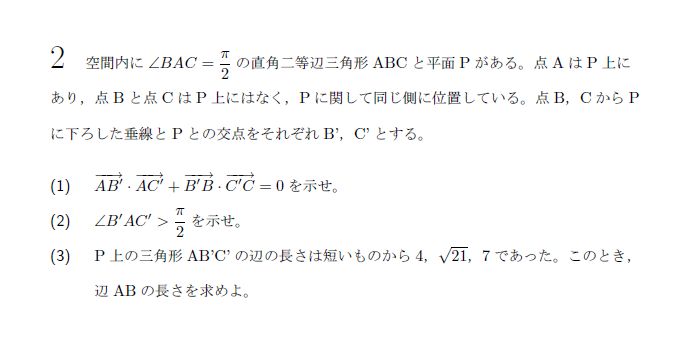
点 $\text{B}, \text{C}$ から平面 $\text{P}$ に下ろした垂線の足が $\text{B}', \text{C}'$ であるため、$\overrightarrow{\text{B}'\text{B}}$ および $\overrightarrow{\text{C}'\text{C}}$ は平面 $\text{P}$ に垂直なベクトルである。 一方、点 $\text{A}, \text{B}', \text{C}'$ はすべて平面 $\text{P}$ 上にあるため、$\overrightarrow{\text{AB}'}$ および $\overrightarrow{\text{AC}'}$ は平面 $\text{P}$ 上のベクトルである。 したがって、平面 $\text{P}$ に垂直なベクトルと平行なベクトルの内積は $0$ となることから、
$$ \overrightarrow{\text{AB}'} \cdot \overrightarrow{\text{C}'\text{C}} = 0, \quad \overrightarrow{\text{AC}'} \cdot \overrightarrow{\text{B}'\text{B}} = 0 $$
が成り立つ。
$\overrightarrow{\text{AB}} = \overrightarrow{\text{AB}'} + \overrightarrow{\text{B}'\text{B}}$、$\overrightarrow{\text{AC}} = \overrightarrow{\text{AC}'} + \overrightarrow{\text{C}'\text{C}}$ と表せるため、これらの内積を計算する。
$$ \begin{aligned} \overrightarrow{\text{AB}} \cdot \overrightarrow{\text{AC}} &= (\overrightarrow{\text{AB}'} + \overrightarrow{\text{B}'\text{B}}) \cdot (\overrightarrow{\text{AC}'} + \overrightarrow{\text{C}'\text{C}}) \\ &= \overrightarrow{\text{AB}'} \cdot \overrightarrow{\text{AC}'} + \overrightarrow{\text{AB}'} \cdot \overrightarrow{\text{C}'\text{C}} + \overrightarrow{\text{B}'\text{B}} \cdot \overrightarrow{\text{AC}'} + \overrightarrow{\text{B}'\text{B}} \cdot \overrightarrow{\text{C}'\text{C}} \\ &= \overrightarrow{\text{AB}'} \cdot \overrightarrow{\text{AC}'} + 0 + 0 + \overrightarrow{\text{B}'\text{B}} \cdot \overrightarrow{\text{C}'\text{C}} \\ &= \overrightarrow{\text{AB}'} \cdot \overrightarrow{\text{AC}'} + \overrightarrow{\text{B}'\text{B}} \cdot \overrightarrow{\text{C}'\text{C}} \end{aligned} $$
ここで、条件より $\angle\text{BAC} = \frac{\pi}{2}$ であるから、$\overrightarrow{\text{AB}} \cdot \overrightarrow{\text{AC}} = 0$ である。 ゆえに、
$$ \overrightarrow{\text{AB}'} \cdot \overrightarrow{\text{AC}'} + \overrightarrow{\text{B}'\text{B}} \cdot \overrightarrow{\text{C}'\text{C}} = 0 $$
が示された。
(2)
(1) の結果より、
$$ \overrightarrow{\text{AB}'} \cdot \overrightarrow{\text{AC}'} = - \overrightarrow{\text{B}'\text{B}} \cdot \overrightarrow{\text{C}'\text{C}} $$
ここで、点 $\text{B}$ と点 $\text{C}$ は平面 $\text{P}$ 上になく、$\text{P}$ に関して同じ側にある。 したがって、垂線ベクトル $\overrightarrow{\text{B}'\text{B}}$ と $\overrightarrow{\text{C}'\text{C}}$ は同じ向きを向く零でないベクトルである。 ゆえに、その内積は正となる。
$$ \overrightarrow{\text{B}'\text{B}} \cdot \overrightarrow{\text{C}'\text{C}} = |\overrightarrow{\text{B}'\text{B}}| |\overrightarrow{\text{C}'\text{C}}| > 0 $$
これより、
$$ \overrightarrow{\text{AB}'} \cdot \overrightarrow{\text{AC}'} < 0 $$
である。
もし $\overrightarrow{\text{AB}'} = \vec{0}$ または $\overrightarrow{\text{AC}'} = \vec{0}$ であれば、内積は $0$ となり上式に矛盾するため、$\overrightarrow{\text{AB}'} \neq \vec{0}$ かつ $\overrightarrow{\text{AC}'} \neq \vec{0}$ である。 よって、
$$ \cos \angle\text{B}'\text{AC}' = \frac{\overrightarrow{\text{AB}'} \cdot \overrightarrow{\text{AC}'}}{|\overrightarrow{\text{AB}'}| |\overrightarrow{\text{AC}'}|} < 0 $$
$0 < \angle\text{B}'\text{AC}' < \pi$ であるから、$\angle\text{B}'\text{AC}' > \frac{\pi}{2}$ が示された。
(3)
(2) より $\angle\text{B}'\text{AC}' > \frac{\pi}{2}$ であるから、$\triangle\text{AB}'\text{C}'$ は鈍角三角形であり、最大の角は $\angle\text{B}'\text{AC}'$ である。 三角形において最大角の対辺が最長となるため、最大辺は $\text{B}'\text{C}'$ である。 与えられた辺の長さ $4, \sqrt{21}, 7$ のうち、最大のものは $7$ であるため、
$$ \text{B}'\text{C}' = 7 $$
と確定する。 残る2辺 $\text{AB}', \text{AC}'$ の長さは $4, \sqrt{21}$ のいずれかである。すなわち、
$$ |\overrightarrow{\text{AB}'}|^2 + |\overrightarrow{\text{AC}'}|^2 = 4^2 + (\sqrt{21})^2 = 16 + 21 = 37 $$
が成り立つ。
$\triangle\text{AB}'\text{C}'$ においてベクトルの長さの平方を計算すると、
$$ \begin{aligned} |\overrightarrow{\text{B}'\text{C}'}|^2 &= |\overrightarrow{\text{AC}'} - \overrightarrow{\text{AB}'}|^2 \\ &= |\overrightarrow{\text{AC}'}|^2 - 2\overrightarrow{\text{AB}'} \cdot \overrightarrow{\text{AC}'} + |\overrightarrow{\text{AB}'}|^2 \\ &= (|\overrightarrow{\text{AB}'}|^2 + |\overrightarrow{\text{AC}'}|^2) - 2\overrightarrow{\text{AB}'} \cdot \overrightarrow{\text{AC}'} \end{aligned} $$
これに $|\overrightarrow{\text{B}'\text{C}'}| = 7$ と和の値を代入して、
$$ 49 = 37 - 2\overrightarrow{\text{AB}'} \cdot \overrightarrow{\text{AC}'} $$
$$ 2\overrightarrow{\text{AB}'} \cdot \overrightarrow{\text{AC}'} = -12 \implies \overrightarrow{\text{AB}'} \cdot \overrightarrow{\text{AC}'} = -6 $$
これと (1) の結果から、
$$ \overrightarrow{\text{B}'\text{B}} \cdot \overrightarrow{\text{C}'\text{C}} = 6 $$
ここで、直角二等辺三角形 $\text{ABC}$ の等しい辺の長さを $\text{AB} = \text{AC} = l \ (l > 0)$ とおく。 $\triangle\text{ABB}'$ および $\triangle\text{ACC}'$ は直角三角形であるから、三平方の定理より
$$ |\overrightarrow{\text{B}'\text{B}}|^2 = l^2 - |\overrightarrow{\text{AB}'}|^2, \quad |\overrightarrow{\text{C}'\text{C}}|^2 = l^2 - |\overrightarrow{\text{AC}'}|^2 $$
$\overrightarrow{\text{B}'\text{B}}$ と $\overrightarrow{\text{C}'\text{C}}$ は同じ向きのベクトルであるため、
$$ \overrightarrow{\text{B}'\text{B}} \cdot \overrightarrow{\text{C}'\text{C}} = |\overrightarrow{\text{B}'\text{B}}| |\overrightarrow{\text{C}'\text{C}}| = 6 $$
両辺を2乗して、
$$ |\overrightarrow{\text{B}'\text{B}}|^2 |\overrightarrow{\text{C}'\text{C}}|^2 = 36 $$
これに先ほどの式を代入して、
$$ (l^2 - |\overrightarrow{\text{AB}'}|^2)(l^2 - |\overrightarrow{\text{AC}'}|^2) = 36 $$
展開すると、
$$ l^4 - (|\overrightarrow{\text{AB}'}|^2 + |\overrightarrow{\text{AC}'}|^2)l^2 + |\overrightarrow{\text{AB}'}|^2 |\overrightarrow{\text{AC}'}|^2 = 36 $$
ここで、和は $37$ であり、積は $16 \times 21 = 336$ であるから、
$$ l^4 - 37l^2 + 336 = 36 $$
$$ l^4 - 37l^2 + 300 = 0 $$
$$ (l^2 - 12)(l^2 - 25) = 0 $$
よって、$l^2 = 12$ または $l^2 = 25$ である。
また、点 $\text{B, C}$ は平面 $\text{P}$ 上にないため、$\text{BB}' > 0$ かつ $\text{CC}' > 0$ である。 したがって、$l^2 > |\overrightarrow{\text{AB}'}|^2$ かつ $l^2 > |\overrightarrow{\text{AC}'}|^2$ が成り立たなければならない。 $|\overrightarrow{\text{AB}'}|^2$ と $|\overrightarrow{\text{AC}'}|^2$ は $16$ と $21$ であるため、
$$ l^2 > 21 $$
を満たす必要がある。 これより $l^2 = 12$ は不適であり、$l^2 = 25$ が適する。 $l > 0$ より $l = 5$ となる。
解法2
(1), (2) の別解:座標を設定する方法
点 $\text{A}$ を原点 $(0,0,0)$ にとり、平面 $\text{P}$ を $xy$ 平面(方程式 $z=0$)に設定する。 点 $\text{B}, \text{C}$ は $\text{P}$ 上になく、$\text{P}$ に関して同じ側にあるため、その $z$ 座標を $z_1, z_2$ とするとこれらは同符号である。 対称性から、両方とも正($z_1 > 0, z_2 > 0$)としても一般性を失わない。 点 $\text{B}(x_1, y_1, z_1)$、$\text{C}(x_2, y_2, z_2)$ とおく。 点 $\text{B}', \text{C}'$ はそれぞれ点 $\text{B}, \text{C}$ から $xy$ 平面に下ろした垂線の足であるから、 $\text{B}'(x_1, y_1, 0)$、$\text{C}'(x_2, y_2, 0)$ と表せる。
各ベクトルを成分表示すると、
$$ \overrightarrow{\text{AB}} = (x_1, y_1, z_1), \quad \overrightarrow{\text{AC}} = (x_2, y_2, z_2) $$
$$ \overrightarrow{\text{AB}'} = (x_1, y_1, 0), \quad \overrightarrow{\text{AC}'} = (x_2, y_2, 0) $$
$$ \overrightarrow{\text{B}'\text{B}} = (0, 0, z_1), \quad \overrightarrow{\text{C}'\text{C}} = (0, 0, z_2) $$
(1) の証明
$\angle\text{BAC} = \frac{\pi}{2}$ であるから、$\overrightarrow{\text{AB}} \cdot \overrightarrow{\text{AC}} = 0$。 成分で計算すると、
$$ x_1 x_2 + y_1 y_2 + z_1 z_2 = 0 \quad \cdots \text{①} $$
一方、示すべき式の各項を計算すると、
$$ \overrightarrow{\text{AB}'} \cdot \overrightarrow{\text{AC}'} = x_1 x_2 + y_1 y_2 $$
$$ \overrightarrow{\text{B}'\text{B}} \cdot \overrightarrow{\text{C}'\text{C}} = z_1 z_2 $$
これらを足し合わせると、
$$ \overrightarrow{\text{AB}'} \cdot \overrightarrow{\text{AC}'} + \overrightarrow{\text{B}'\text{B}} \cdot \overrightarrow{\text{C}'\text{C}} = x_1 x_2 + y_1 y_2 + z_1 z_2 $$
①よりこれは $0$ に等しいため、題意は示された。
(2) の証明
上記より、
$$ \overrightarrow{\text{AB}'} \cdot \overrightarrow{\text{AC}'} = - z_1 z_2 $$
ここで $z_1 > 0, z_2 > 0$ であるから、$z_1 z_2 > 0$ である。 したがって、
$$ \overrightarrow{\text{AB}'} \cdot \overrightarrow{\text{AC}'} < 0 $$
が成り立つ。 (1) の解法と同様に、内積が負であることから $\cos \angle\text{B}'\text{AC}' < 0$ となり、$\angle\text{B}'\text{AC}' > \frac{\pi}{2}$ が示される。
(3) の解法は解法1と同様なので省略する。
解説
空間図形において、平面への正射影を考える問題の典型的な解法を問う問題である。 空間ベクトルを「平面上の成分」と「法線方向の成分」に直交分解するという基本的なアプローチをしっかり取れるかがカギとなる。(1) はこの分解を式で追うだけで自然に導かれる。 (3) は「辺の長さ」の割り当てが問題となるが、(2) で求めた「鈍角」という幾何的性質から、迷うことなく最大辺を確定させることができるように誘導されている。 最後に、辺の長さを求める際に出てくる $l^2 = 12$ という解を、図形の成立条件(斜辺は他の辺より長い)から適切に除外できるかが最後の関門となる。
答え
(1)
$$ \overrightarrow{\text{AB}'} \cdot \overrightarrow{\text{AC}'} + \overrightarrow{\text{B}'\text{B}} \cdot \overrightarrow{\text{C}'\text{C}} = 0 $$
(2)
$$ \angle\text{B}'\text{A}\text{C}' > \frac{\pi}{2} $$
(3)
$5$
この問題の前に見る基礎問題


類題
自分の記録
誤りを報告
解説の誤り、誤字、表示崩れに気づいた場合は送信してください。ログイン不要です。