大阪大学 1997年 理系 第5問 解説
方針・初手
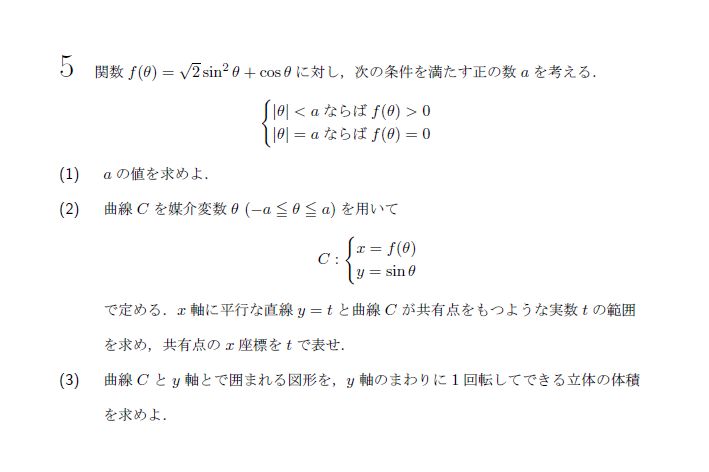
(1) では、まず $f(\theta) = 0$ という方程式を解き、関数 $f(\theta)$ の符号が切り替わる $\theta$ の境界を求める。三角関数の種類を $\cos \theta$ に統一することで、因数分解により解を導くことができる。
(2) では、$y = \sin \theta = t$ とおき、与えられた定義域 $-a \leqq \theta \leqq a$ のもとで $\theta$ と $t$ の対応関係を調べる。$\cos \theta$ を $\pm \sqrt{1 - t^2}$ の形で表す際、$\theta$ の値域によって符号が変化することに注意して場合分けを行う。
(3) では、(2) で求めた $x$ と $y$ の関係から図形の概形を把握し、回転体の体積を定積分で立式する。$y$ の式として体積を立式した後、媒介変数 $\theta$ を用いた置換積分に持ち込む(あるいは最初から $\theta$ の積分として立式する)と計算がスムーズに進む。
解法1
(1)
$f(\theta)$ の $\sin^2 \theta$ を $1 - \cos^2 \theta$ に書き換えると、次のように変形できる。
$$ f(\theta) = \sqrt{2} (1 - \cos^2 \theta) + \cos \theta = -\sqrt{2} \cos^2 \theta + \cos \theta + \sqrt{2} $$
$f(\theta) = 0$ とおくと、$-\sqrt{2} \cos^2 \theta + \cos \theta + \sqrt{2} = 0$ すなわち $\sqrt{2} \cos^2 \theta - \cos \theta - \sqrt{2} = 0$ となる。これを因数分解すると以下のようになる。
$$ (\sqrt{2} \cos \theta + 1)(\cos \theta - \sqrt{2}) = 0 $$
$-1 \leqq \cos \theta \leqq 1$ であるから、$\cos \theta - \sqrt{2} < 0$ は常に成り立つ。したがって、$f(\theta) = 0$ となる条件は以下の通りである。
$$ \cos \theta = -\frac{1}{\sqrt{2}} $$
また、$f(\theta)$ の符号について考えると、$f(\theta) = -\sqrt{2} (\sqrt{2} \cos \theta + 1)(\cos \theta - \sqrt{2})$ であり、$- \sqrt{2} (\cos \theta - \sqrt{2}) > 0$ であるため、$f(\theta)$ の符号は $\sqrt{2} \cos \theta + 1$ の符号と一致する。すなわち、
$$ \cos \theta > -\frac{1}{\sqrt{2}} \text{ のとき } f(\theta) > 0 $$
$$ \cos \theta = -\frac{1}{\sqrt{2}} \text{ のとき } f(\theta) = 0 $$
条件より、$|\theta| < a$ のとき $f(\theta) > 0$、$|\theta| = a$ のとき $f(\theta) = 0$ となる正の数 $a$ を求める。$\cos \theta = -\frac{1}{\sqrt{2}}$ を満たす $\theta$ のうち、原点に最も近い正の数は $\frac{3}{4}\pi$ である。
区間 $-\frac{3}{4}\pi < \theta < \frac{3}{4}\pi$ においては常に $\cos \theta > -\frac{1}{\sqrt{2}}$ であり $f(\theta) > 0$ を満たす。よって、条件を満たす正の数 $a$ は $a = \frac{3}{4}\pi$ である。
(2)
(1) より、曲線 $C$ は $\theta$ が $-\frac{3}{4}\pi \leqq \theta \leqq \frac{3}{4}\pi$ の範囲を動くときの $(x, y) = (f(\theta), \sin \theta)$ の軌跡である。
$y = t$ とすると $t = \sin \theta$ となる。$\theta$ の定義域 $-\frac{3}{4}\pi \leqq \theta \leqq \frac{3}{4}\pi$ において $\sin \theta$ のとりうる値の範囲は $-1 \leqq \sin \theta \leqq 1$ であるから、$t$ の範囲は以下のようになる。
$$ -1 \leqq t \leqq 1 $$
このとき、$x$ 座標は $x = \sqrt{2} \sin^2 \theta + \cos \theta = \sqrt{2} t^2 + \cos \theta$ と表される。$\sin \theta = t$ より $\cos^2 \theta = 1 - t^2$ であるが、$-\frac{3}{4}\pi \leqq \theta \leqq \frac{3}{4}\pi$ における $\cos \theta$ の符号は $\theta$ の範囲によって以下のように場合分けされる。
(i)
$-\frac{1}{\sqrt{2}} < t < \frac{1}{\sqrt{2}}$ のとき
この $t$ に対応する $\theta$ は区間 $\left(-\frac{\pi}{4}, \frac{\pi}{4}\right)$ にただ1つ存在する。このとき $\cos \theta > 0$ であるから、$\cos \theta = \sqrt{1 - t^2}$ となる。よって、共有点の $x$ 座標は1つであり、以下の式で表される。
$$ x = \sqrt{2} t^2 + \sqrt{1 - t^2} $$
(ii)
$-1 \leqq t \leqq -\frac{1}{\sqrt{2}}$ または $\frac{1}{\sqrt{2}} \leqq t \leqq 1$ のとき
この $t$ に対応する $\theta$ は、$\cos \theta \geqq 0$ となる区間 $\left[-\frac{\pi}{2}, -\frac{\pi}{4}\right] \cup \left[\frac{\pi}{4}, \frac{\pi}{2}\right]$ に1つ、$\cos \theta \leqq 0$ となる区間 $\left[-\frac{3}{4}\pi, -\frac{\pi}{2}\right] \cup \left[\frac{\pi}{2}, \frac{3}{4}\pi\right]$ に1つの、合計2つ存在する。($t = \pm 1$ のときは $\theta = \pm \frac{\pi}{2}$ の重解となる) したがって $\cos \theta = \pm \sqrt{1 - t^2}$ の両方を取りうるため、共有点の $x$ 座標は以下の2つとなる。
$$ x = \sqrt{2} t^2 + \sqrt{1 - t^2}, \quad \sqrt{2} t^2 - \sqrt{1 - t^2} $$
(3)
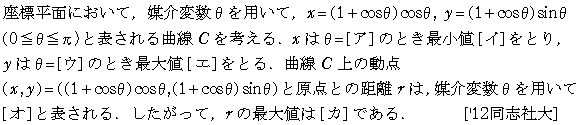
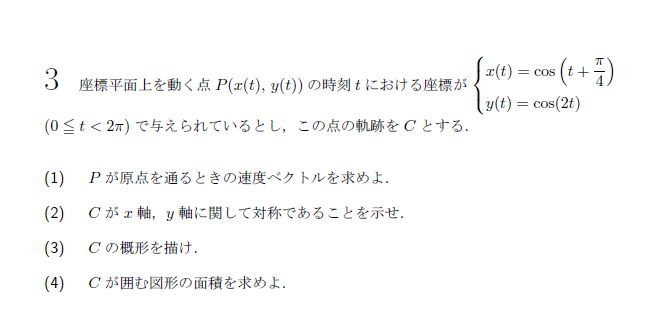
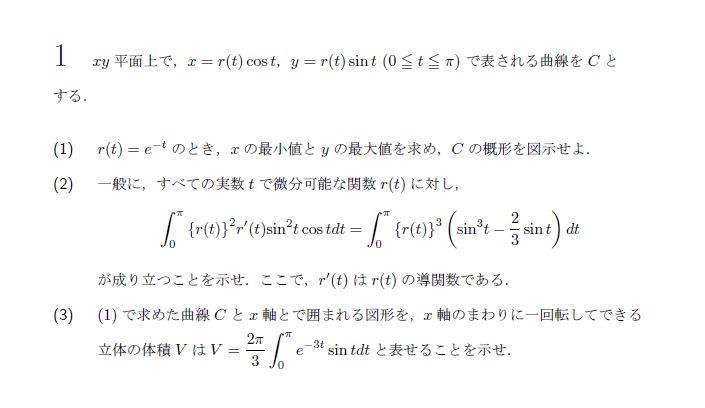
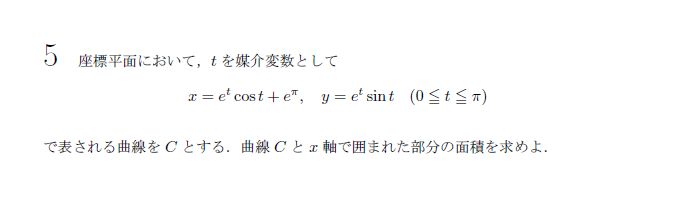
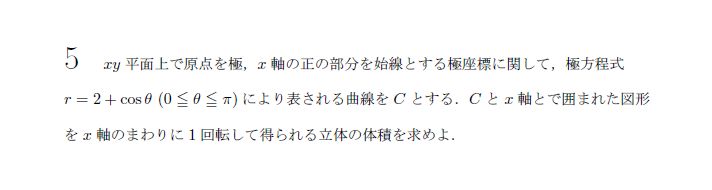
(2) の結果より、曲線 $C$ は $y$ 軸に対して右側($x \geqq 0$)に存在する閉じたループ状の図形を描く(両端点で $y$ 軸と交わる)。 求める体積 $V$ は、曲線に沿って $x^2$ を $y$ で積分することで求められる。$\theta$ の増加に伴う点の移動方向を考慮すると、体積 $V$ は $\theta$ を用いて次のように立式できる。
$$ V = \pi \int_{-\frac{3}{4}\pi}^{\frac{3}{4}\pi} x^2 dy = \pi \int_{-\frac{3}{4}\pi}^{\frac{3}{4}\pi} \{f(\theta)\}^2 \frac{dy}{d\theta} d\theta $$
ここで、$y = \sin \theta$ より $\frac{dy}{d\theta} = \cos \theta$ であるから、被積分関数は以下のようになる。
$$ \{f(\theta)\}^2 \cos \theta = (\sqrt{2} \sin^2 \theta + \cos \theta)^2 \cos \theta $$
$$ = (2 \sin^4 \theta + 2\sqrt{2} \sin^2 \theta \cos \theta + \cos^2 \theta) \cos \theta $$
$$ = 2 \sin^4 \theta \cos \theta + 2\sqrt{2} \sin^2 \theta \cos^2 \theta + \cos^3 \theta $$
この関数は偶関数であるため、積分区間を $0$ から $\frac{3}{4}\pi$ として2倍にすることができる。
$$ V = 2\pi \int_{0}^{\frac{3}{4}\pi} (2 \sin^4 \theta \cos \theta + 2\sqrt{2} \sin^2 \theta \cos^2 \theta + \cos^3 \theta) d\theta $$
各項の不定積分は次のように計算できる。 第1項:
$$ \int 2 \sin^4 \theta \cos \theta d\theta = \frac{2}{5} \sin^5 \theta $$
第2項(半角の公式を利用):
$$ \int 2\sqrt{2} \sin^2 \theta \cos^2 \theta d\theta = \int \frac{\sqrt{2}}{2} \sin^2 2\theta d\theta = \int \frac{\sqrt{2}}{4} (1 - \cos 4\theta) d\theta = \frac{\sqrt{2}}{4} \left( \theta - \frac{1}{4} \sin 4\theta \right) $$
第3項:
$$ \int \cos^3 \theta d\theta = \int (1 - \sin^2 \theta) \cos \theta d\theta = \sin \theta - \frac{1}{3} \sin^3 \theta $$
これらを $\theta = 0$ から $\frac{3}{4}\pi$ まで定積分する。$\sin \frac{3}{4}\pi = \frac{1}{\sqrt{2}}$、$\sin 4\left(\frac{3}{4}\pi\right) = \sin 3\pi = 0$ であることに注意する。
第1項の定積分:
$$ \left[ \frac{2}{5} \sin^5 \theta \right]_0^{\frac{3}{4}\pi} = \frac{2}{5} \left( \frac{1}{\sqrt{2}} \right)^5 = \frac{1}{10\sqrt{2}} = \frac{\sqrt{2}}{20} $$
第2項の定積分:
$$ \left[ \frac{\sqrt{2}}{4} \left( \theta - \frac{1}{4} \sin 4\theta \right) \right]_0^{\frac{3}{4}\pi} = \frac{\sqrt{2}}{4} \cdot \frac{3}{4}\pi = \frac{3\sqrt{2}}{16}\pi $$
第3項の定積分:
$$ \left[ \sin \theta - \frac{1}{3} \sin^3 \theta \right]_0^{\frac{3}{4}\pi} = \frac{1}{\sqrt{2}} - \frac{1}{3} \left( \frac{1}{\sqrt{2}} \right)^3 = \frac{1}{\sqrt{2}} - \frac{1}{6\sqrt{2}} = \frac{5}{6\sqrt{2}} = \frac{5\sqrt{2}}{12} $$
これらを合計して $V$ を計算する。
$$ V = 2\pi \left( \frac{\sqrt{2}}{20} + \frac{3\sqrt{2}}{16}\pi + \frac{5\sqrt{2}}{12} \right) $$
$$ = 2\pi \left( \frac{3\sqrt{2} + 25\sqrt{2}}{60} + \frac{3\sqrt{2}}{16}\pi \right) $$
$$ = 2\pi \left( \frac{7\sqrt{2}}{15} + \frac{3\sqrt{2}}{16}\pi \right) $$
$$ = \frac{14\sqrt{2}}{15}\pi + \frac{3\sqrt{2}}{8}\pi^2 $$
解説
媒介変数表示された曲線の概形を捉え、回転体の体積を計算する標準的かつ総合的な問題である。(2) の共有点の $x$ 座標を求める過程は、(3) の積分区間の設定や図形の上下関係を把握するための重要なステップとなっている。 (3) の体積計算では、$y$ で積分する式 $\int \pi (x_1^2 - x_2^2) dy$ を立ててから置換積分してもよいが、解説のように最初から媒介変数 $\theta$ のまま定積分 $\int \pi x^2 \frac{dy}{d\theta} d\theta$ を実行すると、図形の複雑な境界に煩わされることなく一気に計算を進めることができる。これはグリーンの定理(線積分による面積・体積計算)を1次元に落とし込んだ考え方であり、媒介変数表示の図形問題において非常に強力な手法である。
答え
(1)
$a = \frac{3}{4}\pi$
(2)
$t$ の範囲は $-1 \leqq t \leqq 1$ 共有点の $x$ 座標は、 $-\frac{1}{\sqrt{2}} < t < \frac{1}{\sqrt{2}}$ のとき $x = \sqrt{2}t^2 + \sqrt{1 - t^2}$ $-1 \leqq t \leqq -\frac{1}{\sqrt{2}}$ または $\frac{1}{\sqrt{2}} \leqq t \leqq 1$ のとき $x = \sqrt{2}t^2 + \sqrt{1 - t^2}, \quad \sqrt{2}t^2 - \sqrt{1 - t^2}$
(3)
$\frac{14\sqrt{2}}{15}\pi + \frac{3\sqrt{2}}{8}\pi^2$
この問題の前に見る基礎問題


類題
自分の記録
誤りを報告
解説の誤り、誤字、表示崩れに気づいた場合は送信してください。ログイン不要です。