東北大学 2017年 理系 第6問 解説
方針・初手
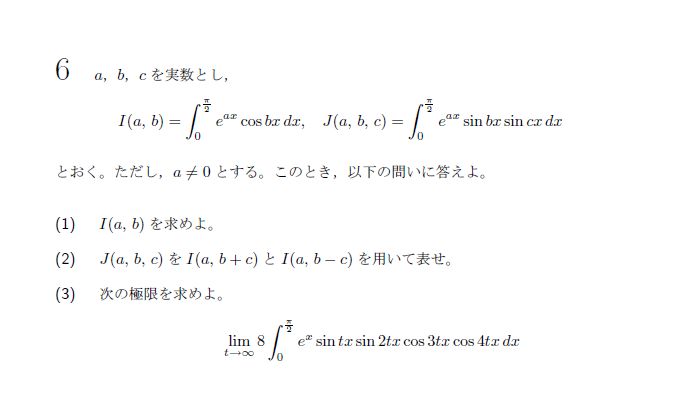
まず $I(a,b)$ を直接積分して閉じた形を得る。次に $\sin bx\sin cx$ を積和公式で $\cos$ の形に直し,$J(a,b,c)$ を $I(a,\cdot)$ で表す。最後は三角関数の積を和に変形し,(1) の結果を用いて高周波項がすべて $0$ に収束することを示す。
解法1
(1)
$$ \frac{d}{dx}\left(\frac{e^{ax}(a\cos bx+b\sin bx)}{a^2+b^2}\right) ================================================================== e^{ax}\cos bx $$
である。したがって,
$$ I(a,b) ====== \left[ \frac{e^{ax}(a\cos bx+b\sin bx)}{a^2+b^2} \right]_{0}^{\pi/2}. $$
よって
$$ I(a,b) ====== \frac{ e^{a\pi/2}\left(a\cos\frac{b\pi}{2}+b\sin\frac{b\pi}{2}\right)-a }{a^2+b^2}. $$
(2)
積和公式
$$ \sin bx\sin cx ============== \frac{1}{2}{\cos (b-c)x-\cos (b+c)x} $$
を用いると,
$$ \begin{aligned} J(a,b,c) &= \int_{0}^{\pi/2} e^{ax}\sin bx\sin cx,dx \\ &= \frac12\int_{0}^{\pi/2} e^{ax}\cos (b-c)x,dx -\frac12\int_{0}^{\pi/2} e^{ax}\cos (b+c)x,dx \\ &= \frac12\Bigl(I(a,b-c)-I(a,b+c)\Bigr). \end{aligned} $$
(3)
$$ L(t):= 8\int_{0}^{\pi/2} e^x\sin tx\sin 2tx\cos 3tx\cos 4tx,dx $$
とおく。
まず
$$ \sin tx\sin 2tx=\frac12(\cos tx-\cos 3tx),\qquad \cos 3tx\cos 4tx=\frac12(\cos tx+\cos 7tx) $$
より,
$$ 8\sin tx\sin 2tx\cos 3tx\cos 4tx ================================ 2(\cos tx-\cos 3tx)(\cos tx+\cos 7tx) $$
となる。これを展開し,さらに積和公式を用いると,
$$ \begin{aligned} 8\sin tx\sin 2tx\cos 3tx\cos 4tx &= 2\cos^2 tx+2\cos tx\cos 7tx-2\cos 3tx\cos tx-2\cos 3tx\cos 7tx \\ &= (1+\cos 2tx)+(\cos 6tx+\cos 8tx)-(\cos 2tx+\cos 4tx)-(\cos 4tx+\cos 10tx) \\ &= 1-2\cos 4tx+\cos 6tx+\cos 8tx-\cos 10tx. \end{aligned} $$
したがって
$$ L(t) ==== \int_{0}^{\pi/2} e^x,dx -2I(1,4t)+I(1,6t)+I(1,8t)-I(1,10t). $$
ここで (1) の結果に $a=1,\ b=\lambda$ を代入すると,
$$ I(1,\lambda) ============ \frac{ e^{\pi/2}\left(\cos\frac{\lambda\pi}{2}+\lambda\sin\frac{\lambda\pi}{2}\right)-1 }{1+\lambda^2}. $$
ゆえに $|\cos(\lambda\pi/2)|\le 1,\ |\sin(\lambda\pi/2)|\le 1$ より
$$ |I(1,\lambda)| \le \frac{e^{\pi/2}(1+|\lambda|)+1}{1+\lambda^2} \to 0 \qquad (\lambda\to\infty) $$
である。したがって $t\to\infty$ のとき
$$ I(1,4t),\ I(1,6t),\ I(1,8t),\ I(1,10t)\to 0 $$
となるので,
$$ \lim_{t\to\infty}L(t) ===================== # \int_{0}^{\pi/2} e^x,dx e^{\pi/2}-1. $$
解説
この問題では,指数関数と三角関数の積の積分を,積和公式によって $\cos$ の積分 $I(a,b)$ に帰着するのが基本方針である。
(1) は原始関数をまとめて見つければ一度で処理できる。(2) は $\sin\sin$ を $\cos$ の差に直す標準公式そのものである。(3) は見た目は複雑だが,積を和に直すと定数項と高周波の余弦項に分かれる。高周波項は (1) の公式から分母が $1+\lambda^2$ となるため $0$ に収束し,定数項だけが残る。
答え
$$ I(a,b) ====== \frac{ e^{a\pi/2}\left(a\cos\frac{b\pi}{2}+b\sin\frac{b\pi}{2}\right)-a }{a^2+b^2} $$
$$ J(a,b,c) ======== \frac12\Bigl(I(a,b-c)-I(a,b+c)\Bigr) $$
$$ \lim_{t\to\infty} 8\int_{0}^{\pi/2} e^x\sin tx\sin 2tx\cos 3tx\cos 4tx,dx ======================================================= e^{\pi/2}-1 $$
この問題の前に見る基礎問題






類題
自分の記録
誤りを報告
解説の誤り、誤字、表示崩れに気づいた場合は送信してください。ログイン不要です。