東京工業大学 1989年 理系 第2問 解説
方針・初手
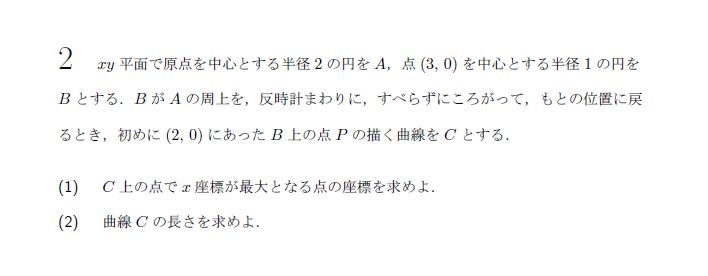
動円の中心と接点の座標を、原点周りの回転角 $\theta$ を用いて表す。 円がすべらずに転がる条件から、動円の中心から見た接点と点 $P$ の相対的な位置関係(回転角)を導き、点 $P$ の描く曲線 $C$ をパラメータ $\theta$ で表す。 軌跡の式が求まれば、(1) は三角関数の公式を用いた最大値問題、(2) は曲線の長さの公式 $\int \sqrt{(x')^2 + (y')^2} d\theta$ を用いる定積分計算に帰着できる。
解法1
円 $B$ の中心を $C_B$ とし、線分 $OC_B$ が $x$ 軸の正の向きとなす角を $\theta$ $(0 \le \theta \le 2\pi)$ とする。 円 $A$ の半径は $2$ 、円 $B$ の半径は $1$ であるから、動円の中心 $C_B$ は原点 $O$ を中心とする半径 $3$ の円周上を動く。 したがって、$C_B$ の座標は $(3\cos\theta, 3\sin\theta)$ と表せる。
このとき、円 $A$ と円 $B$ の接点を $T$ とすると、$T$ は線分 $OC_B$ を $2 : 1$ に内分する点であるから、その座標は $(2\cos\theta, 2\sin\theta)$ である。 円 $B$ の中心 $C_B$ から接点 $T$ へ向かうベクトルは、
$$ \vec{C_B T} = (-\cos\theta, -\sin\theta) $$
となる。このベクトルが $x$ 軸の正の向きとなす角は $\theta + \pi$ である。
点 $P$ は初め $(2,0)$ にあり、円 $B$ がすべらずに転がるとき、接点 $T$ が円 $A$ 上を動いた弧の長さと、点 $P$ から接点 $T$ までの円 $B$ 上の弧の長さは等しい。 接点 $T$ が動いた円 $A$ 上の弧の長さは $2\theta$ であり、円 $B$ の半径は $1$ であるから、円 $B$ の中心 $C_B$ から見た弧に対する中心角も $2\theta$ となる。 円 $B$ が円 $A$ の外側を反時計回りに公転するとき、点 $P$ は接点 $T$ から見て、円 $B$ の中心周りに反時計回りに $2\theta$ 回転した位置にある。 したがって、ベクトル $\vec{C_B P}$ が $x$ 軸の正の向きとなす角は、$(\theta + \pi) + 2\theta = 3\theta + \pi$ となる。 これにより、
$$ \vec{C_B P} = (\cos(3\theta + \pi), \sin(3\theta + \pi)) = (-\cos 3\theta, -\sin 3\theta) $$
と表せる。 よって、点 $P$ の座標 $(x(\theta), y(\theta))$ は、$\vec{OP} = \vec{OC_B} + \vec{C_B P}$ より、
$$ \begin{cases} x(\theta) = 3\cos\theta - \cos 3\theta \\ y(\theta) = 3\sin\theta - \sin 3\theta \end{cases} $$
となる。
(1)
$x(\theta) = 3\cos\theta - \cos 3\theta$ について、3倍角の公式 $\cos 3\theta = 4\cos^3\theta - 3\cos\theta$ を用いると、
$$ x(\theta) = 3\cos\theta - (4\cos^3\theta - 3\cos\theta) = -4\cos^3\theta + 6\cos\theta $$
ここで、$t = \cos\theta$ とおくと、$0 \le \theta \le 2\pi$ より $-1 \le t \le 1$ であり、$x$ 座標を $t$ の関数 $f(t)$ として表すと、
$$ f(t) = -4t^3 + 6t $$
これを $t$ で微分すると、
$$ f'(t) = -12t^2 + 6 = -6(2t^2 - 1) $$
$f'(t) = 0$ となるのは、$t = \pm \frac{1}{\sqrt{2}}$ のときである。 $-1 \le t \le 1$ における $f(t)$ の増減表は以下のようになる。
| $t$ | $-1$ | $\cdots$ | $-\frac{1}{\sqrt{2}}$ | $\cdots$ | $\frac{1}{\sqrt{2}}$ | $\cdots$ | $1$ |
|---|---|---|---|---|---|---|---|
| $f'(t)$ | $-$ | $0$ | $+$ | $0$ | $-$ | ||
| $f(t)$ | $-2$ | $\searrow$ | $-2\sqrt{2}$ | $\nearrow$ | $2\sqrt{2}$ | $\searrow$ | $2$ |
増減表より、$f(t)$ は $t = \frac{1}{\sqrt{2}}$ のとき最大値 $2\sqrt{2}$ をとる。 $t = \cos\theta = \frac{1}{\sqrt{2}}$ を満たす $\theta$ ($0 \le \theta \le 2\pi$)は、$\theta = \frac{\pi}{4}, \frac{7\pi}{4}$ である。 それぞれの $\theta$ に対する $y$ 座標を求める。
$\theta = \frac{\pi}{4}$ のとき、
$$ y\left(\frac{\pi}{4}\right) = 3\sin\frac{\pi}{4} - \sin\frac{3\pi}{4} = 3 \cdot \frac{1}{\sqrt{2}} - \frac{1}{\sqrt{2}} = \sqrt{2} $$
$\theta = \frac{7\pi}{4}$ のとき、
$$ y\left(\frac{7\pi}{4}\right) = 3\sin\frac{7\pi}{4} - \sin\frac{21\pi}{4} = 3 \cdot \left(-\frac{1}{\sqrt{2}}\right) - \left(-\frac{1}{\sqrt{2}}\right) = -\sqrt{2} $$
したがって、$x$ 座標が最大となる点の座標は $(2\sqrt{2}, \sqrt{2})$ と $(2\sqrt{2}, -\sqrt{2})$ である。
(2)
曲線 $C$ の長さを $L$ とする。 パラメータ $\theta$ による微分は以下の通りである。
$$ \frac{dx}{d\theta} = -3\sin\theta + 3\sin 3\theta $$
$$ \frac{dy}{d\theta} = 3\cos\theta - 3\cos 3\theta $$
これらを用いて、曲線の長さの積分要素を計算する。
$$ \begin{aligned} \left( \frac{dx}{d\theta} \right)^2 + \left( \frac{dy}{d\theta} \right)^2 &= (-3\sin\theta + 3\sin 3\theta)^2 + (3\cos\theta - 3\cos 3\theta)^2 \\ &= 9 \left( \sin^2\theta - 2\sin\theta\sin 3\theta + \sin^2 3\theta \right) + 9 \left( \cos^2\theta - 2\cos\theta\cos 3\theta + \cos^2 3\theta \right) \\ &= 9 \left( (\sin^2\theta + \cos^2\theta) + (\sin^2 3\theta + \cos^2 3\theta) - 2(\cos 3\theta\cos\theta + \sin 3\theta\sin\theta) \right) \\ &= 9 \left( 1 + 1 - 2\cos(3\theta - \theta) \right) \\ &= 18(1 - \cos 2\theta) \end{aligned} $$
半角の公式 $1 - \cos 2\theta = 2\sin^2\theta$ を適用すると、
$$ \left( \frac{dx}{d\theta} \right)^2 + \left( \frac{dy}{d\theta} \right)^2 = 18 \cdot 2\sin^2\theta = 36\sin^2\theta $$
となる。したがって、
$$ \sqrt{\left( \frac{dx}{d\theta} \right)^2 + \left( \frac{dy}{d\theta} \right)^2} = \sqrt{36\sin^2\theta} = 6|\sin\theta| $$
曲線 $C$ が描かれる範囲は $0 \le \theta \le 2\pi$ であるから、曲線の長さ $L$ は次のように求められる。
$$ L = \int_{0}^{2\pi} 6|\sin\theta| d\theta $$
区間を $0 \le \theta \le \pi$ ($\sin\theta \ge 0$)と $\pi \le \theta \le 2\pi$ ($\sin\theta \le 0$)に分けて定積分を計算する。
$$ \begin{aligned} L &= \int_{0}^{\pi} 6\sin\theta d\theta + \int_{\pi}^{2\pi} (-6\sin\theta) d\theta \\ &= 6 \left[ -\cos\theta \right]_{0}^{\pi} - 6 \left[ -\cos\theta \right]_{\pi}^{2\pi} \\ &= 6 \left( -(-1) - (-1) \right) - 6 \left( -1 - 1 \right) \\ &= 12 + 12 = 24 \end{aligned} $$
解説
この問題は、外サイクロイド(エピサイクロイド)の軌跡を求める典型的なテーマである。 動円の軌跡の問題では、「動円の中心の位置」と「動円の中心から見た描画点の相対位置(ベクトル)」の2つに分けて考えるのが基本である。特に「すべらずに転がる」という条件から、公転による回転角と自転による弧の長さの関係を正しく立式し、描画点の座標をパラメータ表示できるかが最大のポイントとなる。 (1) では、$\theta$ で微分して増減を調べることも可能だが、3倍角の公式を用いて $\cos\theta$ についての3次関数の最大値問題に帰着させる方が、三角方程式を解く手間が減り見通しが良くなる。 (2) では、加法定理 $\cos(\alpha - \beta) = \cos\alpha\cos\beta + \sin\alpha\sin\beta$ を逆に用いて式を簡略化するテクニックと、根号を外す際の絶対値記号の処理、および積分区間の分割が必須である。
答え
(1)
$(2\sqrt{2}, \sqrt{2}), (2\sqrt{2}, -\sqrt{2})$
(2)
$24$
この問題の前に見る基礎問題

類題
自分の記録
誤りを報告
解説の誤り、誤字、表示崩れに気づいた場合は送信してください。ログイン不要です。