大阪大学 1996年 理系 第4問 解説
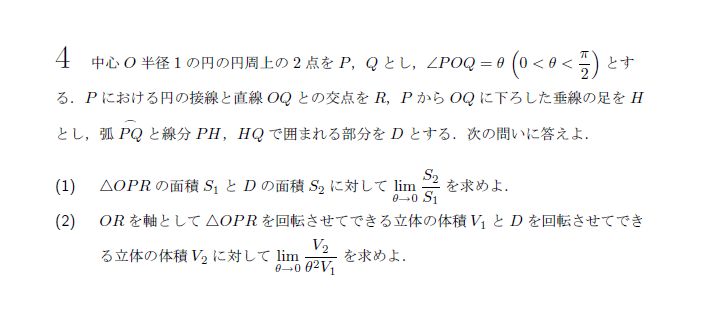
方針・初手
点 $O$ を原点とし、直線 $OQ$ を $x$ 軸とする座標系を設定すると、各点の座標が三角関数を用いて簡潔に表せる。この座標系を利用して、各図形の面積と回転体の体積を $\theta$ の式で表し、極限を計算する。面積・体積の計算後は、$\theta \to 0$ における三角関数の極限の基本公式 $\lim_{\theta \to 0} \frac{\sin \theta}{\theta} = 1$ に帰着させるような式変形を行う。
解法1
点 $O(0,0)$ とし、半直線 $OQ$ を $x$ 軸の正の向きに取る。
$OP = OQ = 1$ より $Q(1, 0)$ であり、$\angle POQ = \theta$ であるから、点 $P$ の座標は $P(\cos \theta, \sin \theta)$ と表せる。
点 $H$ は $P$ から $x$ 軸への垂線の足なので、$H(\cos \theta, 0)$ である。
点 $R$ は、$P$ における円の接線と $x$ 軸との交点である。円 $x^2 + y^2 = 1$ 上の点 $P(\cos \theta, \sin \theta)$ における接線の方程式は、
$$ (\cos \theta)x + (\sin \theta)y = 1 $$
と表せる。これと $x$ 軸 ($y = 0$) との交点 $R$ の $x$ 座標は、$\cos \theta \neq 0$ より $x = \frac{1}{\cos \theta}$ となる。よって、$R\left( \frac{1}{\cos \theta}, 0 \right)$ である。
(1)
$\triangle OPR$ は $\angle OPR = \frac{\pi}{2}$ の直角三角形である。線分の長さは $OP = 1$, $PR = \tan \theta$ であるから、その面積 $S_1$ は、
$$ S_1 = \frac{1}{2} \cdot OP \cdot PR = \frac{1}{2} \tan \theta $$
領域 $D$ の面積 $S_2$ は、おうぎ形 $OPQ$ の面積から $\triangle OPH$ の面積を引いたものである。おうぎ形 $OPQ$ の面積は $\frac{1}{2} \cdot 1^2 \cdot \theta = \frac{1}{2} \theta$ である。$\triangle OPH$ は底辺 $OH = \cos \theta$、高さ $PH = \sin \theta$ の直角三角形であるから、その面積は $\frac{1}{2} \cos \theta \sin \theta$ である。よって、
$$ S_2 = \frac{1}{2} \theta - \frac{1}{2} \sin \theta \cos \theta $$
求める極限は以下のようになる。
$$ \lim_{\theta \to 0} \frac{S_2}{S_1} = \lim_{\theta \to 0} \frac{\frac{1}{2} \theta - \frac{1}{2} \sin \theta \cos \theta}{\frac{1}{2} \tan \theta} $$
$$ \lim_{\theta \to 0} \frac{S_2}{S_1} = \lim_{\theta \to 0} \frac{\theta - \sin \theta \cos \theta}{\frac{\sin \theta}{\cos \theta}} $$
$$ \lim_{\theta \to 0} \frac{S_2}{S_1} = \lim_{\theta \to 0} \left( \frac{\theta}{\sin \theta} \cos \theta - \cos^2 \theta \right) $$
ここで、$\lim_{\theta \to 0} \frac{\theta}{\sin \theta} = 1$、$\lim_{\theta \to 0} \cos \theta = 1$ であるため、
$$ \lim_{\theta \to 0} \frac{S_2}{S_1} = 1 \cdot 1 - 1^2 = 0 $$
(2)
$V_1$ は、$\triangle OPR$ を $x$ 軸の周りに回転させた立体の体積である。この立体は、$\triangle OPH$ の回転体(円錐)と $\triangle PHR$ の回転体(円錐)を合わせたものであり、底面を共有している。したがって、底面の半径が $PH = \sin \theta$ で、高さが $OH + HR = OR = \frac{1}{\cos \theta}$ の円錐の体積に等しくなる。よって、
$$ V_1 = \frac{1}{3} \pi \cdot PH^2 \cdot OR = \frac{1}{3} \pi \sin^2 \theta \cdot \frac{1}{\cos \theta} = \frac{\pi \sin^2 \theta}{3 \cos \theta} $$
$V_2$ は、領域 $D$ を $x$ 軸の周りに回転させた立体の体積である。領域 $D$ は、曲線 $y = \sqrt{1-x^2}$ ($x \ge 0$) の $\cos \theta \le x \le 1$ の部分と、$x$ 軸および直線 $x = \cos \theta$ で囲まれた領域であるため、次のように計算できる。
$$ V_2 = \pi \int_{\cos \theta}^{1} y^2 \,dx = \pi \int_{\cos \theta}^{1} (1 - x^2) \,dx $$
$$ V_2 = \pi \left[ x - \frac{x^3}{3} \right]_{\cos \theta}^{1} $$
$$ V_2 = \pi \left( 1 - \frac{1}{3} - \left( \cos \theta - \frac{\cos^3 \theta}{3} \right) \right) $$
$$ V_2 = \pi \left( \frac{2}{3} - \cos \theta + \frac{\cos^3 \theta}{3} \right) $$
極限を求める式にこれらを代入して整理する。
$$ \frac{V_2}{\theta^2 V_1} = \frac{\pi \left( \frac{2}{3} - \cos \theta + \frac{\cos^3 \theta}{3} \right)}{\theta^2 \cdot \frac{\pi \sin^2 \theta}{3 \cos \theta}} $$
$$ \frac{V_2}{\theta^2 V_1} = \frac{3 \cos \theta \left( \frac{2}{3} - \cos \theta + \frac{\cos^3 \theta}{3} \right)}{\theta^2 \sin^2 \theta} $$
$$ \frac{V_2}{\theta^2 V_1} = \frac{2 \cos \theta - 3 \cos^2 \theta + \cos^4 \theta}{\theta^2 \sin^2 \theta} $$
分子を $\cos \theta$ でくくる。
$$ \text{分子} = \cos \theta ( \cos^3 \theta - 3 \cos \theta + 2 ) $$
多項式 $t^3 - 3t + 2$ は $t=1$ のとき $0$ になるため、$t-1$ を因数にもち、$(t-1)^2(t+2)$ と因数分解できる。これを用いると、
$$ \text{分子} = \cos \theta (\cos \theta - 1)^2 (\cos \theta + 2) = \cos \theta (1 - \cos \theta)^2 (\cos \theta + 2) $$
と変形できる。これを元の式に戻し、極限の基本公式が使える形に式を分割する。
$$ \frac{V_2}{\theta^2 V_1} = \frac{\cos \theta (1 - \cos \theta)^2 (\cos \theta + 2)}{\theta^2 \sin^2 \theta} $$
$$ \frac{V_2}{\theta^2 V_1} = \cos \theta (\cos \theta + 2) \cdot \left( \frac{1 - \cos \theta}{\theta^2} \right)^2 \cdot \left( \frac{\theta}{\sin \theta} \right)^2 $$
ここで、$\theta \to 0$ における各部分の極限を求める。
$$ \lim_{\theta \to 0} \frac{1 - \cos \theta}{\theta^2} = \lim_{\theta \to 0} \frac{(1 - \cos \theta)(1 + \cos \theta)}{\theta^2 (1 + \cos \theta)} = \lim_{\theta \to 0} \left( \frac{\sin \theta}{\theta} \right)^2 \cdot \frac{1}{1 + \cos \theta} = 1^2 \cdot \frac{1}{2} = \frac{1}{2} $$
$$ \lim_{\theta \to 0} \frac{\theta}{\sin \theta} = 1 $$
$$ \lim_{\theta \to 0} \cos \theta (\cos \theta + 2) = 1 \cdot (1 + 2) = 3 $$
これらを掛け合わせることで、求める極限値が得られる。
$$ \lim_{\theta \to 0} \frac{V_2}{\theta^2 V_1} = 3 \cdot \left( \frac{1}{2} \right)^2 \cdot 1^2 = \frac{3}{4} $$
解説
図形の面積と体積の極限を求める標準的な微積分・極限の問題である。座標平面上に図形を配置することで、立式が機械的かつ確実に行える。
(1) では素直に $\theta$ と $\sin \theta, \cos \theta, \tan \theta$ の極限公式に帰着させるだけで答えが出る。(2) においては式が少し複雑になるが、分子の多項式について $\theta \to 0$ のとき $\cos \theta \to 1$ となることに着目し、$1 - \cos \theta$ という因数をくくり出す方針を取るのが定石である。
答え
(1)
$0$
(2)
$\frac{3}{4}$
この問題の前に見る基礎問題



類題
自分の記録
誤りを報告
解説の誤り、誤字、表示崩れに気づいた場合は送信してください。ログイン不要です。