東北大学 2002年 文系 第2問 解説
方針・初手
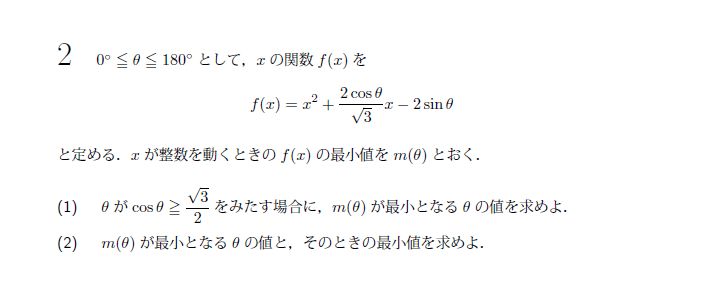
$x$ について平方完成すると、整数 $x$ に対する最小値は、$-\dfrac{\cos\theta}{\sqrt3}$ に最も近い整数で決まる。
ここで
$$ -\frac{\cos\theta}{\sqrt3}\in \left[-\frac1{\sqrt3},\frac1{\sqrt3}\right] $$
であるから、最小値を与える候補は $x=-1,0,1$ のみである。したがって、まず $f(-1),f(0),f(1)$ を比較して $m(\theta)$ を場合分けする。
解法1
$f(x)$ を平方完成すると、
$$ f(x)=x^2+\frac{2\cos\theta}{\sqrt3}x-2\sin\theta =\left(x+\frac{\cos\theta}{\sqrt3}\right)^2-\frac{\cos^2\theta}{3}-2\sin\theta $$
となる。
よって、整数 $x$ に対して $f(x)$ を最小にするには、
$$ \left|x+\frac{\cos\theta}{\sqrt3}\right| $$
が最小となる整数 $x$ を選べばよい。
しかも
$$ -\frac{\cos\theta}{\sqrt3}\in \left[-\frac1{\sqrt3},\frac1{\sqrt3}\right] $$
であるから、候補は $x=-1,0,1$ に限られる。
実際に値を求めると、
$$ f(0)=-2\sin\theta $$
$$ f(1)=1+\frac{2\cos\theta}{\sqrt3}-2\sin\theta $$
$$ f(-1)=1-\frac{2\cos\theta}{\sqrt3}-2\sin\theta $$
である。
ここで、
- $f(-1)\le f(0)$ は $1-\dfrac{2\cos\theta}{\sqrt3}\le 0$、すなわち $\cos\theta\ge \dfrac{\sqrt3}{2}$ と同値
- $f(1)\le f(0)$ は $1+\dfrac{2\cos\theta}{\sqrt3}\le 0$、すなわち $\cos\theta\le -\dfrac{\sqrt3}{2}$ と同値
であるから、
$$ m(\theta)= \begin{cases} 1-\dfrac{2\cos\theta}{\sqrt3}-2\sin\theta & \left(\cos\theta\ge \dfrac{\sqrt3}{2}\right),[1.2ex] -2\sin\theta & \left(-\dfrac{\sqrt3}{2}\le \cos\theta\le \dfrac{\sqrt3}{2}\right),[1.2ex] 1+\dfrac{2\cos\theta}{\sqrt3}-2\sin\theta & \left(\cos\theta\le -\dfrac{\sqrt3}{2}\right) \end{cases} $$
となる。
(1) $\cos\theta\ge \dfrac{\sqrt3}{2}$ のとき
$0^\circ\le \theta\le 180^\circ$ より、この条件は
$$ 0^\circ\le \theta\le 30^\circ $$
である。
このとき
$$ m(\theta)=1-\frac{2\cos\theta}{\sqrt3}-2\sin\theta =1-2\left(\sin\theta+\frac{\cos\theta}{\sqrt3}\right) $$
であり、
$$ \sin\theta+\frac{\cos\theta}{\sqrt3} =\frac{2}{\sqrt3}\sin(\theta+30^\circ) $$
だから、
$$ m(\theta)=1-\frac{4}{\sqrt3}\sin(\theta+30^\circ) $$
となる。
ここで $0^\circ\le \theta\le 30^\circ$ では $\theta+30^\circ\in[30^\circ,60^\circ]$ であり、$\sin(\theta+30^\circ)$ は増加する。したがって $m(\theta)$ は $\theta$ が大きいほど小さくなるので、最小となるのは
$$ \theta=30^\circ $$
である。
(2) $m(\theta)$ の全体での最小
(i) $0^\circ\le \theta\le 30^\circ$ のとき
$$ m(\theta)=1-\frac{4}{\sqrt3}\sin(\theta+30^\circ) $$
より、最小値は $\theta=30^\circ$ で
$$ m(30^\circ)=1-\frac{4}{\sqrt3}\sin60^\circ=1-2=-1 $$
である。
(ii) $30^\circ\le \theta\le 150^\circ$ のとき
この範囲では $-\dfrac{\sqrt3}{2}\le \cos\theta\le \dfrac{\sqrt3}{2}$ なので、
$$ m(\theta)=-2\sin\theta $$
である。
$\sin\theta$ は $\theta=90^\circ$ で最大値 $1$ をとるから、$m(\theta)$ は $\theta=90^\circ$ で最小となり、
$$ m(90^\circ)=-2 $$
である。
(iii) $150^\circ\le \theta\le 180^\circ$ のとき
$$ m(\theta)=1+\frac{2\cos\theta}{\sqrt3}-2\sin\theta =1-2\left(\sin\theta-\frac{\cos\theta}{\sqrt3}\right) $$
さらに
$$ \sin\theta-\frac{\cos\theta}{\sqrt3} =\frac{2}{\sqrt3}\sin(\theta-30^\circ) $$
より、
$$ m(\theta)=1-\frac{4}{\sqrt3}\sin(\theta-30^\circ) $$
となる。
ここで $\theta-30^\circ\in[120^\circ,150^\circ]$ であり、この範囲では $\sin(\theta-30^\circ)$ は減少する。したがって最小値は $\theta=150^\circ$ で、
$$ m(150^\circ)=1-\frac{4}{\sqrt3}\sin120^\circ=1-2=-1 $$
である。
以上より、全体での最小値は
$$ -2 $$
であり、そのとき
$$ \theta=90^\circ $$
である。
解説
この問題の要点は、$x$ が整数であることを利用して、連続変数としての最小ではなく「頂点に最も近い整数」を選ぶことである。
平方完成すると頂点の $x$ 座標は $-\dfrac{\cos\theta}{\sqrt3}$ と分かる。この値が常に $\left[-\dfrac1{\sqrt3},\dfrac1{\sqrt3}\right]$ に入るため、候補が $-1,0,1$ の三つに絞れる。ここまで落とせれば、あとは三つを比較して $\theta$ の範囲ごとに $m(\theta)$ を求めるだけである。
また、三角関数の合成
$$ \sin\theta+\frac{\cos\theta}{\sqrt3} =\frac{2}{\sqrt3}\sin(\theta+30^\circ) $$
を使うと、単調性が見やすくなる。
答え
(1) $\cos\theta\ge \dfrac{\sqrt3}{2}$ のもとで $m(\theta)$ が最小となるのは
$$ \theta=30^\circ $$
である。
(2) $m(\theta)$ が全体で最小となるのは
$$ \theta=90^\circ $$
であり、そのときの最小値は
$$ m(90^\circ)=-2 $$
である。
この問題の前に見る基礎問題






類題
自分の記録
誤りを報告
解説の誤り、誤字、表示崩れに気づいた場合は送信してください。ログイン不要です。