東京工業大学 1996年 理系 第2問 解説
方針・初手
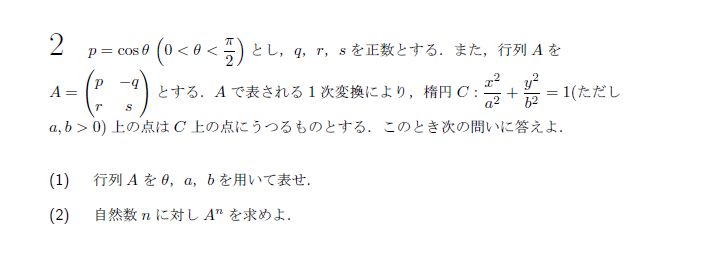
- (1) 楕円 $C$ 上の点 $(x, y)$ は、パラメータ $\phi$ を用いて $x = a \cos \phi, y = b \sin \phi$ と媒介変数表示できる。これが1次変換によってうつった点 $(X, Y)$ も $C$ の方程式を満たすことから、$\phi$ についての恒等式を立てる。
- または、座標軸を定数倍して楕円を単位円に変換し、「単位円を自身にうつす1次変換(回転または折り返し)」の性質を利用すると見通しが良い。
- (2) (1) で求めた行列 $A$ が、回転行列と対角行列の積に分解できる形をしていることに着目する。
解法1
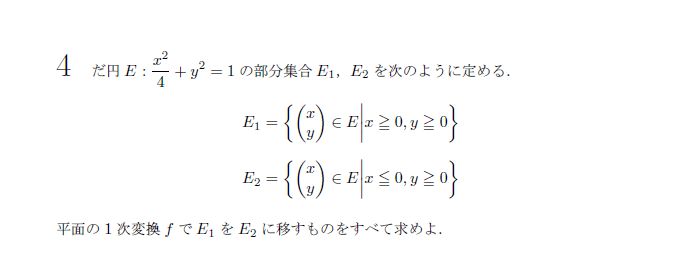
(1) 楕円 $C: \frac{x^2}{a^2} + \frac{y^2}{b^2} = 1$ 上の点は、パラメータ $\phi$ を用いて
$$ \begin{pmatrix} x \\ y \end{pmatrix} = \begin{pmatrix} a \cos \phi \\ b \sin \phi \end{pmatrix} $$
と表される。この点が $A$ によって点 $(X, Y)$ にうつるとすると、
$$ \begin{pmatrix} X \\ Y \end{pmatrix} = \begin{pmatrix} p & -q \\ r & s \end{pmatrix} \begin{pmatrix} a \cos \phi \\ b \sin \phi \end{pmatrix} = \begin{pmatrix} pa \cos \phi - qb \sin \phi \\ ra \cos \phi + sb \sin \phi \end{pmatrix} $$
となる。$(X, Y)$ も $C$ 上の点であるから、
$$ \frac{(pa \cos \phi - qb \sin \phi)^2}{a^2} + \frac{(ra \cos \phi + sb \sin \phi)^2}{b^2} = 1 $$
が成り立つ。左辺を展開して整理すると、
$$ \left( p^2 + \frac{a^2}{b^2}r^2 \right) \cos^2 \phi + 2 \left( -\frac{b}{a}pq + \frac{a}{b}rs \right) \cos \phi \sin \phi + \left( \frac{b^2}{a^2}q^2 + s^2 \right) \sin^2 \phi = 1 $$
この等式が任意の $\phi$ について成り立つための条件は、$\cos^2 \phi + \sin^2 \phi = 1$ と係数を比較して、
$$ \begin{cases} p^2 + \frac{a^2}{b^2}r^2 = 1 & \cdots \text{①} \\ -\frac{b}{a}pq + \frac{a}{b}rs = 0 & \cdots \text{②} \\ \frac{b^2}{a^2}q^2 + s^2 = 1 & \cdots \text{③} \end{cases} $$
$p = \cos \theta$ を①に代入すると、$\cos^2 \theta + \frac{a^2}{b^2}r^2 = 1$ より $\frac{a^2}{b^2}r^2 = \sin^2 \theta$ となる。 $0 < \theta < \frac{\pi}{2}$ より $\sin \theta > 0$ であり、$a, b, r$ は正数なので、
$$ r = \frac{b}{a} \sin \theta $$
次に、②より $rs a^2 = pq b^2$ であるから、これに $p, r$ を代入して、
$$ \left( \frac{b}{a} \sin \theta \right) s a^2 = (\cos \theta) q b^2 \quad \iff \quad q = \frac{a \sin \theta}{b \cos \theta} s $$
これを③に代入して、
$$ \frac{b^2}{a^2} \left( \frac{a \sin \theta}{b \cos \theta} s \right)^2 + s^2 = 1 \quad \iff \quad \frac{\sin^2 \theta}{\cos^2 \theta} s^2 + s^2 = 1 $$
$$ s^2 \left( \frac{\sin^2 \theta + \cos^2 \theta}{\cos^2 \theta} \right) = 1 \quad \iff \quad \frac{s^2}{\cos^2 \theta} = 1 $$
$0 < \theta < \frac{\pi}{2}$ より $\cos \theta > 0$、$s > 0$ であるから、$s = \cos \theta$。 このとき $q$ は、
$$ q = \frac{a \sin \theta}{b \cos \theta} \cos \theta = \frac{a}{b} \sin \theta $$
以上より、
$$ A = \begin{pmatrix} \cos \theta & -\frac{a}{b} \sin \theta \\ \frac{b}{a} \sin \theta & \cos \theta \end{pmatrix} $$
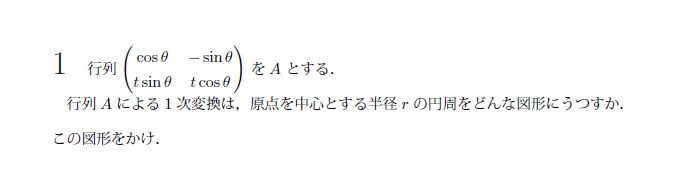
(2) (1) の結果より、行列 $A$ は次のように分解できる。
$$ A = \begin{pmatrix} 1 & 0 \\ 0 & \frac{b}{a} \end{pmatrix} \begin{pmatrix} \cos \theta & -\sin \theta \\ \sin \theta & \cos \theta \end{pmatrix} \begin{pmatrix} 1 & 0 \\ 0 & \frac{a}{b} \end{pmatrix} $$
ここで、$P = \begin{pmatrix} 1 & 0 \\ 0 & \frac{b}{a} \end{pmatrix}$ とおくと、$P^{-1} = \begin{pmatrix} 1 & 0 \\ 0 & \frac{a}{b} \end{pmatrix}$ であり、$R(\theta) = \begin{pmatrix} \cos \theta & -\sin \theta \\ \sin \theta & \cos \theta \end{pmatrix}$ とおくと、
$$ A = P R(\theta) P^{-1} $$
と表せる。よって、
$$ A^n = (P R(\theta) P^{-1})^n = P R(\theta)^n P^{-1} = P R(n\theta) P^{-1} $$
回転行列の累乗の性質より $R(\theta)^n = R(n\theta)$ となるから、
$$ A^n = \begin{pmatrix} 1 & 0 \\ 0 & \frac{b}{a} \end{pmatrix} \begin{pmatrix} \cos n\theta & -\sin n\theta \\ \sin n\theta & \cos n\theta \end{pmatrix} \begin{pmatrix} 1 & 0 \\ 0 & \frac{a}{b} \end{pmatrix} = \begin{pmatrix} \cos n\theta & -\frac{a}{b} \sin n\theta \\ \frac{b}{a} \sin n\theta & \cos n\theta \end{pmatrix} $$
解法2
(1) 点 $(x, y)$ を $(x', y') = \left( \frac{x}{a}, \frac{y}{b} \right)$ に移す1次変換を考える。これを表す行列を $P^{-1} = \begin{pmatrix} \frac{1}{a} & 0 \\ 0 & \frac{1}{b} \end{pmatrix}$ とおく。 この変換によって、楕円 $C: \frac{x^2}{a^2} + \frac{y^2}{b^2} = 1$ は単位円 $C': x'^2 + y'^2 = 1$ にうつる。
楕円 $C$ 上の点 $\mathbf{x} = \begin{pmatrix} x \\ y \end{pmatrix}$ は行列 $A$ によって同じく $C$ 上の点 $\mathbf{X} = A\mathbf{x}$ にうつる。 それぞれの点を $P^{-1}$ で変換した点を $\mathbf{x'} = P^{-1}\mathbf{x}$、$\mathbf{X'} = P^{-1}\mathbf{X}$ とすると、これらは単位円 $C'$ 上にある。 ここで、
$$ \mathbf{X'} = P^{-1}\mathbf{X} = P^{-1}A\mathbf{x} = (P^{-1}AP)\mathbf{x'} $$
が成り立つので、行列 $P^{-1}AP$ は単位円 $C'$ を単位円 $C'$ 自身にうつす1次変換を表す。
単位円を自身にうつす1次変換は、原点中心の回転移動か、原点を通る直線を軸とする折り返しである。
$$ P^{-1}AP = \begin{pmatrix} \frac{1}{a} & 0 \\ 0 & \frac{1}{b} \end{pmatrix} \begin{pmatrix} p & -q \\ r & s \end{pmatrix} \begin{pmatrix} a & 0 \\ 0 & b \end{pmatrix} = \begin{pmatrix} p & -\frac{b}{a}q \\ \frac{a}{b}r & s \end{pmatrix} $$
この行列は、回転行列 $\begin{pmatrix} \cos \alpha & -\sin \alpha \\ \sin \alpha & \cos \alpha \end{pmatrix}$ または折り返しの行列 $\begin{pmatrix} \cos \alpha & \sin \alpha \\ \sin \alpha & -\cos \alpha \end{pmatrix}$ の形になる。 条件より第1行第1列の成分は $p = \cos \theta$ であり、$q, r > 0, a, b > 0$ であるから、第1行第2列の成分 $-\frac{b}{a}q$ は負である。 折り返しの行列だと仮定すると第1行第2列は $\sin \alpha$ となり、第2行第1列も $\sin \alpha$ となるため正負が一致するはずだが、$P^{-1}AP$ の第1行第2列は負、第2行第1列 $\frac{a}{b}r$ は正となり矛盾する。
したがって、$P^{-1}AP$ は回転行列であり、
$$ \begin{pmatrix} p & -\frac{b}{a}q \\ \frac{a}{b}r & s \end{pmatrix} = \begin{pmatrix} \cos \theta & -\sin \theta \\ \sin \theta & \cos \theta \end{pmatrix} $$
となる。成分を比較して、
$$ p = \cos \theta, \quad q = \frac{a}{b} \sin \theta, \quad r = \frac{b}{a} \sin \theta, \quad s = \cos \theta $$
よって、
$$ A = \begin{pmatrix} \cos \theta & -\frac{a}{b} \sin \theta \\ \frac{b}{a} \sin \theta & \cos \theta \end{pmatrix} $$
解説
- 楕円上の点が楕円上の点にうつるという条件を処理する際、解法1のように「媒介変数表示を利用した恒等式」に持ち込むのが確実な定石である。
- 解法2のように「座標軸の伸縮によって楕円を単位円に変換する」という視点を持つと、計算量が大幅に削減できる。この手法は、積分による面積計算や2次曲線の問題全般で非常に有用な考え方である。
- 行列の $n$ 乗を計算する際、対角化を行うのが一般的だが、本問のように $A = P R(\theta) P^{-1}$($R(\theta)$ は回転行列)という形に分解できる場合、$A^n = P R(n\theta) P^{-1}$ と簡単に求まる。
答え
(1)
$$ A = \begin{pmatrix} \cos \theta & -\frac{a}{b} \sin \theta \\ \frac{b}{a} \sin \theta & \cos \theta \end{pmatrix} $$
(2)
$$ A^n = \begin{pmatrix} \cos n\theta & -\frac{a}{b} \sin n\theta \\ \frac{b}{a} \sin n\theta & \cos n\theta \end{pmatrix} $$
この問題の前に見る基礎問題





類題
自分の記録
誤りを報告
解説の誤り、誤字、表示崩れに気づいた場合は送信してください。ログイン不要です。