東京大学 2024年 文系 第1問 解説
方針・初手
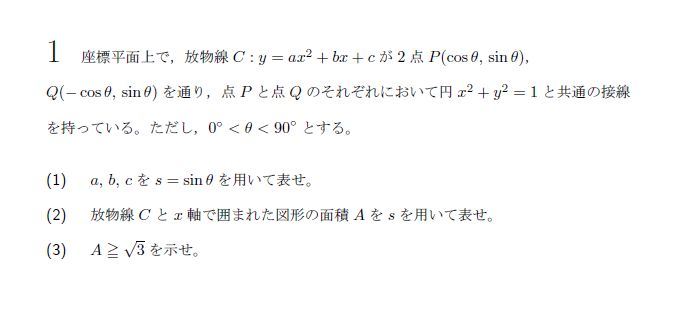
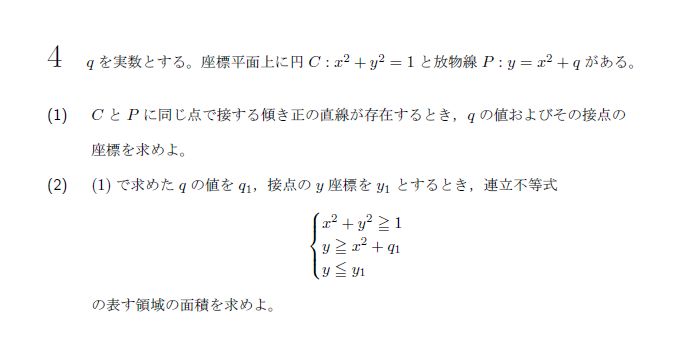
点 $P$, $Q$ が $y$ 軸対称であることから、放物線 $C$ の軸は $y$ 軸である。まずこの対称性を用いて $b=0$ を出す。
次に、円と放物線が共通接線をもつという条件を傾きで表して $a$, $c$ を求める。(2) の面積は積分で求め、(3) は得られた式を1変数関数として評価する。
解法1
(1)
放物線
$$ C : y = ax^2 + bx + c $$
が2点
$$ P(\cos \theta, \sin \theta), \quad Q(-\cos \theta, \sin \theta) $$
を通るので、
$$ \begin{cases} \sin \theta = a \cos^2 \theta + b \cos \theta + c \\ \sin \theta = a \cos^2 \theta - b \cos \theta + c \end{cases} $$
である。両式の差をとると
$$ 2b \cos \theta = 0 $$
となる。$0^\circ < \theta < 90^\circ$ より $\cos \theta > 0$ であるから
$$ b = 0 $$
である。
したがって
$$ C : y = ax^2 + c $$
である。
点 $P$ は円
$$ x^2 + y^2 = 1 $$
上にあるから、点 $P$ における接線は
$$ \cos \theta \, x + \sin \theta \, y = 1 $$
である。これを $y$ について解くと傾きは
$$ - \frac{\cos \theta}{\sin \theta} $$
である。
一方、放物線 $C$ の導関数は
$$ y' = 2ax $$
であるから、点 $P$ における接線の傾きは
$$ 2a \cos \theta $$
である。共通接線をもつので
$$ 2a \cos \theta = - \frac{\cos \theta}{\sin \theta} $$
となる。$\cos \theta > 0$ より
$$ 2a = - \frac{1}{\sin \theta} $$
である。ここで
$$ s = \sin \theta $$
とおくと、
$$ a = - \frac{1}{2s} $$
である。
さらに $P$ は放物線上にもあるから、
$$ s = a \cos^2 \theta + c $$
である。$\cos^2 \theta = 1 - s^2$ を用いると、
$$ s = - \frac{1}{2s} (1-s^2) + c $$
となるので、
$$ c = s + \frac{1-s^2}{2s} = \frac{s^2+1}{2s} $$
である。
以上より、
$$ a = - \frac{1}{2s}, \quad b = 0, \quad c = \frac{s^2+1}{2s} $$
を得る。
(2)
(1) より放物線は
$$ y = - \frac{1}{2s} x^2 + \frac{s^2+1}{2s} $$
である。これと $x$ 軸との交点は
$$ - \frac{1}{2s} x^2 + \frac{s^2+1}{2s} = 0 $$
より
$$ x = \pm \sqrt{s^2+1} $$
である。
したがって、面積 $A$ は
$$ A = \int_{-\sqrt{s^2+1}}^{\sqrt{s^2+1}} \left( - \frac{1}{2s} x^2 + \frac{s^2+1}{2s} \right) dx $$
である。ここで
$$ \alpha = - \sqrt{s^2+1}, \quad \beta = \sqrt{s^2+1} $$
とおくと、
$$ - \frac{1}{2s} x^2 + \frac{s^2+1}{2s} = - \frac{1}{2s} (x-\alpha)(x-\beta) $$
であるから、
$$ A = - \frac{1}{2s} \int_\alpha^\beta (x-\alpha)(x-\beta) \, dx $$
となる。
公式
$$ \int_\alpha^\beta (x-\alpha)(x-\beta) \, dx = - \frac{1}{6} (\beta-\alpha)^3 $$
を用いると、
$$ \begin{aligned} A &= - \frac{1}{2s} \left\{ - \frac{1}{6} (\beta-\alpha)^3 \right\} \\ &= \frac{1}{12s} \left( 2 \sqrt{s^2+1} \right)^3 \\ &= \frac{2 (s^2+1) \sqrt{s^2+1}}{3s} \end{aligned} $$
となる。
(3)
(2) より
$$ A = \frac{2}{3} \sqrt{\frac{(s^2+1)^3}{s^2}} $$
である。ここで
$$ t = s^2 $$
とおくと、$0 < s < 1$ より
$$ 0 < t < 1 $$
であり、
$$ A = \frac{2}{3} \sqrt{\frac{(t+1)^3}{t}} $$
となる。
そこで
$$ g(t) = \frac{(t+1)^3}{t} $$
とおくと、
$$ g(t) = t^2 + 3t + 3 + \frac{1}{t} $$
であるから、
$$ g'(t) = 2t + 3 - \frac{1}{t^2} = \frac{2t^3 + 3t^2 - 1}{t^2} $$
となる。分子は
$$ 2t^3 + 3t^2 - 1 = (t+1)^2 (2t-1) $$
と因数分解できるので、
$$ g'(t) = \frac{(t+1)^2 (2t-1)}{t^2} $$
である。
したがって、$0 < t < 1$ において $g'(t)=0$ となるのは
$$ t = \frac{1}{2} $$
のときだけであり、このとき $g(t)$ は最小となる。その最小値は
$$ g \left( \frac{1}{2} \right) = \frac{\left( \frac{3}{2} \right)^3}{\frac{1}{2}} = \frac{27}{4} $$
である。よって
$$ g(t) \geqq \frac{27}{4} $$
であり、
$$ A = \frac{2}{3} \sqrt{g(t)} \geqq \frac{2}{3} \sqrt{\frac{27}{4}} = \sqrt{3} $$
となる。以上より
$$ A \geqq \sqrt{3} $$
が成り立つ。
解法2
(3) は相加平均と相乗平均の大小関係を用いても示せる。
再び $t = s^2$ とおくと
$$ A = \frac{2}{3} \sqrt{\frac{(t+1)^3}{t}} $$
である。ここで
$$ t + 1 = t + \frac{1}{2} + \frac{1}{2} $$
と見て相加平均と相乗平均の大小関係を用いると、
$$ t + 1 \geqq 3 \sqrt[3]{t \cdot \frac{1}{2} \cdot \frac{1}{2}} = 3 \sqrt[3]{\frac{t}{4}} $$
である。両辺を3乗すると、
$$ (t+1)^3 \geqq \frac{27}{4} t $$
となるから、
$$ \frac{(t+1)^3}{t} \geqq \frac{27}{4} $$
である。よって
$$ A \geqq \frac{2}{3} \sqrt{\frac{27}{4}} = \sqrt{3} $$
を得る。
解説
対称な2点を通ることから $b=0$ を出し、共通接線の傾きを一致させて $a$, $c$ を求める流れが基本である。
面積は積分で求められるが、(2) の結果を (3) でそのまま1変数関数の評価に持ち込める形に整理しておくと見通しがよい。最小値は微分でも相加平均と相乗平均でも求められる。
答え
(1)
$$ a = - \frac{1}{2s}, \quad b = 0, \quad c = \frac{s^2+1}{2s} $$
(2)
$$ A = \frac{2(s^2+1)\sqrt{s^2+1}}{3s} $$
(3)
$$ A \geqq \sqrt{3} $$
等号は
$$ s = \frac{1}{\sqrt{2}} $$
のときに成り立つ。
この問題の前に見る基礎問題



類題
自分の記録
誤りを報告
解説の誤り、誤字、表示崩れに気づいた場合は送信してください。ログイン不要です。