北海道大学 1964年 文系 第6問 解説
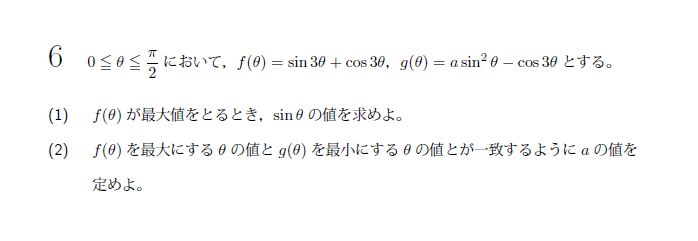
注意 画像の一部が不鮮明で、特に「$g(\theta)$ の式における $\cos 3\theta$ の前の符号」の読取りに不確実性があります。画像では「$-$(マイナス)」にも見えますが、その場合題意を満たす $a$ が存在しないため、以下は出題の意図として妥当と思われる「$+$(プラス)」、すなわち $g(\theta) = a \sin^2 \theta + \cos 3\theta$ として解釈した場合の解答解説です。
方針・初手
- (1) は、三角関数の合成を用いて $f(\theta)$ の最大値をとる $\theta$ を求める。
- (2) は、(1) で求めた $\theta$ において $g(\theta)$ が最小値をとるための条件を考える。区間の内点で最小となるためには微分係数が $0$(極小)となることが必要である点に着目し、さらにそれが最小値を与えることの十分性を確認する。
解法1
(1)
$f(\theta) = \sin 3\theta + \cos 3\theta$ について、三角関数の合成を用いると、
$$ \begin{aligned} f(\theta) &= \sqrt{2} \left( \sin 3\theta \cdot \frac{1}{\sqrt{2}} + \cos 3\theta \cdot \frac{1}{\sqrt{2}} \right) \\ &= \sqrt{2} \left( \sin 3\theta \cos \frac{\pi}{4} + \cos 3\theta \sin \frac{\pi}{4} \right) \\ &= \sqrt{2} \sin\left(3\theta + \frac{\pi}{4}\right) \end{aligned} $$
$0 \leqq \theta \leqq \frac{\pi}{2}$ であるから、
$$ \frac{\pi}{4} \leqq 3\theta + \frac{\pi}{4} \leqq \frac{7}{4}\pi $$
この範囲において、$\sin\left(3\theta + \frac{\pi}{4}\right)$ が最大値 $1$ をとるのは、
$$ 3\theta + \frac{\pi}{4} = \frac{\pi}{2} $$
のときである。これを解いて $\theta = \frac{\pi}{12}$ を得る。 このときの $\sin \theta$ の値は、加法定理を用いて次のように求められる。
$$ \begin{aligned} \sin \frac{\pi}{12} &= \sin\left(\frac{\pi}{4} - \frac{\pi}{6}\right) \\ &= \sin \frac{\pi}{4} \cos \frac{\pi}{6} - \cos \frac{\pi}{4} \sin \frac{\pi}{6} \\ &= \frac{\sqrt{2}}{2} \cdot \frac{\sqrt{3}}{2} - \frac{\sqrt{2}}{2} \cdot \frac{1}{2} \\ &= \frac{\sqrt{6} - \sqrt{2}}{4} \end{aligned} $$
(2)
(1) より、$f(\theta)$ を最大にする $\theta$ の値は $\theta = \frac{\pi}{12}$ である。 したがって、$g(\theta)$ を最小にする $\theta$ の値が $\theta = \frac{\pi}{12}$ となるような $a$ の値を求める。
$g(\theta) = a \sin^2 \theta + \cos 3\theta$ において、$\sin^2 \theta = 1 - \cos^2 \theta$ および3倍角の公式 $\cos 3\theta = 4\cos^3 \theta - 3\cos \theta$ を用いると、
$$ \begin{aligned} g(\theta) &= a(1 - \cos^2 \theta) + 4\cos^3 \theta - 3\cos \theta \\ &= 4\cos^3 \theta - a\cos^2 \theta - 3\cos \theta + a \end{aligned} $$
ここで、$x = \cos \theta$ とおく。 $0 \leqq \theta \leqq \frac{\pi}{2}$ より、$x$ のとりうる値の範囲は $0 \leqq x \leqq 1$ である。 また、$\theta = \frac{\pi}{12}$ のときの $x$ の値を $\alpha$ とおくと、半角の公式より
$$ \alpha^2 = \cos^2 \frac{\pi}{12} = \frac{1 + \cos \frac{\pi}{6}}{2} = \frac{1 + \frac{\sqrt{3}}{2}}{2} = \frac{2 + \sqrt{3}}{4} $$
であり、$\alpha > 0$ より $\alpha = \frac{\sqrt{6} + \sqrt{2}}{4}$ である。
$g(\theta)$ を $x$ の関数として $G(x)$ とおくと、
$$ G(x) = 4x^3 - ax^2 - 3x + a $$
$g(\theta)$ が $\theta = \frac{\pi}{12}$ で最小値をとる条件は、$G(x)$ が区間 $0 \leqq x \leqq 1$ において $x = \alpha$ で最小値をとることである。 $x = \alpha$ は区間 $0 \leqq x \leqq 1$ の内点であるため、ここで最小値をとるならば、$G(x)$ は $x = \alpha$ で極小となり、$G'(\alpha) = 0$ を満たすことが必要である。
$G(x)$ を微分すると、
$$ G'(x) = 12x^2 - 2ax - 3 $$
$G'(\alpha) = 0$ より、$\alpha^2 = \frac{2 + \sqrt{3}}{4}$ を代入して、
$$ \begin{aligned} 12 \cdot \frac{2 + \sqrt{3}}{4} - 2a\alpha - 3 &= 0 \\ 3(2 + \sqrt{3}) - 2a\alpha - 3 &= 0 \\ 2a\alpha &= 3 + 3\sqrt{3} \end{aligned} $$
$\alpha = \frac{\sqrt{6} + \sqrt{2}}{4}$ を代入すると、
$$ \begin{aligned} 2a \cdot \frac{\sqrt{6} + \sqrt{2}}{4} &= 3(1 + \sqrt{3}) \\ a \frac{\sqrt{2}(\sqrt{3} + 1)}{2} &= 3(1 + \sqrt{3}) \end{aligned} $$
両辺を $1 + \sqrt{3} \ (\neq 0)$ で割り、整理すると、
$$ \frac{\sqrt{2}}{2} a = 3 $$
$$ a = \frac{6}{\sqrt{2}} = 3\sqrt{2} $$
次に、$a = 3\sqrt{2}$ のとき、実際に $x = \alpha$ で最小となるか(十分性)を確認する。 このとき、
$$ \begin{aligned} G'(x) &= 12x^2 - 6\sqrt{2}x - 3 \\ &= 3(4x^2 - 2\sqrt{2}x - 1) \end{aligned} $$
$G'(x) = 0$ となる $x$ の値は、$4x^2 - 2\sqrt{2}x - 1 = 0$ を解いて、
$$ x = \frac{\sqrt{2} \pm \sqrt{2 - 4(-1)}}{4} = \frac{\sqrt{2} \pm \sqrt{6}}{4} $$
$x = \alpha = \frac{\sqrt{6} + \sqrt{2}}{4}$ はこの解の一つであり、もう一つの解は負である。 したがって、$0 \leqq x \leqq 1$ の範囲において $G'(x) = 0$ となるのは $x = \alpha$ のみである。 $x < \alpha$ のとき $G'(x) < 0$、$x > \alpha$ のとき $G'(x) > 0$ となるため、$G(x)$ は $x = \alpha$ において極小かつ最小となる。
以上より、題意を満たす $a$ の値は $a = 3\sqrt{2}$ である。
解法2
(2)の別解($\theta$ の関数のまま微分する)
$g(\theta) = a \sin^2 \theta + \cos 3\theta$ を $\theta$ で微分する。
$$ \begin{aligned} g'(\theta) &= 2a \sin \theta \cos \theta - 3\sin 3\theta \\ &= a \sin 2\theta - 3\sin 3\theta \end{aligned} $$
$g(\theta)$ が区間の内点 $\theta = \frac{\pi}{12}$ で最小となるための必要条件は $g'\left(\frac{\pi}{12}\right) = 0$ である。
$$ \begin{aligned} g'\left(\frac{\pi}{12}\right) &= a \sin \frac{\pi}{6} - 3\sin \frac{\pi}{4} \\ &= \frac{a}{2} - \frac{3\sqrt{2}}{2} = 0 \end{aligned} $$
よって $a = 3\sqrt{2}$ となる。 このとき、
$$ \begin{aligned} g'(\theta) &= 3\sqrt{2} \sin 2\theta - 3\sin 3\theta \\ &= 3(\sqrt{2} \sin 2\theta - \sin 3\theta) \end{aligned} $$
ここで、$\sin 2\theta = 2\sin \theta \cos \theta$、$\sin 3\theta = 3\sin \theta - 4\sin^3 \theta$ を用いると、
$$ \begin{aligned} g'(\theta) &= 3\{ 2\sqrt{2} \sin \theta \cos \theta - (3\sin \theta - 4\sin^3 \theta) \} \\ &= 3\sin \theta (2\sqrt{2} \cos \theta - 3 + 4\sin^2 \theta) \\ &= 3\sin \theta \{ 2\sqrt{2} \cos \theta - 3 + 4(1 - \cos^2 \theta) \} \\ &= -3\sin \theta (4\cos^2 \theta - 2\sqrt{2} \cos \theta - 1) \end{aligned} $$
$0 < \theta < \frac{\pi}{2}$ において $\sin \theta > 0$ であるから、$g'(\theta)$ の符号は $-(4\cos^2 \theta - 2\sqrt{2} \cos \theta - 1)$ の符号と一致する。 $4\cos^2 \theta - 2\sqrt{2} \cos \theta - 1 = 0$ を解くと $\cos \theta = \frac{\sqrt{2} \pm \sqrt{6}}{4}$ となるが、区間内でこれを満たすのは $\cos \theta = \frac{\sqrt{6} + \sqrt{2}}{4}$(すなわち $\theta = \frac{\pi}{12}$)のみである。 $\theta$ が $0$ から $\frac{\pi}{2}$ まで増加するとき、$\cos \theta$ は単調減少するため、
- $0 \leqq \theta < \frac{\pi}{12}$ のとき、$4\cos^2 \theta - 2\sqrt{2} \cos \theta - 1 > 0$ となり $g'(\theta) < 0$
- $\frac{\pi}{12} < \theta \leqq \frac{\pi}{2}$ のとき、$4\cos^2 \theta - 2\sqrt{2} \cos \theta - 1 < 0$ となり $g'(\theta) > 0$
したがって、$g(\theta)$ は $\theta = \frac{\pi}{12}$ で極小かつ最小となる。
解説
- (1) は三角関数の合成の基本問題である。$\sin \frac{\pi}{12}$ の値は加法定理や半角の公式を用いて導出できる。
- (2) において、「最小値をとる」ための条件を処理する際、変数を $\cos \theta$ に統一して代数関数に帰着させる(解法1)か、そのまま微分して三角関数の性質を用いる(解法2)ことができる。
- 変数変換を行った場合もそのまま微分した場合も、微分係数が $0$ となることは極値をとる(今回であれば最小となる)ための必要条件に過ぎないため、求まった $a$ の値に対して実際に最小値をとること(十分性)を増減を調べて確認する記述が必須である。
答え
(1) $\sin \theta = \frac{\sqrt{6} - \sqrt{2}}{4}$
(2) $a = 3\sqrt{2}$
この問題の前に見る基礎問題






類題
自分の記録
誤りを報告
解説の誤り、誤字、表示崩れに気づいた場合は送信してください。ログイン不要です。