北海道大学 1971年 文系 第4問 解説
方針・初手
$\sin 2\theta$ および $\cos 2\theta$ を $\tan \theta$ を用いて表すことで、三角関数の問題を $\tan \theta$ に関する代数的な不等式や方程式に帰着させる。
具体的には、$\tan \theta = t$ とおき、以下の変換公式を利用する。
$$ \sin 2\theta = \frac{2\tan \theta}{1+\tan^2 \theta} = \frac{2t}{1+t^2} $$
$$ \cos 2\theta = \frac{1-\tan^2 \theta}{1+\tan^2 \theta} = \frac{1-t^2}{1+t^2} $$
解法1
(1)
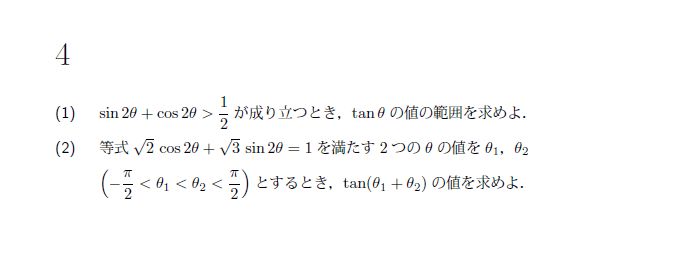
$\cos \theta = 0$ のとき、$\sin 2\theta = 2\sin \theta \cos \theta = 0$、$\cos 2\theta = \cos^2 \theta - \sin^2 \theta = -1$ となる。 これを与えられた不等式に代入すると $-1 > \frac{1}{2}$ となり、不成立である。 したがって、与えられた不等式を満たす $\theta$ について $\cos \theta \neq 0$ と仮定してよく、$\tan \theta$ は定義される。
$\tan \theta = t$ とおくと、$\sin 2\theta = \frac{2t}{1+t^2}$、$\cos 2\theta = \frac{1-t^2}{1+t^2}$ と表せる。 これらを不等式に代入すると、
$$ \frac{2t}{1+t^2} + \frac{1-t^2}{1+t^2} > \frac{1}{2} $$
すべての実数 $t$ において $1+t^2 > 0$ であるから、両辺に $2(1+t^2)$ を掛けて整理する。
$$ 2(2t + 1 - t^2) > 1 + t^2 $$
$$ 4t + 2 - 2t^2 > 1 + t^2 $$
$$ 3t^2 - 4t - 1 < 0 $$
$3t^2 - 4t - 1 = 0$ の解は $t = \frac{2 \pm \sqrt{7}}{3}$ であるから、この2次不等式の解は以下のようになる。
$$ \frac{2 - \sqrt{7}}{3} < t < \frac{2 + \sqrt{7}}{3} $$
$t = \tan \theta$ であるから、求める $\tan \theta$ の値の範囲は以下の通りである。
$$ \frac{2 - \sqrt{7}}{3} < \tan \theta < \frac{2 + \sqrt{7}}{3} $$
(2)
(1)と同様に $\tan \theta = t$ とおく。 $-\frac{\pi}{2} < \theta < \frac{\pi}{2}$ の範囲において、$\theta$ と $t$ は1対1に対応し、$t$ はすべての実数値をとりうる。 等式 $\sqrt{2}\cos 2\theta + \sqrt{3}\sin 2\theta = 1$ を $t$ で表すと以下のようになる。
$$ \sqrt{2} \cdot \frac{1-t^2}{1+t^2} + \sqrt{3} \cdot \frac{2t}{1+t^2} = 1 $$
両辺に $1+t^2$ を掛けて整理する。
$$ \sqrt{2}(1-t^2) + 2\sqrt{3}t = 1 + t^2 $$
$$ (\sqrt{2}+1)t^2 - 2\sqrt{3}t + 1 - \sqrt{2} = 0 $$
この $t$ についての2次方程式の判別式を $D$ とすると、
$$ \frac{D}{4} = (-\sqrt{3})^2 - (\sqrt{2}+1)(1-\sqrt{2}) = 3 - (1 - 2) = 4 > 0 $$
となり、方程式は異なる2つの実数解をもつ。 $-\frac{\pi}{2} < \theta_1 < \theta_2 < \frac{\pi}{2}$ より、これらに対応する $\tan \theta_1, \tan \theta_2$ はこの2次方程式の2つの解である。 これらを $t_1, t_2$ とおくと、解と係数の関係より以下の式が成り立つ。
$$ t_1 + t_2 = \frac{2\sqrt{3}}{\sqrt{2}+1} = 2\sqrt{3}(\sqrt{2}-1) $$
$$ t_1 t_2 = \frac{1-\sqrt{2}}{\sqrt{2}+1} = \frac{(1-\sqrt{2})^2}{1-2} = -(1 - 2\sqrt{2} + 2) = 2\sqrt{2} - 3 $$
求める値は $\tan(\theta_1 + \theta_2)$ であり、正接の加法定理を用いると次のように計算できる。
$$ \tan(\theta_1 + \theta_2) = \frac{\tan \theta_1 + \tan \theta_2}{1 - \tan \theta_1 \tan \theta_2} = \frac{t_1 + t_2}{1 - t_1 t_2} $$
求めた解と係数の関係の値を代入する。
$$ \tan(\theta_1 + \theta_2) = \frac{2\sqrt{3}(\sqrt{2}-1)}{1 - (2\sqrt{2}-3)} $$
$$ \tan(\theta_1 + \theta_2) = \frac{2\sqrt{3}(\sqrt{2}-1)}{4 - 2\sqrt{2}} $$
分母を $2\sqrt{2}$ でくくって約分する。
$$ \tan(\theta_1 + \theta_2) = \frac{2\sqrt{3}(\sqrt{2}-1)}{2\sqrt{2}(\sqrt{2}-1)} = \frac{\sqrt{3}}{\sqrt{2}} = \frac{\sqrt{6}}{2} $$
解説
$\sin 2\theta$ と $\cos 2\theta$ を $\tan \theta$ の式で表す変換は、三角関数の式を代数的な多項式(有理関数)として扱うことができる強力な手法である。 本問のように $\tan \theta$ 自身の値の範囲を問われている場合や、(2)のように $\tan (\theta_1 + \theta_2)$ という $\tan$ に関連した対称式を求める場合には、この置換を行う方針が最も自然である。 (2)では2次方程式の解を具体的に求める必要はなく、解と係数の関係を利用することで計算量を抑えることができる。
答え
(1)
$$ \frac{2 - \sqrt{7}}{3} < \tan \theta < \frac{2 + \sqrt{7}}{3} $$
(2)
$$ \frac{\sqrt{6}}{2} $$
この問題の前に見る基礎問題





類題
自分の記録
誤りを報告
解説の誤り、誤字、表示崩れに気づいた場合は送信してください。ログイン不要です。