九州大学 1978年 理系 第4問 解説
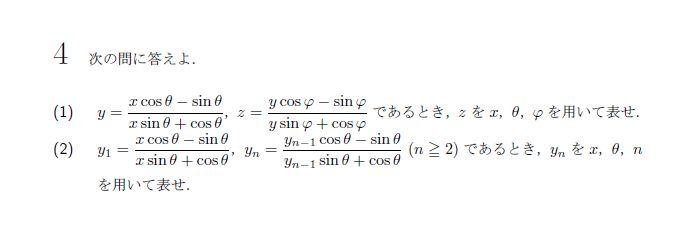
方針・初手
(1) は与えられた $z$ の式に $y$ の式をそのまま代入し、繁分数を整理します。その後、分母と分子にそれぞれ三角関数の加法定理(コサイン・サインの加法定理)を適用して簡略化します。 (2) は (1) の結果から、同じ形の操作を繰り返すと角度部分が足されていくことに着目します。一般項 $y_n$ を推測し、数学的帰納法を用いてそれを証明します。
解法1
(1)
与えられた $z$ の式に、$\displaystyle y = \frac{x \cos \theta - \sin \theta}{x \sin \theta + \cos \theta}$ を代入する。
$$z = \frac{\frac{x \cos \theta - \sin \theta}{x \sin \theta + \cos \theta} \cos \varphi - \sin \varphi}{\frac{x \cos \theta - \sin \theta}{x \sin \theta + \cos \theta} \sin \varphi + \cos \varphi}$$
分母と分子の両方に $(x \sin \theta + \cos \theta)$ を掛けて整理する。
分子について:
$$\begin{aligned} \text{(分子)} &= (x \cos \theta - \sin \theta) \cos \varphi - (x \sin \theta + \cos \theta) \sin \varphi \\ &= x (\cos \theta \cos \varphi - \sin \theta \sin \varphi) - (\sin \theta \cos \varphi + \cos \theta \sin \varphi) \end{aligned}$$
加法定理より $\cos(\theta + \varphi) = \cos \theta \cos \varphi - \sin \theta \sin \varphi$、$\sin(\theta + \varphi) = \sin \theta \cos \varphi + \cos \theta \sin \varphi$ であるから、
$$\text{(分子)} = x \cos(\theta + \varphi) - \sin(\theta + \varphi)$$
分母について:
$$\begin{aligned} \text{(分母)} &= (x \cos \theta - \sin \theta) \sin \varphi + (x \sin \theta + \cos \theta) \cos \varphi \\ &= x (\cos \theta \sin \varphi + \sin \theta \cos \varphi) - \sin \theta \sin \varphi + \cos \theta \cos \varphi \end{aligned}$$
同様に加法定理より、
$$\text{(分母)} = x \sin(\theta + \varphi) + \cos(\theta + \varphi)$$
よって、求める $z$ の式は以下のようになる。
$$z = \frac{x \cos(\theta + \varphi) - \sin(\theta + \varphi)}{x \sin(\theta + \varphi) + \cos(\theta + \varphi)}$$
(2)
(1) の結果から、「変数 $X$ と角 $\alpha$ による式」を「角 $\beta$ の式」に代入すると、結果は「変数 $X$ と角 $\alpha + \beta$ による式」になることがわかる。 これより、$n$ 回同じ操作を繰り返した $y_n$ は、角が $n\theta$ になると推測できる。すなわち、
$$y_n = \frac{x \cos(n\theta) - \sin(n\theta)}{x \sin(n\theta) + \cos(n\theta)} \quad \cdots (*)$$
と推測される。これを数学的帰納法で証明する。
(I) $n=1$ のとき
与えられた $y_1$ の式より、
$$y_1 = \frac{x \cos \theta - \sin \theta}{x \sin \theta + \cos \theta}$$
となり、$(*)$ は成立する。
(II) $n=k$ ($k \geqq 1$) のとき、$(*)$ が成立すると仮定する。すなわち、
$$y_k = \frac{x \cos(k\theta) - \sin(k\theta)}{x \sin(k\theta) + \cos(k\theta)}$$
$n=k+1$ のとき、漸化式より
$$y_{k+1} = \frac{y_k \cos \theta - \sin \theta}{y_k \sin \theta + \cos \theta}$$
これは、(1) で証明した恒等式において、$x$ を $x$、$\theta$ を $k\theta$、$\varphi$ を $\theta$ に置き換えたものに等しい。したがって、(1) の結果を利用すると、
$$\begin{aligned} y_{k+1} &= \frac{x \cos(k\theta + \theta) - \sin(k\theta + \theta)}{x \sin(k\theta + \theta) + \cos(k\theta + \theta)} \\ &= \frac{x \cos((k+1)\theta) - \sin((k+1)\theta)}{x \sin((k+1)\theta) + \cos((k+1)\theta)} \end{aligned}$$
となり、$n=k+1$ のときも $(*)$ は成立する。
(I), (II) より、すべての自然数 $n$ について $(*)$ は成り立つ。
$$y_n = \frac{x \cos(n\theta) - \sin(n\theta)}{x \sin(n\theta) + \cos(n\theta)}$$
解法2
変数の置き換えによる解法です。 $x$ は実数であるとし、$\cos \alpha \neq 0$ となるような角 $\alpha$ を用いて $\displaystyle x = \frac{\sin \alpha}{\cos \alpha}$ とおく。
(1)
与式に $\displaystyle x = \frac{\sin \alpha}{\cos \alpha}$ を代入し、分母分子に $\cos \alpha$ を掛ける。
$$\begin{aligned} y &= \frac{\frac{\sin \alpha}{\cos \alpha} \cos \theta - \sin \theta}{\frac{\sin \alpha}{\cos \alpha} \sin \theta + \cos \theta} \\ &= \frac{\sin \alpha \cos \theta - \cos \alpha \sin \theta}{\sin \alpha \sin \theta + \cos \alpha \cos \theta} \end{aligned}$$
加法定理より、
$$y = \frac{\sin(\alpha - \theta)}{\cos(\alpha - \theta)}$$
同様に、$z$ の式に上記の $y$ を代入し、分母分子に $\cos(\alpha - \theta)$ を掛ける。
$$\begin{aligned} z &= \frac{\frac{\sin(\alpha - \theta)}{\cos(\alpha - \theta)} \cos \varphi - \sin \varphi}{\frac{\sin(\alpha - \theta)}{\cos(\alpha - \theta)} \sin \varphi + \cos \varphi} \\ &= \frac{\sin(\alpha - \theta) \cos \varphi - \cos(\alpha - \theta) \sin \varphi}{\sin(\alpha - \theta) \sin \varphi + \cos(\alpha - \theta) \cos \varphi} \end{aligned}$$
再び加法定理を用いると、
$$\begin{aligned} z &= \frac{\sin((\alpha - \theta) - \varphi)}{\cos((\alpha - \theta) - \varphi)} \\ &= \frac{\sin(\alpha - (\theta + \varphi))}{\cos(\alpha - (\theta + \varphi))} \end{aligned}$$
これを $\alpha$ と $\theta + \varphi$ の加法定理で展開し直す。
$$z = \frac{\sin \alpha \cos(\theta + \varphi) - \cos \alpha \sin(\theta + \varphi)}{\sin \alpha \sin(\theta + \varphi) + \cos \alpha \cos(\theta + \varphi)}$$
分母分子を $\cos \alpha$ で割り、$\displaystyle \frac{\sin \alpha}{\cos \alpha} = x$ に戻す。
$$\begin{aligned} z &= \frac{\frac{\sin \alpha}{\cos \alpha} \cos(\theta + \varphi) - \sin(\theta + \varphi)}{\frac{\sin \alpha}{\cos \alpha} \sin(\theta + \varphi) + \cos(\theta + \varphi)} \\ &= \frac{x \cos(\theta + \varphi) - \sin(\theta + \varphi)}{x \sin(\theta + \varphi) + \cos(\theta + \varphi)} \end{aligned}$$
(2)
(1) の前半の計算から、$y_1$ は
$$y_1 = \frac{\sin(\alpha - \theta)}{\cos(\alpha - \theta)}$$
と表される。また、漸化式 $\displaystyle y_n = \frac{y_{n-1} \cos \theta - \sin \theta}{y_{n-1} \sin \theta + \cos \theta}$ は (1) の $z$ と $y$ の関係と全く同じ構造であるため、角が $\theta$ ずつ引かれていくことがわかる。すなわち、
$$y_n = \frac{\sin(\alpha - n\theta)}{\cos(\alpha - n\theta)}$$
となる(厳密には数学的帰納法で示される)。 これを (1) の後半と同様に展開して $x$ の式に戻す。
$$\begin{aligned} y_n &= \frac{\sin \alpha \cos(n\theta) - \cos \alpha \sin(n\theta)}{\sin \alpha \sin(n\theta) + \cos \alpha \cos(n\theta)} \\ &= \frac{\frac{\sin \alpha}{\cos \alpha} \cos(n\theta) - \sin(n\theta)}{\frac{\sin \alpha}{\cos \alpha} \sin(n\theta) + \cos(n\theta)} \\ &= \frac{x \cos(n\theta) - \sin(n\theta)}{x \sin(n\theta) + \cos(n\theta)} \end{aligned}$$
解説
与えられた式は「一次分数変換」と呼ばれる形をしています。この問題の式は、行列を用いて表すと、平面上の原点を中心とする時計回りの回転移動(角度 $-\theta$ の回転)に対応しています。 行列の積が回転角の和になる性質と対応しているため、(1) で $\theta + \varphi$ が現れ、(2) で $n\theta$ が現れるのは必然的です。
また、解法2で示したように、$x = \tan \alpha$ とおくと、正接($\tan$)の加法定理 $\displaystyle \tan(\alpha - \theta) = \frac{\tan \alpha - \tan \theta}{1 + \tan \alpha \tan \theta}$ と本質的に同じ構造であることが見えやすくなります(分子分母を $\cos \theta$ で割ると完全に一致します)。計算量や見通しの良さを考慮して、最も確実な方針を選べるようにしておきましょう。
答え
(1)
$$z = \frac{x \cos(\theta + \varphi) - \sin(\theta + \varphi)}{x \sin(\theta + \varphi) + \cos(\theta + \varphi)}$$
(2)
$$y_n = \frac{x \cos(n\theta) - \sin(n\theta)}{x \sin(n\theta) + \cos(n\theta)}$$
この問題の前に見る基礎問題

類題
自分の記録
誤りを報告
解説の誤り、誤字、表示崩れに気づいた場合は送信してください。ログイン不要です。