北海道大学 1997年 文系 第3問 解説
方針・初手
- 点 $P$、$Q$ の座標を円の媒介変数表示を用いて設定する。
- 問題の定義に従い、線分 $OP'$ と $OQ'$ の長さを $\theta$ (および $t$ )と $a$ を用いて表す。
- (2)は(1)で求めた面積 $S$ の関数を $t$ で微分し、最大値を求める。その際、変数 $t$ の定義域と、極値をとる $t$ の値の大小関係による場合分けが必要になる。
解法1
(1)
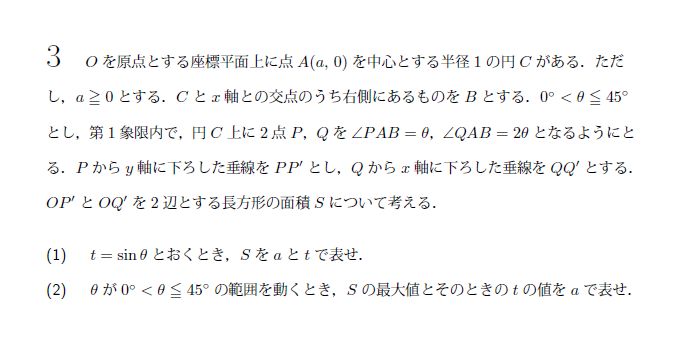
点 $A$ は $(a, 0)$ であり、円 $C$ の半径は $1$ である。 点 $B$ は円 $C$ と $x$ 軸の交点のうち右側のものであるから、半直線 $AB$ は $x$ 軸の正の向きと一致する。 $\angle PAB = \theta$ であり、点 $P$ は第1象限の円 $C$ 上にあるから、点 $P$ の座標は
$$ \begin{aligned} P(a + 1 \cdot \cos\theta, 0 + 1 \cdot \sin\theta) = (a + \cos\theta, \sin\theta) \end{aligned} $$
と表せる。 点 $P'$ は $P$ から $y$ 軸に下ろした垂線の足であるから、その座標は $(0, \sin\theta)$ となる。 $0^\circ < \theta \leqq 45^\circ$ より $\sin\theta > 0$ であるため、線分 $OP'$ の長さは
$$ OP' = \sin\theta $$
である。 同様に、$\angle QAB = 2\theta$ であり、点 $Q$ は第1象限の円 $C$ 上にあるから、点 $Q$ の座標は
$$ \begin{aligned} Q(a + \cos2\theta, \sin2\theta) \end{aligned} $$
と表せる。 点 $Q'$ は $Q$ から $x$ 軸に下ろした垂線の足であるから、その座標は $(a + \cos2\theta, 0)$ となる。 ここで、$0^\circ < \theta \leqq 45^\circ$ より $0^\circ < 2\theta \leqq 90^\circ$ である。 また、$a \geqq 0$ であるから、$a + \cos2\theta > 0$ となり、線分 $OQ'$ の長さは
$$ OQ' = a + \cos2\theta $$
である。 長方形の面積 $S$ は $S = OP' \cdot OQ'$ であるから、
$$ S = \sin\theta (a + \cos2\theta) $$
となる。ここで、$t = \sin\theta$ とおき、2倍角の公式 $\cos2\theta = 1 - 2\sin^2\theta$ を用いると、
$$ \begin{aligned} S &= t (a + 1 - 2t^2) \\ &= -2t^3 + (a+1)t \end{aligned} $$
となる。
(2)
(1)より、$S$ を $t$ の関数とみて $f(t) = -2t^3 + (a+1)t$ とおく。 $\theta$ の変域が $0^\circ < \theta \leqq 45^\circ$ であり、$t = \sin\theta$ はこの範囲で単調増加するから、$t$ のとり得る値の範囲は
$$ 0 < t \leqq \frac{\sqrt{2}}{2} $$
である。 $f(t)$ を $t$ で微分すると、
$$ f'(t) = -6t^2 + a + 1 $$
となる。$f'(t) = 0$ とすると、$t^2 = \frac{a+1}{6}$ となる。 $a \geqq 0$ より $\frac{a+1}{6} > 0$ であるから、$t > 0$ における $f'(t) = 0$ の解は
$$ t = \sqrt{\frac{a+1}{6}} $$
のみである。これを $t_0$ とおく。 最大値を求めるため、$t_0$ と区間の右端 $\frac{\sqrt{2}}{2}$ との大小関係で場合分けを行う。
(i) $t_0 \leqq \frac{\sqrt{2}}{2}$ のとき
$$ \sqrt{\frac{a+1}{6}} \leqq \frac{\sqrt{2}}{2} $$
両辺は正であるから2乗して整理すると、
$$ \begin{aligned} \frac{a+1}{6} &\leqq \frac{1}{2} \\ a + 1 &\leqq 3 \\ a &\leqq 2 \end{aligned} $$
問題の条件 $a \geqq 0$ と合わせて、$0 \leqq a \leqq 2$ となる。 このとき、$0 < t < t_0$ において $f'(t) > 0$、$t = t_0$ において $f'(t) = 0$、$t_0 < t \leqq \frac{\sqrt{2}}{2}$ において $f'(t) < 0$ であるから、$f(t)$ は $t = t_0$ で極大かつ最大となる。 そのときの最大値は、
$$ \begin{aligned} f(t_0) &= t_0 (-2t_0^2 + a + 1) \\ &= \sqrt{\frac{a+1}{6}} \left( -2 \cdot \frac{a+1}{6} + a + 1 \right) \\ &= \sqrt{\frac{a+1}{6}} \left( -\frac{a+1}{3} + a + 1 \right) \\ &= \sqrt{\frac{a+1}{6}} \cdot \frac{2(a+1)}{3} \\ &= \frac{2(a+1)\sqrt{6(a+1)}}{18} \\ &= \frac{(a+1)\sqrt{6(a+1)}}{9} \end{aligned} $$
となる。
(ii) $t_0 > \frac{\sqrt{2}}{2}$ のとき
(i) の不等号が反転する場合であるから、$a > 2$ である。 このとき、区間 $0 < t \leqq \frac{\sqrt{2}}{2}$ において常に $f'(t) > 0$ となるため、$f(t)$ は単調増加する。 したがって、$f(t)$ は $t = \frac{\sqrt{2}}{2}$ で最大となる。 そのときの最大値は、
$$ \begin{aligned} f\left(\frac{\sqrt{2}}{2}\right) &= -2 \left( \frac{\sqrt{2}}{2} \right)^3 + (a+1) \cdot \frac{\sqrt{2}}{2} \\ &= -2 \cdot \frac{2\sqrt{2}}{8} + \frac{\sqrt{2}}{2}a + \frac{\sqrt{2}}{2} \\ &= -\frac{\sqrt{2}}{2} + \frac{\sqrt{2}}{2}a + \frac{\sqrt{2}}{2} \\ &= \frac{\sqrt{2}}{2}a \end{aligned} $$
となる。
解説
- 座標平面上の円上の点を、中心の座標と半径、および偏角を用いて設定する典型的な問題である。点 $P(a+\cos\theta, \sin\theta)$ のように素早く立式できるかが鍵となる。
- 三角関数を含む面積の式を、指定された変数 $t = \sin\theta$ の多項式に帰着させることで、微分の問題として処理できるようになる。このとき、置き換えた変数の変域を必ず確認することが重要である。
- 定義域を持つ3次関数の最大・最小問題では、極値をとる $t$ の値と定義域の端点との大小関係によって場合分けを行う定石の手順を踏む。
答え
(1) $S = -2t^3 + (a+1)t$
(2) $0 \leqq a \leqq 2$ のとき、$t = \sqrt{\frac{a+1}{6}}$ で最大値 $\frac{(a+1)\sqrt{6(a+1)}}{9}$ $a > 2$ のとき、$t = \frac{\sqrt{2}}{2}$ で最大値 $\frac{\sqrt{2}}{2}a$
この問題の前に見る基礎問題






類題

自分の記録
誤りを報告
解説の誤り、誤字、表示崩れに気づいた場合は送信してください。ログイン不要です。