名古屋大学 1991年 理系 第2問 解説
方針・初手
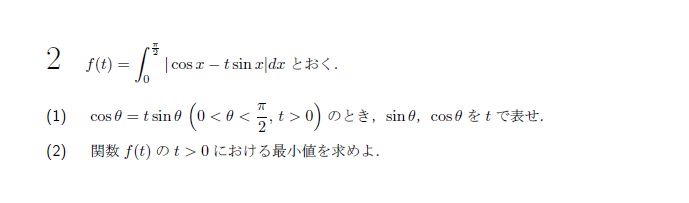
(1) 与えられた関係式を三角比の相互関係を用いて変形する。$\tan \theta$ を求め、そこから $\sin \theta$, $\cos \theta$ を導出するのが自然な流れである。
(2) 絶対値を含む定積分であるから、積分区間内における被積分関数の符号を調べ、絶対値を外す。その際、被積分関数が $0$ になる $x$ の値が (1) で与えられた $\theta$ になることに着目する。定積分を計算した後、得られた関数 $f(t)$ を $t$ について微分して増減を調べる。
解法1
(1)
$0 < \theta < \frac{\pi}{2}$ より $\cos \theta > 0$ である。与式 $\cos \theta = t \sin \theta$ の両辺を $\cos \theta$ で割ると、
$$ 1 = t \frac{\sin \theta}{\cos \theta} $$
$t > 0$ より、
$$ \tan \theta = \frac{1}{t} $$
三角比の相互関係 $1 + \tan^2 \theta = \frac{1}{\cos^2 \theta}$ より、
$$ \frac{1}{\cos^2 \theta} = 1 + \left( \frac{1}{t} \right)^2 = \frac{t^2 + 1}{t^2} $$
よって、
$$ \cos^2 \theta = \frac{t^2}{t^2 + 1} $$
$\cos \theta > 0$ であるから、
$$ \cos \theta = \frac{t}{\sqrt{t^2 + 1}} $$
また、$\sin \theta = \tan \theta \cos \theta$ であるから、
$$ \sin \theta = \frac{1}{t} \cdot \frac{t}{\sqrt{t^2 + 1}} = \frac{1}{\sqrt{t^2 + 1}} $$
(2)
$f(t) = \int_0^{\frac{\pi}{2}} |\cos x - t \sin x| dx$ について考える。
積分区間 $0 \le x \le \frac{\pi}{2}$ において、$\cos x - t \sin x = 0$ となる $x$ を探す。 $x = \frac{\pi}{2}$ は解ではないため、両辺を $\cos x$ で割ると $\tan x = \frac{1}{t}$ となる。 $t > 0$ より、この等式を満たす $x$ は区間内にただ1つ存在し、それは (1) で定めた $\theta$ と一致する。
$0 \le x \le \frac{\pi}{2}$ において $\tan x$ は単調増加であるから、積分区間を $x = \theta$ で分割して絶対値を外すことができる。
$0 \le x \le \theta$ のとき、$\tan x \le \frac{1}{t}$ より $t \sin x \le \cos x$ となり、$\cos x - t \sin x \ge 0$ $\theta \le x \le \frac{\pi}{2}$ のとき、$\tan x \ge \frac{1}{t}$ より $t \sin x \ge \cos x$ となり、$\cos x - t \sin x \le 0$
よって、関数 $f(t)$ は次のように計算できる。
$$ f(t) = \int_0^\theta (\cos x - t \sin x) dx + \int_\theta^{\frac{\pi}{2}} (-\cos x + t \sin x) dx $$
$$ = \left[ \sin x + t \cos x \right]_0^\theta + \left[ -\sin x - t \cos x \right]_\theta^{\frac{\pi}{2}} $$
$$ = (\sin \theta + t \cos \theta - t) + \left( -1 - (-\sin \theta - t \cos \theta) \right) $$
$$ = 2 \sin \theta + 2t \cos \theta - t - 1 $$
ここで、(1) の結果を代入すると、
$$ f(t) = 2 \cdot \frac{1}{\sqrt{t^2 + 1}} + 2t \cdot \frac{t}{\sqrt{t^2 + 1}} - t - 1 $$
$$ = \frac{2(1 + t^2)}{\sqrt{t^2 + 1}} - t - 1 $$
$$ = 2 \sqrt{t^2 + 1} - t - 1 $$
$t > 0$ における $f(t)$ の最小値を求めるために、$t$ について微分する。
$$ f'(t) = 2 \cdot \frac{2t}{2\sqrt{t^2 + 1}} - 1 = \frac{2t}{\sqrt{t^2 + 1}} - 1 = \frac{2t - \sqrt{t^2 + 1}}{\sqrt{t^2 + 1}} $$
$f'(t) = 0$ とすると、
$$ 2t = \sqrt{t^2 + 1} $$
$t > 0$ より両辺ともに正であるから、両辺を2乗して解くと、
$$ 4t^2 = t^2 + 1 $$
$$ 3t^2 = 1 $$
$t > 0$ より $t = \frac{1}{\sqrt{3}}$ である。 $f'(t)$ の符号は分子の $2t - \sqrt{t^2 + 1}$ の符号と一致し、$t > 0$ の範囲での増減表は以下のようになる。
$$ \begin{array}{c|c|c|c|c} t & (0) & \cdots & \frac{1}{\sqrt{3}} & \cdots \\ \hline f'(t) & & - & 0 & + \\ \hline f(t) & & \searrow & 極小 & \nearrow \end{array} $$
増減表より、$f(t)$ は $t = \frac{1}{\sqrt{3}}$ で最小となる。 その最小値は、
$$ f\left(\frac{1}{\sqrt{3}}\right) = 2 \sqrt{\frac{1}{3} + 1} - \frac{1}{\sqrt{3}} - 1 $$
$$ = 2 \sqrt{\frac{4}{3}} - \frac{1}{\sqrt{3}} - 1 $$
$$ = \frac{4}{\sqrt{3}} - \frac{1}{\sqrt{3}} - 1 $$
$$ = \frac{3}{\sqrt{3}} - 1 = \sqrt{3} - 1 $$
解説
絶対値を含む定積分の典型問題である。被積分関数の符号が切り替わる境界として (1) で定めた $\theta$ をそのまま利用できるかに気づくことがポイントとなる。定積分の計算自体に $\theta$ を残したまま進め、後から $\sin \theta$ と $\cos \theta$ の式を代入することで計算量を大きく削減できる。得られた関数 $f(t)$ の微分方程式を解く際には、両辺がともに正であることを確認してから2乗することで、同値性を保ちつつ正しく解を導ける。
答え
(1) $\sin \theta = \frac{1}{\sqrt{t^2+1}}$ , $\cos \theta = \frac{t}{\sqrt{t^2+1}}$
(2) $\sqrt{3}-1$
この問題の前に見る基礎問題





類題
自分の記録
誤りを報告
解説の誤り、誤字、表示崩れに気づいた場合は送信してください。ログイン不要です。